Childhood lost: Children forced into labour at small-scale mines
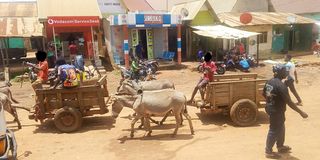
Children in Lwamgasa, Geita Region, ride on carts drawn by donkeys as they transport gold bearing rocks from small scale mines to crushing sites. PHOTO | ROSEMARY MIRONDO
Geita. In Lwamgasa, Geita Region, a 14-year-old boy (name withheld) who lives in Kwa Emmanueli area, spends his days breaking rocks under the scorching sun, helping support himself and his two brothers.
With no steady family income, the three rely on every shilling they earn to survive. From dawn to dusk, the boy, together with his 17 and 19-year-old brothers struggle to survive.
They chip stones into smaller pieces for a pay of Sh2,000 to Sh5,000 a day.
“Our mother left us and our father broke his leg and returned to our ancestral village. My elder brother and I grind rocks while my 17-year-old brother works at a cybercafé,” the boy told The Citizen. “We look for food and clothing ourselves because there is no one else to support us.”
His younger brother said education had become a distant dream.
“I work in a computer shop where I earn around Sh2,000 a day. The money helps me support myself and my brothers,” he said.
Their eldest sibling, who was not present during the interview, works around a mining shaft. Despite the long hours and meagre earnings, the three continue working because they see no alternative.
Their story is far from unique.
A visit to Lwamgasa reveals a community built around gold mining and the informal economy that accompanies it. Arriving from Katoro in one of the overcrowded Noah taxis that ferry passengers into the settlement, visitors are greeted by a busy gold market, roadside eateries, betting shops and makeshift bars already crowded from early morning.
Behind the commercial activity lie dozens of artisanal mining sites and processing centres where ore is crushed, washed and traded.
It is here that children can be found carrying sacks of stones, crushing rocks or washing ore in search of gold.
Some are as young as 13. Others are even younger, loitering around mining sites while their parents work nearby.
The scenes expose a troubling reality: despite laws prohibiting child labour, poverty continues to push children out of classrooms and into dangerous mining activities.
Laws exist, but enforcement remains a challenge
Tanzania has a comprehensive legal framework designed to protect children from hazardous work.
Section 5(1) of the Employment and Labour Relations Act, Cap. 366 (Revised Edition 2023), prohibits the employment of children in hazardous occupations, including mining. Similar protections are contained in the Law of the Child Act and the Mineral Policy of 2009.
The country has also adopted strategies aimed at eliminating the worst forms of child labour, particularly in mining, agriculture, fishing and domestic work.
Implementation involves coordination among labour officers, local government authorities, social welfare departments, schools, police and mining regulators.
However, in communities such as Lwamgasa, economic hardship often undermines enforcement efforts.
Children between the ages of 10 and 15 are dropping out of school and entering the mining sector, sacrificing their education in exchange for daily survival.
Reached for comment Minerals Commissioner Abdulrahman Mwanga said authorities are intensifying inspections to eliminate child labour in mining areas.
“We conduct regular inspections and take prohibition measures very seriously. We work closely with social welfare officers, district commissioners and village governments,” he said.
“As a sector, we have established systems to remove children whenever inspections are conducted.”
He stressed that children are not permitted to participate in mining activities under any circumstances.
“Even if the mining activity is initiated by a child’s parents, involving children remains illegal. Licensed operators understand that engaging in such practices can result in immediate suspension of their licences,” he said.
Dr Mwanga warned that mine operators found violating regulations risk losing their licences permanently.
“If we catch anyone breaching these rules, we revoke their licence for life,” he added.
Hunger pushes children out of school
Yet on the ground, the realities tell a more complex story.
During a visit to Lwamgasa in March 2026, The Citizen encountered numerous children who were no longer attending school.
One 14-year-old boy was playing pool with friends after spending part of the morning breaking and washing stones.
He said persistent hunger forced him to abandon school.
“I left because we had no food. I would attend classes hungry and return home to find nothing cooked,” he said. “When the hunger became unbearable, I had no choice but to quit. I left in Standard Six. By now I would have been in Standard Seven.”
In Mwaloni area, a 15-year-old boy earns a living grinding stones.
“When I fill one sack, I get paid Sh2,000. The money helps me buy food,” he said.
He dropped out in Standard Four and admits he struggles to read and write.
“I asked my mother to send me back to school, but she said she couldn’t afford it.”
Nearby, another 14-year-old who left school in Standard Five spends his days crushing stones.
“I don’t have dreams for the future at the moment,” he said quietly. “Only God knows what will happen.”
Not all children have entirely abandoned school.
A 13-year-old boy carrying a sulphate bag filled with stones insisted he still attends classes.
“Today is the only day I missed school,” he said. “If I find a buyer, I can earn Sh1,000. I need the money to buy school shorts.”
Parents trapped between poverty and education
For many families, the decision to withdraw children from school is driven by economic desperation rather than choice.
Adventina Bundala, a mother of three, said she removed her daughter from school after giving birth to twins.
“My husband ran away, leaving me to provide for the family alone,” she said.
Her daughter, then aged nine, left school to help care for the twins while she searched for stones to sell.
“Hopefully, when the younger children are older, she can return to school.”
Another parent explained that she left the village temporarily in search of work and returned to discover that her 13-year-old child had dropped out of school because there was no food at home.
“These children spend their days grinding and washing stones simply to survive,” she said. It robs them of both childhood and education.”
Not every young miner has abandoned educational ambitions entirely.
A 17-year-old who completed Standard Seven now earns up to Sh20,000 a day grinding stones. He says he is saving money to enrol at the Vocational Education and Training Authority (Veta).
“I support my parents with some of the money and save the rest,” he said. My dream is to become an electrician.”
Another 14-year-old, left to care for younger siblings while his parents travelled, earns Sh2,000 for each sulphate bag he transports between processing sites.
He said he previously handled mercury while washing stones but stopped after developing a skin infection on his fingers.
Nearby, women worked amid clouds of dust, some carrying babies on their backs while crushing rocks.
Mothers struggling to survive
Among them was Joyce Malomo, who carried her three-month-old daughter, born with deformed legs.
She said the child’s father had abandoned them, leaving her to shoulder the burden alone.
“I need money for treatment,” she explained. Hospital services are free, but the medical equipment my daughter requires costs around Sh200,000.”
Unable to afford childcare, she brings the infant to the mining site while she works.
Similar scenes were common across Lwamgasa, where mothers with children aged between a few months and five years worked long hours processing stones.
The presence of young children around mining activities underscores the difficult choices families face when poverty leaves them with few alternatives.
At Miembeni Gold Mine, a boy wearing a safety helmet and gumboots declined to reveal his age. He said he started working there after failing Standard Seven examinations before walking away when questioned further.
Nearby, donkey carts loaded with heavy sacks of ore were being pulled along rough roads by groups of boys heading towards processing areas in Gombani.
Several declined to speak to journalists.
Mine operators insist safeguards are in place
Mining operators maintain that they have taken steps to prevent children from entering formal mining sites.
At Mpandachalo Gold Mine, Chief Inspector of Mines January Mwendo said strict safety procedures are enforced.
“The mine is fenced and access is controlled. Supervisors ensure that nobody under the age of 18 is employed,” he said.
Mine owner Hamisi Mbaga said security personnel are deployed to prevent unauthorised access.
“Every worker’s age is verified and all must meet the minimum age requirement of 18 years,” he said.
Register to begin your journey to our premium contentSubscribe for full access to premium content