Diplomats propose ways of improving business climate
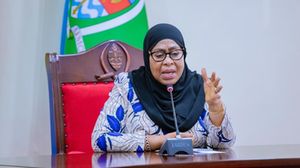
The Minister of State in the President’s Office (Planning and Investment), Prof Kitila Mkumbo, speaks in Dar es Salaam yesterday during a high-level consultation meeting that brought together the government, ambassadors, representatives of international organisations and development partners. PHOTO | CORRESPONDENT
Dar es Salaam. Diplomats have outlined a series of reforms they believe Tanzania should prioritise to strengthen its investment climate, including tax restructuring, cutting red tape, harmonising digital systems and enhancing regulatory transparency.
The proposals were presented during a high-level consultation meeting bringing together the government, ambassadors, representatives of international organisations and development partners under the theme Conducive Investment and Business Environment: A Strategic Instrument for Achieving Vision 2050.
The Minister of State in the President’s Office (Planning and Investment), Prof Kitila Mkumbo, acknowledged that bureaucratic delays and excessive regulation remain obstacles to efficient business operations.
He said the Business Environment Improvement Programme (Mkumbi II) contains wide-ranging recommendations aimed at reducing over-regulation and rationalising regulatory fees.
“Though business has to be regulated, our businesses are over-regulated. Tax reforms are required. We intend to reduce the number of regulatory authorities, retaining only those strictly necessary, while maintaining an appropriate balance between regulation and business facilitation,” he said.
Prof Mkumbo pointed to the One-Stop Facilitation Centre, which brings together about 14 government institutions, including the Business Registrations and Licensing Agency (Brela), allowing investors to complete up to 90 per cent of procedures through a centralised system.
However, he conceded that operational challenges persist, particularly when institutions assign officers without decision-making authority. Strengthening the centre’s effectiveness, he said, remains a priority.
A representative of the Zambia High Commission, Mr Mwamina Ngwale, noted that Tanzania’s growing economy naturally attracts increased private sector participation, particularly in clerical services and information and communication technology.
“As businesses expand, private sector actors pursue profit-optimisation strategies. However, this can create challenges, especially where external players operate across borders and enforcement within national jurisdictions may prove costly,” he said.
He proposed the introduction of an online dispute-resolution mechanism to address pricing and regulatory concerns, particularly involving foreign service providers. Such a system, he said, would support trade expansion and regional integration.
On regulatory charges, Mr Ngwale recommended aligning fees more closely with taxation principles and ensuring they reflect the services provided, arguing that this would ease revenue pressure on regulators while improving predictability for investors.
A representative of the United States of America, Mr Jonathan Howard, welcomed ongoing reform efforts but called for greater transparency in implementation.
He said stakeholders had received summary recommendations outlining 59 key challenges and 246 proposed reforms, but emphasised that meaningful validation requires access to comprehensive documentation.
Mr Howard also urged a review of progress under earlier initiatives, including those of the President’s Tax Reform Commission launched about 18 months ago, noting that improvements over the past year had been uneven.
He cautioned that certain pre-election measures, including local currency and banking regulations, while potentially popular domestically, may not necessarily encourage international investment or private sector-led growth.
Meanwhile, a representative from Sierra Leone, Mr Yusuf Seilsay, called for a fully integrated one-stop centre to enable investors to complete company registration, tax registration, licensing and municipal approvals without navigating multiple institutions such as Brela and the Tanzania Revenue Authority (TRA).
“Investors should be able to finalise all requirements efficiently through a single integrated system,” he said.
The discussions underscored a common message from the diplomatic community: sustained reforms, transparency and institutional efficiency are essential if Tanzania is to enhance competitiveness and realise its long-term development ambitions under Vision 2050.