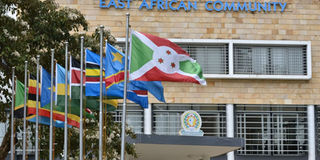
East African Community turns to AI to unlock efficiency

Dar es Salaam. For years, the East African Community (EAC) has grappled with a familiar set of challenges: slow customs clearance at borders, fragmented data systems, weak coordination among partner states, revenue leakages and limited research capacity.

While the bloc has made notable progress in market integration and digital reforms, inefficiencies continue to cost the region billions in lost productivity and missed trade opportunities, according to experts. It is against this backdrop that Artificial Intelligence (AI) is emerging, not as a fashionable slogan, but as a potential structural solution.

Across the globe, AI is reshaping how governments operate. PwC estimates that AI could contribute up to $15.7 trillion to the global economy by 2030. For Africa, McKinsey projects that AI could add more than $1 trillion annually if effectively deployed.

Yet East Africa’s adoption remains nascent. It is constrained by limited computing infrastructure, acute skills shortages and fragmented regulatory frameworks. For the EAC, the central question is not whether AI is transformative, but whether it can address the bloc’s long-standing operational weaknesses.

The East African Science and Technology Commission (EASTECO), in collaboration with the Inter-University Council for East Africa (IUCEA), is set to convene the 4th EAC Regional Science, Technology and Innovation Conference in Kigali next month.

Experts say the meeting could mark a historic shift in the bloc’s development agenda.

For the first time, the EAC will host a high-level conference dedicated entirely to Artificial Intelligence. Under the theme “Harnessing Artificial Intelligence for a Resilient, Inclusive, and Innovative East Africa”, the meeting signals a strategic recognition: AI is no longer optional. It is central to how the region will operate, integrate and compete.

This comes at a time when intra-EAC trade has grown steadily, yet non-tariff barriers and bureaucratic delays remain persistent complaints among traders. The World Bank has previously noted that inefficient border procedures in parts of sub-Saharan Africa can raise trade costs by up to 40 percent.

AI-powered customs management systems could alter this dynamic. By analysing cargo data, identifying high-risk consignments and automating documentation verification, AI reduces human discretion and accelerates clearance processes.

“AI introduces predictive capacity into customs operations,” explains a regional ICT policy analyst, Dr Gaspard Banyankimbona. “Instead of reacting to problems, systems can anticipate irregularities, reducing delays and opportunities for corruption.”

For EAC operations, this would translate into smoother cross-border trade, faster cargo turnaround and improved investor confidence. Revenue leakages and the persistence of ghost workers have periodically surfaced across public institutions in the region.

While digital systems such as Tanzania’s Government e-Payment Gateway (GePG) and electronic fiscal devices have improved transparency, AI could take oversight a step further.

Machine learning systems can detect unusual procurement patterns, flag duplicate payments and identify anomalies in payroll databases. “AI does not get tired or compromised,” said Dr Banyankimbona.

“When embedded in auditing systems, it becomes a powerful anti-corruption tool.”

For a bloc striving for fiscal stability and deeper economic integration, stronger revenue management would support more predictable budgeting and foster greater public trust.

Agriculture employs more than 60 percent of East Africans and contributes significantly to regional GDP. Yet climate shocks, pest infestations and weak market coordination continue to undermine productivity.

AI applications, including satellite-driven crop monitoring, predictive weather analytics and pest surveillance, could enable governments to anticipate food shortages and respond proactively. For the EAC, coordinated AI-driven agricultural systems could stabilise food supply chains and strengthen resilience against climate change.

An agricultural data scientist at Sokoine University of Agriculture (SUA), Dr Neema Msuya, notes: “If regional data is shared, AI models can forecast crop performance across borders. That improves food security planning and reduces emergency imports.”

The Covid-19 pandemic exposed weaknesses in cross-border health data sharing. Experts say AI-powered disease surveillance systems can analyse real-time trends, detect abnormal patterns and support early warning mechanisms.

“AI also has implications for security and migration management. Intelligent systems can support biometric verification and detect fraudulent documentation, enhancing border management without slowing movement,” said Dr Msuya.

Tanzania has taken concrete steps to narrow this gap. The revised National ICT Policy of 2023 places emphasis on emerging technologies. The University of Dar es Salaam has introduced data science programmes, while the Nelson Mandela African Institution of Science and Technology (NM-AIST) is advancing research in machine learning applications for energy and agriculture.

The Dar es Salaam Institute of Technology (DIT) is also integrating AI modules into engineering courses. These initiatives aim to build a domestic skills base capable of supporting national and regional digital ambitions.

However, experts caution that infrastructure investment and regulatory harmonisation across the bloc will be critical. Without reliable data centres, secure connectivity and shared governance standards, AI systems risk remaining fragmented and underutilised.

The Kigali conference is therefore expected to go beyond technical discussions. It will also focus on policy coordination, ethical frameworks and regional cooperation.

If successful, the meeting could lay the foundation for a shared AI strategy that supports trade facilitation, revenue integrity, food security and public service efficiency across East Africa.

For the EAC, the promise of AI lies not in abstract technological ambition, but in its capacity to deliver practical solutions to persistent development constraints. The challenge now is to translate vision into sustained action.