Government invests Sh1.34 trillion in primary healthcare, says Prof Nagu
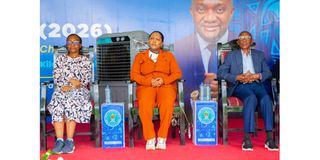
The Deputy Permanent Secretary in the Prime Minister’s Office (Regional Administration and Local Government – TAMISEMI) responsible for Health, Professor Tumaini Nagu (centre), witnesses the national health commemorations held in Kibiti, Pwani Region. On the left is the Chief Medical Officer, Dr Grace Magembe.
Kibiti. The government has invested about Sh1.34 trillion in strengthening primary healthcare services over the past four years, as part of efforts to improve access to quality and affordable medical care.
Deputy Permanent Secretary for Health in the Prime Minister’s Office (RALG), Prof Tumaini Nagu, said the investment has significantly expanded healthcare infrastructure across the country under President Samia Suluhu Hassan’s administration.
Speaking during the 2026 National Health Week commemorations on April 30, 2026 in Kibiti District, Coast Region, Prof Nagu said the funds have supported the construction of 129 district council hospitals, rehabilitation of 48 existing hospitals, and upgrading of 367 health centres to provide emergency obstetric and newborn care.
“PMO–RALG will continue constructing new health centres, depending on the availability of funds, especially in areas facing geographical and infrastructure challenges,” she said.
She added that the government is also strengthening the country’s capacity to diagnose and treat diseases through procurement of medical equipment, recruitment of health workers, and improvement of working conditions, including construction of staff housing.
Prof Nagu noted that access to Water, Sanitation and Hygiene (WASH) services remains a key priority in improving public health and preventing infectious and epidemic diseases.
“Our main objective is to strengthen public health and protect communities from communicable and outbreak-prone diseases,” she said.
Over the past five years, the government has constructed water infrastructure, modern sanitation facilities and handwashing systems in 3,457 primary healthcare facilities, including hospitals, health centres and dispensaries.
In the 2025/26 financial year alone, 505 health facilities have received Sh20.9 billion for WASH infrastructure.
During the commemorations, the government, in collaboration with development partners including Gavi, also handed over seven boats worth Sh1.1 billion to improve vaccine delivery in island and coastal communities along the Indian Ocean.
Handing over the boats at Nyamisati Port in Kibiti District, Health Minister, Mr Mohamed Mchengerwa said the investment underscores the government’s commitment to ensuring equitable access to healthcare services.
He said the boats will enhance outreach services, ensure reliable vaccine delivery, strengthen supervision of integrated health services, and improve timely mobile healthcare.
“These boats will help extend essential health services to hard-to-reach populations and ensure no citizen is denied healthcare due to geographical barriers,” he said.
Chief Medical Officer, Dr Grace Magembe said the boats will help reach “zero-dose” children—those who have not received any vaccines—many of whom live in remote and coastal areas.
She said the boats will serve areas including Kibiti, Rufiji, Kigoma, Uvinza and Zanzibar.
“Our goal is to ensure that no child is left behind,” she said.
Unicef Tanzania Representative, Ms Elke Wisch commended the country’s progress in immunisation, noting a significant reduction in vaccine-preventable diseases.
“As we mark National Health Week, we must ensure that every child in Tanzania receives life-saving vaccines. No child should be left behind,” she said.