Government rallies local solutions as education funding pressures mount
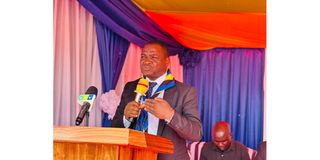
Acting Permanent Secretary in the Ministry of Education, Science and Technology, Dr Ephraim Simbeye, addresses a gathering of education stakeholders hosted by TEN/MET during the closing of the GAWE 2026 activities in Momba District in Songwe region. PHOTO|JACOB MOSENDA
Songwe . The government has called for stronger collaboration with non-state actors and communities to sustain education financing, warning that shrinking global support is placing increasing pressure on the sector.
Closing the 2026 Global Action Week for Education (GAWE) in Momba District over the weekend, Acting Permanent Secretary in the Ministry of Education, Science and Technology, Dr Ephraim Simbeye, said Tanzania must now look inward to safeguard gains made in expanding access to education.
“GAWE 2026 has come at a very important time when the education sector requires deep discussion on sustainable financing,” he said, pointing to a global decline in development assistance that is already affecting efforts to improve quality, equity and inclusion.
He stressed that while the government will continue to invest in infrastructure, teaching materials and reforms, it cannot do it alone.
“The agenda of domestic resource mobilisation responds to the need for government to continue allocating funds… while working closely with stakeholders to improve education delivery,” he said.
The message comes as Tanzania pushes forward with major reforms under the 2014 Education Policy (2023 edition), including the rollout of the competency-based curriculum and the introduction of the ‘amali’ vocational stream.
These reforms require sustained funding at a time when demand for education is rising.
Data and observations shared during the week-long event in Songwe show both progress and pressure points.
Stakeholders visited five schools in Momba District, where they noted improvements in infrastructure, the expansion of alternative learning pathways, and growing school feeding initiatives. In Songwe Region alone, the alternative pathways have enrolled mire than 4,000 learners and participants.
At the same time, persistent challenges remain. These include shortages of classrooms, desks and teachers, long distances to school, inadequate sanitation facilities, and high dropout rates—particularly among girls due to teenage pregnancies and gender-based violence.
It is these gaps that non-state actors are now being called upon to help close.
The Tanzania Education Network (TEN/MET), which brings together 265 civil society organisations, used the GAWE platform to push for a stronger role for communities, parents and the private sector.
Board Chair Mr Simon Nanyaro, said the shift towards domestic resource mobilisation is no longer optional.
“This week has reminded us that mobilising domestic resources is not an option but a necessity if we are to build an inclusive and quality education system,” he said.
He emphasised that communities must take greater ownership—by contributing to school feeding programmes, supporting infrastructure development and ensuring children stay in school.
In a practical demonstration of this approach, TEN/MET committed over Sh53 million to support schools visited during the week.
The funds will go towards building and completing classrooms, supplying desks to reduce congestion, and providing wheelchairs for learners with disabilities.
TEN/MET Coordinator Ms Martha Makala, said the role of civil society goes beyond funding, extending to advocacy and accountability.
“We have spent this week building awareness among communities on their role in education, because real change must start from the ground,” she said.
She added that sustained engagement with parents and local leaders is key to addressing issues such as dropout and child protection, which continue to affect learning outcomes.
The government, for its part, acknowledged these challenges and ongoing efforts to address them, including improving teacher availability and expanding school infrastructure.
Education stakeholders say the significance of GAWE 2026 lies in its clear message: the future of education financing in Tanzania will depend on collective action.
With external funding declining, the burden is shifting towards domestic solutions—where government leadership is matched by active participation from civil society, communities and the private sector.
If this approach takes root, it could mark a turning point in how Tanzania delivers not just access to education, but quality and inclusion for all.
Register to begin your journey to our premium contentSubscribe for full access to premium content