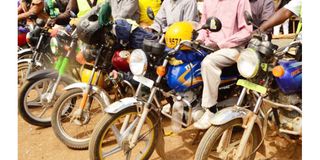
Dar es Salaam. As Tanzania works to raise insurance penetration to at least 50 percent of the adult population by 2030, many motorcycle taxi riders, popularly known as bodaboda, continue to operate without mandatory third-party insurance, exposing themselves, passengers and other road users to significant financial and legal risks in case of accidents.
According to the Tanzania Police Force and the Tanzania Insurance Regulatory Authority (Tira), the exact number of uninsured bodaboda riders remains unknown because there is no consolidated national database tracking insurance coverage among motorcycle operators.
However, a survey conducted by The Citizen between mid-February and March 2026 in various parts of Dar es Salaam has established that many riders purchase insurance only once, usually when they first acquire their motorcycles and rarely renew their policies.
Under Section 4 of the Motor Vehicles Insurance Act, no person may use or permit the use of a motor vehicle on a public road without a valid third-party insurance policy.
According to the law, anyone who violates this requirement commits an offence and is liable to a fine, imprisonment for up to six months, or both.
Despite the legal requirement, several riders admit they continue operating without renewing their insurance due to financial pressures, limited awareness and weak enforcement of the law.
A bodaboda rider stationed at Tabata Relini, Mr Abubakar Suleiman, said many operators depend on motorcycle owners, who often do not prioritise renewing insurance policies.
“Most of us know insurance is required, but our bosses do not see its importance. Because we still need to work, we end up riding without renewing the policy,” he said.
Another rider at Ubungo, Mr Hamisi Aziz, said the cost of renewing insurance discourages many riders whose daily earnings are uncertain.
“Sometimes the money we earn is just enough for fuel and daily living. When the insurance expires, many riders postpone renewal because they prioritise other needs and consider the payment too expensive,” he said.
Another rider from Temeke, Mr William Shuma, said some operators simply believe accidents will not happen to them.
“Many riders think accidents happen to others; some of them believe that if something happens, they can negotiate with the victim instead of using insurance,” he said.
However, road users warn that the absence of insurance can have serious consequences for both riders and victims.
A resident of Mbezi Luis, Ms Doris Mrema, said uninsured bodaboda riders often face serious financial and legal difficulties when accidents occur.
“In some cases, when a rider hits a car or injures someone and has no insurance, the situation becomes very difficult. They end up paying compensation from their own pockets, which many cannot afford,” she said.
She added that some riders abandon their motorcycles or flee accident scenes because of fearing financial burden.
“When a rider has insurance, the process is easier because the insurance company can handle compensation. Without it, disputes often arise and the situation becomes complicated,” she said.
Authorities say enforcement and public education remain key strategies in addressing the problem.
As the main enforcer of road and insurance laws, the Tanzania Police Force says it is strengthening awareness campaigns and inspections to ensure compliance among all road users, including bodaboda riders.
“Providing education is part of our continuous duty to different groups that use the roads. However, as law enforcers, we are also responsible for enforcing various laws, including the insurance law,” said senior police officer Lucas Mkondya, insisting that educating road users remains the police’s ongoing top priority.
He added that the police are working closely with the Tira and other stakeholders to ensure insurance education reaches the general public.
“Therefore, we continue providing education, especially to those reluctant to comply with the law until they are compelled to do so, to ensure the roads remain safe for all users,” he said.
For regulators, the rapid growth of the bodaboda sector presents both challenges and opportunities in expanding insurance coverage.
Industry seen as opportunity, not obstacle
Tira public relations and communications manager Hadija Maulid said the rapid expansion of the bodaboda sector does not threaten the regulator’s goal of increasing insurance usage to 50 percent of adults by 2030.
She said instead, the sector is considered a strategic opportunity to expand coverage.
The target is anchored in the National Financial Inclusion Framework 2023–2028, a national strategy aimed at ensuring Tanzanians can access and actively use affordable, high-quality financial services, including insurance.
According to Tira, more than 37 percent of Tanzanian adults currently use at least one insurance service, indicating steady progress toward the 2030 target.
“Rather than being an obstacle, the bodaboda industry represents a major opportunity for insurance expansion. It is a large and rapidly growing group that operates in high-risk environments and actively uses technology such as mobile money, which is a key driver of financial inclusion,” she said.
Currently, there is no standalone national study focusing exclusively on motorcycle taxi riders to determine exactly how many lack insurance coverage.
However, through financial inclusion surveys and market analysis conducted under the framework, Tira has identified a significant protection gap in the sector, particularly in personal accident and health insurance beyond the mandatory third-party cover.
The regulator relies on vehicle registration and transport licensing data, insurance company reports on motor and personal accident policies and targeted segment analysis to inform its strategy.
Joint awareness and enforcement campaigns
Tira acknowledged that research and stakeholder feedback indicate that some motorcycle taxi riders either do not fully understand the importance of insurance or remain unaware that mandatory third-party motor insurance is a legal requirement.
To address this, the regulator is working closely with the Tanzania Police Force to implement several measures, including providing insurance education during roadside inspections.
Others are holding joint meetings with bodaboda associations through its 10 offices across the country and conducting targeted “road safety and insurance” awareness campaigns.
The authority is also strengthening digital verification systems to enable police officers to quickly confirm the validity of insurance policies and curb the use of fraudulent insurance certificates.
Overall, the regulator believes the growing bodaboda industry could play a critical role in widening insurance penetration while protecting thousands of young Tanzanians who rely on the trade for their livelihoods as the country works toward its 2030 target.
The Association of Tanzania Insurers member of the technical committee, Mr Jared Awando, said organising bodaboda riders into associations would make it easier to provide education and enhance accountability.
“This is because when riders operate individually, it becomes difficult to reach them with education or hold them accountable when accidents occur,” he said.
He noted that the bodaboda sector continues to grow rapidly, providing employment to thousands of young Tanzanians and offering affordable transport to millions of commuters countrywide.
Register to begin your journey to our premium contentSubscribe for full access to premium content