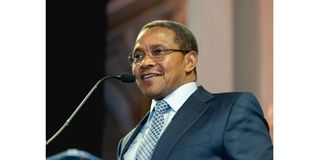
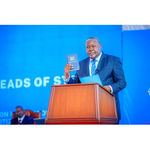
Dar es Salaam. Former President Jakaya Kikwete has called on African countries to invest in education, digital skills and artificial intelligence (AI), warning that infrastructure alone will not deliver the continent’s economic transformation unless it creates opportunities for young people.
Speaking at the Infra for Africa Forum in Dar es Salaam yesterday, Mr Kikwete said the value of roads, railways, ports and digital networks should be measured not by the number of projects completed but by their ability to generate jobs, develop skills and improve livelihoods.
The forum, sponsored by Africa50, brought together policymakers, investors and development partners to discuss financing, infrastructure and Africa’s long-term economic development. Mr Kikwete said Africa was entering a defining period as its youthful population continues to grow, with the continent expected to account for more than a quarter of the world’s working-age population by 2050.
He said the demographic shift could become Africa’s greatest asset if young people are equipped with quality education, relevant skills and productive employment opportunities, but warned it could become a major challenge if they are left behind.
“For many years, infrastructure development has been measured by the number of kilometres of roads built, megawatts of electricity generated, pipelines laid, ports expanded or people connected to the internet,” he said.
“But the real measure should be the opportunities created through those investments, including jobs generated, skills developed, businesses enabled and lives transformed.”
Mr Kikwete said Africa must accelerate investment in education and technology to prepare young people for the rapidly changing world of work, where AI and other digital technologies are reshaping labour markets.
He noted that while some jobs will disappear as technology advances, many new opportunities will emerge for workers with the right skills.
“By 2030, Africa will have more than 230 million jobs requiring digital skills. Countries across the continent must ensure young people acquire the knowledge needed to meet that demand,” he said.
According to Mr Kikwete, the greatest challenge is no longer simply unemployment but the widening skills gap, which risks excluding many young people from available jobs because they lack the capabilities employers require.
He urged African governments not to fear AI or embrace it without adequate preparation, but instead to invest in the skills and innovation needed for the continent to become an active participant in the global digital economy.
“African youth should not remain consumers of technologies developed elsewhere. They must participate in building their own digital platforms, own technological innovation and compete in high-value fields such as engineering, research, data analytics and digital product development,” he said. He said greater investment in science, technology, engineering and mathematics (STEM), digital infrastructure and skills development would enable Africa’s youth to benefit from AI-driven opportunities rather than be displaced by technological change.
Meanwhile, businessman and MeTL Group chief executive officer Mohammed Dewji said Tanzania had made progress in mobilising domestic resources and private sector participation to finance strategic infrastructure projects despite the financing challenges facing many African countries.
However, he said greater investment was still needed in electricity transmission infrastructure, an area that could benefit from stronger public-private partnerships (PPPs) to improve efficiency and expand access.
“As MeTL Group, we plan to invest approximately $250 million in the development of a dry port, railway connectivity to the facility and the infrastructure needed to establish a Special Economic Zone for industrial development,” he said.
Mr Dewji said the investment reflects Tanzania’s strategic position as a transport gateway linking East and Central Africa, as well as the country’s ambition to accelerate industrialisation.