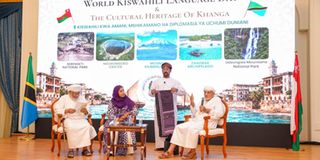
Dar es Salaam. Tanzania’s Ambassador to Oman, Maulidah Hassan, has called for Kiswahili to be used as a tool for promoting trade, investment and economic cooperation between Oman and East African countries.
She said the language carries greater development opportunities than previously recognised, noting that Oman holds a unique place in the history of Kiswahili as the country with the largest number of Kiswahili speakers outside Africa.
Ambassador Maulidah made the remarks in Muscat during Kiswahili celebrations organised by the Tanzanian Embassy in Oman, bringing together diplomats, academics and cultural stakeholders.
The event was held five years after the United Nations Educational, Scientific and Cultural Organisation (Unesco) declared July 7 as World Kiswahili Language Day.
Opening the celebrations, Ambassador Maulidah said Unesco’s recognition of Kiswahili confirmed what millions of people around the world already knew about the language’s importance in society.
She said Kiswahili was not only a means of communication but also carried values of peace, identity, solidarity and the history of communities connected for centuries through the Indian Ocean.
“Oman has a unique position in the history of Kiswahili because it has the largest number of Kiswahili speakers outside the African continent,” she said.
She said Kiswahili was not merely a language taught in classrooms but part of everyday life and a heritage passed from one generation to another.
For many Omanis, she added, speaking Kiswahili remains a way of maintaining links with their history, families and heritage connected to East Africa.
However, the ambassador said it was time to view Kiswahili beyond its historical significance and recognise its potential as an economic development tool.
She said Omani traders who speak Kiswahili have an advantage when entering the East African market because they already share a common language with potential business partners.
“Being able to communicate in the same language removes barriers that slow down trade and investment and strengthens economic cooperation between Tanzania, Oman and the East African region,” she said.
Ambassador Maulidah highlighted shared cultural links between East Africa and Oman, including foods such as pilau, maandazi, chapati and coconut beans, as well as traditional clothing such as baibui, kanzu and khanjar.
She said music traditions along the East African coast and in Oman also reflected centuries of cultural exchange.
“Our similarities in food, clothing and music show that our relationship is much deeper than what is recorded in history books,” she said.
She said the history between Oman and Tanzania was shaped by the winds that carried traditional boats across the Indian Ocean, transporting not only goods such as spices and fabrics but also families, friendships, faith and culture.
She called on the current generation to use that shared heritage to build stronger cooperation in economic diplomacy, investment, tourism, transport, agriculture and the blue economy.
“We must revive these historical ties and use them to build a future that benefits the people of Tanzania and Oman,” she said.
The celebrations concluded with taarab performances, cultural exhibitions and displays of traditional Kiswahili cuisine.
The event also featured a discussion involving Kanga Project Zanzibar Founder and Managing Director Muna Ally, Prof Ibrahim Bakri Al Noor and historian Riadh Al Busaidi.
Ms Ally said the kanga has been part of coastal communities’ lives for centuries and continues to represent identity among Kiswahili-speaking societies.
She said the garment is still known as leso in some parts of Oman and Mombasa, a name derived from Portuguese influence, while in Tanzania the name kanga remains widely used as a symbol of East African women’s identity.
The event was attended by Oman’s Director of African Affairs at the Ministry of Foreign Affairs, Dr Mohammed Al Balushi, alongside representatives from Unesco, the University of Nizwa and the Russian Cultural Centre.