Lissu petition puts prison consultation rules under scrutiny
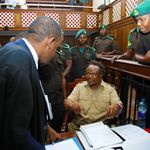
Chadema chairman Tundu Lissu (right) consults his lawyer, John Seka, during proceedings at the High Court in Dar es Salaam on July 23, 2026. PHOTO | SAID POWA
Dar es Salaam. Lawyers representing Chadema national chairman, Mr Tundu Lissu have told the High Court that restrictions imposed during legal consultations at Ukonga Prison violate the constitutional right to confidential communication between a lawyer and a client.
The issue arose on Thursday, July 23, 2026, during the cross-examination of Ukonga Prison Officer in Charge, Mr Andrew N'tamamiro, by advocate John Seka in a constitutional petition challenging the conditions under which lawyers are allowed to meet Mr Lissu.

The respondents are the Attorney General, the Commissioner General of Prisons and the Officer in Charge of Ukonga Prison, while the Tanganyika Law Society (TLS) has been joined as an interested party.
The petition, Constitutional Case No. 7300 of 2026, was filed by advocates Kulwa Maduhu, Nashon Nkungu and Paul Kisabo, who describe themselves as Mr Lissu's legal advisers.
They argue that the restrictions imposed during prison consultations breach constitutional guarantees of privacy and the Prisons Regulations governing communication between lawyers and detainees.
The case, filed at the High Court's Principal Registry in Dodoma, is being heard by a three-judge bench comprising Justice Amir Mruma, who is presiding, Justice Dr Angelo Rumisha and Justice Dr Everisto Longopa.
The bench is sitting at the High Court Sub-Registry in Dar es Salaam.
The matter had initially been scheduled to proceed by way of written submissions alongside a preliminary objection raised by the government.
However, Mr Lissu successfully applied for the petitioners to appear in court so that he could personally cross-examine them on their claims.
After completing his questioning of the petitioners on Wednesday, proceedings resumed on Thursday with Mr Seka cross-examining Mr N'tamamiro.
During the hearing, the prison chief acknowledged that prison regulations recognise the right of detainees to consult their legal advisers in private.
He told the court that although prison officers are required to supervise such meetings, they should do so by observing the consultation without listening to the conversation.
Mr Seka first established that the Prisons Service operates under the Prisons Act and that, as Officer in Charge of Ukonga Prison, Mr N'tamamiro is responsible for safeguarding prisoners' rights and ensuring compliance with the law.
The lawyer then referred the witness to Articles 16, 22, 26 and 29 of the Constitution, which protect privacy, recognise the legal profession and guarantee fundamental rights.
Mr N'tamamiro agreed that public authorities may interfere with privacy only in accordance with constitutional requirements and acknowledged that lawyers are entitled to practise within prisons in accordance with established procedures.
He also agreed that he has a constitutional duty to uphold the Constitution, the laws of Tanzania, the Prisons Act and the Prisons Regulations of 1968.
Attention then turned to Regulation 13 of the Prisons Regulations, which governs consultations between detainees and their legal representatives.
Reading the regulation to the court, Mr N'tamamiro said prisoners and remandees must be given an opportunity to consult their legal advisers, with prison officers supervising the meeting by "seeing but not hearing" the discussion.
Mr Seka asked whether the regulation creates two distinct rights: one for detainees to meet their lawyers and another for lawyers to consult clients without their conversations being overheard.
Mr N'tamamiro agreed.
The lawyer then asked whether, during his 31 years in the Prisons Service, officers had been trained on the distance required to enable them to observe a meeting without hearing its contents.
“There is no specific distance,” Mr N'tamamiro replied, adding that implementation depends on the circumstances.
Mr Seka suggested that this effectively left the matter to the discretion of individual officers, a proposition with which the witness agreed.
The questioning later shifted to the size and layout of offices used for lawyer-client consultations at Ukonga Prison.
Mr Seka asked the witness to describe the size of his office. One of the judges intervened, seeking clarification after the witness described it as "large enough".
The witness attempted to demonstrate the dimensions by gesture but said he could not estimate the exact width.
A government lawyer objected, arguing that discussing the office's size could raise security concerns.
The court overruled the objection, finding that the issue posed no security risk, and directed the witness to answer.
Mr Seka also questioned the witness about the prison's admission office, where lawyer-client consultations are often held.
Using the courtroom as an example, he asked whether conversations could be heard from different distances. The witness replied that this would depend on how loudly the participants spoke.
He further confirmed that he had observed lawyers meeting detainees in the admission office, where they normally sit facing each other across a table.
The petition challenges whether the conditions under which lawyers are allowed to consult Mr Lissu comply with constitutional guarantees of privacy and the requirements of the Prisons Regulations.
The three-judge bench is expected to deliver its ruling on September 16, 2026.
Register to begin your journey to our premium contentSubscribe for full access to premium content