No ban on trophy hunting, Tanzania assures stakeholders
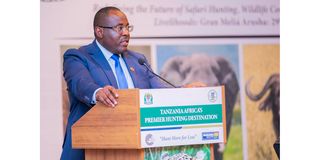
The Permanent Secretary in the Ministry of Natural Resources and Tourism, Dr Hassan Abbas, speaks in Arusha on Wednesday, April 29, 2026, during a stakeholders’ workshop on tourist hunting, which, among other issues, will discuss challenges facing the sector and ways to address them. PHOTO l JANETH MUSHI
Arusha. The government said it has no plans to suspend or ban trophy hunting in the country, and will instead continue improving the subsector to enhance growth and increase its contribution to the national economy.
The remarks were made on Wednesday, April 29, 2026, by the Permanent Secretary in the Ministry of Natural Resources and Tourism, Dr Hassan Abbas.
The PS was speaking during a stakeholders’ meeting on trophy hunting held in Arusha.
Dr Abbas said the government will continue to develop and refine policies to ensure the activity is conducted in line with wildlife conservation while contributing to community development.
He said the government recognises and values the contribution of the subsector, which falls under the Ministry of Natural Resources and Tourism, noting its significant role in the economy, environmental conservation and community livelihoods.
“I am aware there are several challenges, including discussions around VAT (value added tax) and other issues. In this type of tourism, the government will assuring you that our policy direction remains clear and we will continue to support trophy hunting,” he said.
“There is no trophy hunting in Tanzania that has been stopped, nor is there any that will be stopped. The government will continue to maintain a policy that enables this form of tourism. We recognise it and will continue to improve it going forward. This is an important message,” he added.
He said the meeting comes at a time when the tourism sector, which relies heavily on wildlife, contributes more than 17 percent of the country’s Gross Domestic Product (GDP) and provides employment to many Tanzanians both directly and indirectly.
He noted that trophy hunting, although attracting fewer tourists compared to photographic tourism, remains one of the key contributors to tourism revenue.
“The hunting subsector plays a significant role in achieving the country’s broader development goals, despite attracting a relatively small number of tourists. Statistics show that Tanzania receives an average of 448 hunting tourists annually, generating more than Sh41.77 billion,” he said.
“This shows that although trophy hunting tourists are fewer compared to those in photographic tourism, they generate substantial revenue. We expect you to develop strategies to increase the number to 1,500 tourists and raise revenue to Sh100 billion,” he added.
Dr Abbas said Africa loses an estimated 20,000 potential hunting tourists annually, equivalent to about $200 million in revenue.
He urged stakeholders to safeguard the subsector by adhering to ethical standards, strengthening conservation efforts, combating poaching, complying with tax obligations and ensuring benefits reach communities surrounding hunting areas.
“For our stakeholders and investors, we value you greatly. That is why, despite the challenges, we urge you to protect this business by upholding ethics and complying with hunting regulations,” he said.
Earlier, the Director of Wildlife in the ministry, Dr Alexander Lobora, said the department organises annual stakeholder meetings to review the state of trophy hunting, discuss challenges and develop solutions.
He said the meetings have been beneficial, citing the resolution of long-standing issues such as increased block fees and wildlife charges introduced in 2007, which were recently addressed.
He added that stakeholder engagement has also contributed to the successful implementation of anti-poaching strategies, including efforts to curb elephant poaching and illegal wildlife trade, as well as the Elephant Ivory Action Plan.
On his part, the chairman of the Tanzania Hunting Operators Association (Tahoa), Mr Michel Mantheakis, said the association will continue to operate in compliance with laws and regulations.
A stakeholder and veteran professional hunter, Mr Paul Horsley, said operators will continue working with the government to combat poaching and protect wildlife.
“We continue to collaborate with the government, and we have established regular patrols in hunting areas to protect wildlife. The government has encouraged us by acknowledging the challenges facing the subsector and assuring us that there are no plans to ban trophy hunting,” he said.
He cited taxes and levies as some of the challenges facing the sector, expressing optimism that ongoing discussions with the government will help address them.