Reforms rekindle optimism for East African integration
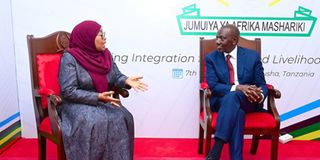
President Samia Suluhu Hassan holds talks with Kenyan President and outgoing East African Community chair William Ruto ahead of the 25th Ordinary Summit of the EAC Heads of States in Arusha on Saturday. PHOTO | STATE HOUSE
Dar es Salaam. The East African Community (EAC) has taken a series of bold decisions aimed at stabilising the bloc after months of financial strain and growing concerns about the pace of regional integration.
According to regional analysts, the decisions taken have addressed what East Africans had been expecting in order to rescue the Community and make it stronger going forward.
During the 25th Ordinary Summit of EAC Heads of State held in Arusha on Saturday, leaders adopted a new financial contribution formula, appointed a new Secretary General and handed the bloc’s rotating chairmanship to Uganda’s President Yoweri Museveni.
The decisions come at a time when the eight-member regional bloc, home to more than 300 million people, has been grappling with delayed member contributions and questions about its institutional effectiveness.
Experts now say the reforms signal optimism but warn that deeper commitment from partner states will be required to ensure that the bloc moves forward.
One of the most significant resolutions was the adoption of a hybrid financial contribution model.
Under the new arrangement, 50 percent of the EAC budget will be shared equally among partner states, while the remaining 50 percent will be determined by the size of each country’s economy, measured through Gross Domestic Product (GDP).
The new formula replaces the previous equal contribution model that had been criticised for ignoring economic disparities among member states.
Regional integration expert Peter Kagwanja told The Citizen yesterday that the hybrid system reflects a pragmatic compromise.
“This model acknowledges economic realities within the bloc. Larger economies will naturally carry a greater responsibility, while smaller economies are protected from excessive financial pressure. This is what we expected.”
However, Prof Kagwanja cautioned that the new model alone will not solve the EAC’s financial challenges.
“The real issue has never been the formula. The problem has been political commitment. Even under a new system, countries must honour their obligations on time.”
The financial crisis had become increasingly visible. By January 2026, the bloc was owed more than $89 million in unpaid contributions, forcing several programmes to stall.
Political analyst Linda Mvungi said the decision to also write off 50 percent of accumulated arrears indicates that leaders wanted a practical reset.
“It is essentially a financial reset button,” Dr Mvungi said. “But if member states fall into the same pattern again, the bloc will face the same crisis in a few years.”
A technocrat at the helm
The Summit also appointed Tanzanian diplomat Stephen Mbundi as the new Secretary General of the EAC for a five-year term.
Observers had earlier suggested that the bloc needed a strong technocratic leader or policy strategist capable of navigating the current institutional challenges.
Mr Mbundi, who previously served as Permanent Secretary in Tanzania’s Ministry of Foreign Affairs and East African Cooperation, brings nearly three decades of diplomatic experience.
Regional affairs analyst Mtasingwa Anold speaking in one of his social media platforms said the appointment reflects the need for administrative discipline within the bloc.
“The EAC at this stage requires a technocratic mind like Ambassador Mbundi, The Secretary General must focus on efficiency, coordination and restoring confidence in the institution. This, as far as I know Mr Mbundi, he will deliver.”
According to Dr Anold, Mr Mbundi’s familiarity with EAC processes and regional diplomacy could help streamline decision-making.
“He understands how the system works and the politics behind it. That knowledge is essential if the Secretariat is to push implementation of key regional programmes.”
However, analysts stress that the Secretary General’s powers remain limited without political support from partner states.
“The Secretariat can propose and coordinate,” Dr Mvungi said. “But implementation ultimately depends on the political will of member states.”
Museveni takes the chair
The leadership transition also saw President Yoweri Museveni of Uganda assume the rotating chairmanship of the EAC.
The chairperson plays a key political role in guiding the bloc’s strategic direction and ensuring that leaders follow through on commitments made under the EAC Treaty.
Experts say Museveni faces a demanding agenda.
“The new chair must restore confidence in the integration process given his experience in the formation of the bloc,” said Dr Mvungi. “The region has ambitious goals, including a political federation, but progress has been uneven.”
One of the immediate priorities will be ensuring that member states implement existing agreements, particularly those related to trade, free movement and infrastructure connectivity.
According to Dr Mvungi, the bloc has often struggled not with policy design but with implementation.
“The EAC is very good at making declarations. The challenge has always been translating those commitments into action.”
Despite the challenges, analysts say the Arusha Summit has at least provided a roadmap for stabilising the regional organisation.
The combination of financial reforms, new leadership at the Secretariat and a renewed political mandate from the chairperson could help the bloc regain momentum.
Register to begin your journey to our premium contentSubscribe for full access to premium content