Samia: Tanzania open to trusted, long-term investment partners
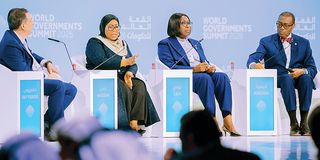
President Samia Suluhu Hassan speaks during a panel discussion on the theme Governments and the Future of Investment: An African Perspective at the World Governments Summit 2026 (WGS2026), held at Madinat Jumeirah in Dubai, United Arab Emirates, yesterday. PHOTO | COURTESY
Dar es Salaam. President Samia Suluhu Hassan has said Tanzania is ready to engage in trusted, long-term and structured investment partnerships that require institutional stability and policy consistency.
Speaking during the launch of the Global Africa Investment Summit (GAIS) on the sidelines of the World Governments Summit in Dubai on February, 3, 2026 President Hassan said modern investors are increasingly driven by trust in institutions, policy consistency, and governments that honour their commitments, which Tanzania can offer.
“What investors seek today is not only opportunity, but trust, trust in institutions, policy consistency, and governments that honour commitments,” a statement issued by the Directorate of Presidential Communications cited President Hassan as saying.
She added that Tanzania was ready to engage GAIS as a credible and reliable investment partner.
Leaders who attended the summit described GAIS as a new phase in how Africa engages global capital.
President Hassan told the gathering of African heads of state, senior policymakers, global investors, and business leaders that Tanzania has deliberately invested in backbone infrastructure, including energy, transport, and logistics, to unlock productivity, industrialisation, and regional integration.
The President cited flagship projects in hydropower, modern railways, ports, and roads, alongside Special Economic Zones and a One-Stop Investment Facilitation Centre, as key reforms that have reduced investment friction and strengthened confidence in the country’s investment climate.
She noted that platforms such as GAIS enable African countries to move away from fragmented project promotion towards structured collaboration aligned with national development priorities and investor expectations.
GAIS has been positioned as market infrastructure rather than a conventional conference, to convert Africa’s sovereign and public assets into bankable, de-risked investment portfolios that meet global standards for governance, risk management, and returns.
For his part, GAIS co-founder and executive chairman and former African Development Bank president, Dr Akinwumi Adesina, said Africa’s main challenge was not a shortage of assets, but the absence of trusted structures that connect those assets to global capital.
“The problem is not a lack of assets, but the absence of trusted structures that connect those assets to global capital,” said Dr Adesina.
He observed that Africa’s strategic assets in energy, minerals, infrastructure, and natural capital remain undervalued due to weak structuring, poor data, fragmented governance, and high due diligence costs.
GAIS, he added, seeks to address these bottlenecks by prioritising scale, predictability, and long-term partnerships over one-off transactions. “Africa must move decisively from aid dependency to investment-led growth,” he said.
Angolan President, João Lourenço, who is also the African Union chairperson, said GAIS reflected Africa’s growing political maturity and readiness to engage global capital responsibly and competitively.
He stressed the need for predictable rules, transparent contracts, and policy consistency, noting that long-term investors require certainty before committing capital.
“Our responsibility as leaders is to create certainty. Investors cannot plan for the long term where policies change unpredictably, or commitments are not honoured,” he said.
He cited Angola’s reforms in privatisation, one-stop investment windows, and energy transition as evidence of commitment to reform and execution.
Ghanaian President, John Mahama, echoed similar sentiments, arguing that Africa needs the right investment architecture to unlock the value of its assets. He cited Ghana’s reforms in the gold and minerals sector, including restrictions on raw mineral exports, as examples of how restructuring and value addition can drive revenue, jobs, and industrialisation.
GAIS is expected to provide Tanzania with a strategic opportunity to attract private and institutional capital into priority sectors, reduce pressure on public finances through public-private partnerships, joint ventures, special purpose vehicles, and blended-finance models, while accelerating industrialisation, export diversification, and job creation.
Tanzania plans to prioritise ports, logistics, and regional trade by leveraging its coastline and port network as a gateway to East and Central Africa; energy and industrial zones to support manufacturing, value addition, and energy security; and a stronger anchor role within the East African Community, positioning the country as a regional production, logistics, and energy hub.
Leaders and investors at the launch agreed that Africa’s next phase of growth must be driven by structured investment rather than rhetoric, ownership rather than dependency, and execution rather than promises.
Register to begin your journey to our premium contentSubscribe for full access to premium content