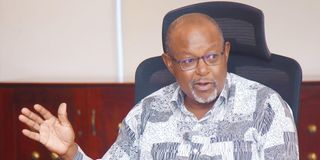
Dar es Salaam. As Tanzania pursues its Vision 2050 goal of building a $1 trillion economy, the country should draw lessons from Singapore by focusing on discipline, prioritisation and a stronger private sector rather than trying to develop every sector at once, former Chief Secretary and Planning Commission member Ombeni Sefue has said.
In an interview with Mwananchi Communications Limited (MCL), Amb Sefue reflected on a lecture delivered by Singapore President Tharman Shanmugaratnam at the University of Dar es Salaam, organised by the Uongozi Institute.
He recalled that President Tharman was asked how Singapore had transformed itself from a poor nation in the 1960s into one of the world's leading economies.
"Because we had nothing," was the President's response. According to Mr Sefue, the answer underscores an important lesson for Tanzania.
"Because Singapore lacked natural resources, its survival depended entirely on human capital, clear priorities and intellectual rigour," he said.
By contrast, he argued, Tanzania's abundance of minerals, fertile land and strategic coastline has encouraged it to spread its efforts too thinly.
"Tanzania's problem is that because we have everything, we try to do a little bit of everything everywhere, and we fail to achieve the critical mass needed for a true economic breakthrough," he said, citing observations made by development partners.
He said Tanzania should identify a few strategic sectors capable of driving broader economic transformation, including the blue economy, logistics and other high-growth industries.
Building a $1 trillion economy
Mr Sefue said the target is achievable, but only if Tanzania fundamentally changes its development model.
He said Vision 2050 envisages the private sector contributing about 70 percent of future economic growth, replacing the long-held expectation that government should be the primary driver of development.
He identified the large informal economy as one of the country's biggest constraints.
Many Tanzanians own valuable assets, including land and buildings, but these remain "dead capital" because they lack formal legal documentation.
Using what he described as the "passport analogy", Mr Sefue said formalisation is essential for unlocking the value of those assets.
"Everyone in your village knows who you are, but when you want to cross a border, you need a passport," he said.
"Formalisation is the passport for your property. Without it, you cannot walk into a bank and secure a loan to expand your business. We must unlock this dead capital."
Creating the right environment
Mr Sefue said achieving Vision 2050 also requires rebuilding trust between government and the private sector after decades in which profit-making was often viewed with suspicion.
He said government's role should increasingly focus on creating an enabling environment through sound policies, reliable infrastructure and security.
"The private sector does the actual business of production and trade," he said, adding that government should facilitate enterprise rather than compete with it.
He also called for stronger financial literacy, citing Geita, where mining has created many young millionaires and billionaires.
According to him, many struggle to preserve their wealth because they lack investment and financial management skills.
"Without financial education, many spend their wealth on luxury cars or multiple marriages instead of reinvesting it as capital," he said.
Balancing investment and national interests
Mr Sefue dismissed claims that Tanzania had been slow in negotiating major investment agreements, arguing that patience had enabled the country to secure better deals.
"Many countries rushed into major contracts only to discover they had surrendered their national sovereignty or a fair share of the benefits," he said.
He said Tanzania had used the extra time to strengthen its technical capacity for negotiations.
As part of that effort, he studied resource governance at Cambridge University, knowledge he said later contributed to negotiations on the proposed $44 billion Liquefied Natural Gas (LNG) project.
He said projects of that scale require balancing national interests with the need to attract investors.
"We should not fear collaboration with foreign capital or technology, provided contracts protect our sovereignty and deliver tangible benefits to our people," he said.
Mr Sefue said Tanzania should adapt—not copy—the discipline that underpinned Singapore's success.
He said the country should focus investment on priority sectors, formalise the economy, empower the private sector and ensure major decisions safeguard national interests.
"If we stop trying to do everything at once and instead build critical mass in strategic sectors, Tanzania can transform its natural wealth into lasting prosperity," he said.
Register to begin your journey to our premium contentSubscribe for full access to premium content