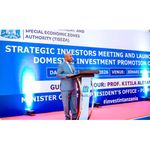
The minister of State in the President’s Office [Planning and Investment], Pro Kitila Mkumbo, addresses journalists yesterday on the commencement of the implementation of the National Development Vision 2050. PHOTO | STATE HOUSE
Josephine Christopher is a senior business journalist for The Citizen and Mwananchi newspapers
Mwananchi Communications Limitted
Dar es Salaam. Tanzania will formally begin implementing the National Development Vision 2050 on July 1, 2026, with government placing major strategic investment projects at the centre of its long-term economic transformation agenda.
The implementation framework was approved during a National Planning Commission meeting held in Dar es Salaam on May 26, 2026, under the chairpersonship of President Samia Suluhu Hassan.
The meeting endorsed key national planning instruments and directed faster execution of flagship projects expected to drive structural economic change over the coming decades.
Among the priority projects are the Liquefied Natural Gas (LNG) project, the Liganga iron and Mchuchuma coal integrated project, the Kabanga Nickel project, the Kahama processing and refining project, and the Engaruka soda ash project.
Collectively, the projects are valued at more than Sh120 trillion (about $47 billion). Government officials say they are expected to attract additional private capital, expand industrial capacity, create jobs, increase export earnings and strengthen fiscal revenues.
The Commission also approved key frameworks to guide implementation, including the National Planning Guidelines, the National Project Appraisal Framework, the National Monitoring and Evaluation Framework, and a Vision 2050 Communication Strategy.
Officials said the instruments are designed to strengthen coordination across government, improve project selection and appraisal, and ensure consistent tracking of implementation progress.
They added that the flagship projects were prioritised due to their potential to drive structural transformation, particularly through industrialisation, energy development, mineral value addition and export expansion.
The LNG project is expected to boost foreign exchange earnings and position Tanzania as a regional energy hub.
The Liganga and Mchuchuma projects are intended to develop a domestic iron and steel value chain while strengthening energy supply for industrial production.
The Kabanga Nickel project is expected to integrate Tanzania into global supply chains for critical minerals used in electric vehicle batteries and clean energy technologies.
The Engaruka soda ash project is projected to support domestic chemical industries and import substitution.
Thr government says the long-term ambition under Vision 2050 is to build an economy worth about $1 trillion, with flagship projects described as “engines of transformation”.
Officials say the prioritisation of these projects reflects a shift towards implementation-focused planning, with emphasis on measurable economic impact, job creation and productivity growth.
In parallel, Vision 2050 will be implemented through a performance management system anchored on 206 key performance indicators (KPIs) across 12 priority sectors, replacing input-based planning with results-oriented governance.
The minister of State in the President’s Office (Planning and Investment), Prof Kitila Mkumbo, said yesterday that the system will guide implementation from July 2026 and ensure alignment of government plans with measurable targets.
He said ministries, departments, agencies and local government authorities will be required to align annual plans and budgets with the indicators. “We are no longer focusing on activities. We are focusing on results and outcomes,” said Prof Mkumbo.
He said education carries the largest share of indicators at 54, reflecting its role in human capital development.
Other priority sectors include agriculture; industry and construction; minerals and energy; tourism; sports and arts; creative and digital industries; land and housing; trade and investment; social protection; the blue economy; and science and technology.
Prof Mkumbo said three cross-cutting reform pillars—governance, productivity and investment, and socio-economic sustainability—will support implementation through an additional 142 indicators.
Director General of the Tanzania Investment and Special Economic Zones Authority (TISEZA), Gilead Teri, said investment inflows have increased from about $3 billion in 2021 to $12 billion in 2025, supported by reforms, infrastructure development and economic diplomacy.
He said Special Economic Zones in Dar es Salaam, Coast, Dodoma, Ruvuma, Mara and Mwanza are helping reduce bottlenecks and attract investors.
Mr Teri said the private sector will remain central to Vision 2050, particularly in industrialisation and job creation.
Register to begin your journey to our premium contentSubscribe for full access to premium content