Dar es Salaam. As artificial intelligence reshapes industries and competition for jobs intensifies globally, graduates entering the labour market are being urged not to rely solely on academic certificates, but to develop creativity, integrity and problem-solving skills that can help them thrive in a rapidly changing economy.
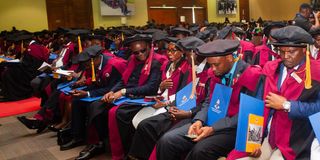
The message featured prominently during the University of Dar es Salaam’s (UDSM) 56th graduation ceremony held on Monday, May 25, 2026, where university leaders challenged graduates to view education not merely as a pathway to employment, but as a tool for transforming society and contributing to national development.
The remarks come at a time when Tanzania, like many countries, is grappling with a growing number of university graduates entering a labour market unable to absorb all of them into formal employment.
As a result, policymakers, educators and employers are increasingly calling for graduates capable of creating opportunities for themselves and others through innovation, entrepreneurship and the effective use of technology.
Speaking during the ceremony, UDSM Vice-Chancellor William Anangisye said higher education must be accompanied by a strong sense of social responsibility.
Prof Anangisye said a total of 878 graduates completed studies at various academic levels, with women accounting for 42.7 percent of the graduating class.
He said 9.4 percent of the graduates attained doctoral degrees, while 60.6 percent completed master’s programmes, with the remainder graduating at undergraduate and diploma levels.
“Use the education you have received to benefit Tanzanians and our nation. Education is not a personal ornament. It is a responsibility, a duty and a debt owed to society,” he told the graduates.
Drawing inspiration from the philosophy of Tanzania’s founding president, Mwalimu Julius Nyerere, Prof Anangisye reminded graduates that those fortunate enough to receive higher education have an obligation to use their knowledge in service of others.
His remarks reflect a longstanding national debate on the purpose of education. Since independence, Tanzania has championed education as a tool for social transformation rather than individual advancement alone.
However, changing economic realities and rising youth unemployment have prompted renewed calls for universities to produce graduates with practical and entrepreneurial skills alongside academic knowledge.
Prof Anangisye said the government under President Samia Suluhu Hassan continues to invest in higher education, skills development and university infrastructure to equip young people for active participation in national development.
He cautioned graduates against becoming discouraged if formal employment opportunities do not materialise immediately after graduation.
“Do not sit and wait for employment alone. Let your education help you think critically, solve problems and create new opportunities,” he said.
He noted that sectors such as entrepreneurship, agriculture, trade, research and the digital economy offer significant opportunities for graduates willing to innovate and apply their knowledge creatively.
The vice-chancellor also urged graduates to serve as ambassadors of the university by upholding discipline, accountability and ethical conduct throughout their professional lives.
At the same time, he emphasised the responsible use of emerging technologies, particularly artificial intelligence, arguing that such tools should be used to advance society rather than undermine social values and cohesion.
The chairperson of the University Council, Ms Mwanaidi Maajar, echoed similar sentiments, saying today’s world demands far more than academic qualifications.
“Society no longer needs certificates alone. It needs innovation, integrity and people who can solve real-life challenges. I'llYour success will be measured by the impact you make in improving the lives of others,” she said.
She added that information and communication technology has become an essential driver of learning, research and service delivery, making it imperative for graduates to harness technological knowledge to bring positive change to their communities.
According to her, UDSM has equipped graduates not only with academic knowledge, but also with values, creativity and leadership skills necessary for advancing sustainable development in Tanzania and beyond.
Education policy analyst and lecturer Hosea Rwegasira said the advice offered by university leaders reflects broader global trends, as employers increasingly value adaptability, communication skills and the ability to solve complex problems as technology transforms workplaces.
“Universities are producing graduates into a world where many traditional jobs are evolving or disappearing.
Academic qualifications remain important, but employers are also looking for critical thinking, digital literacy, teamwork and innovation,” he said.
Dr Rwegasira noted that artificial intelligence is likely to automate some routine tasks, but it will also create new opportunities for graduates who can combine technical knowledge with creativity and ethical judgement.
“The graduates who will succeed are those who continue learning after graduation and who can identify solutions to challenges facing communities and industries,” he added.