Inside Samia’s plan to position Kigoma as a logistics gateway
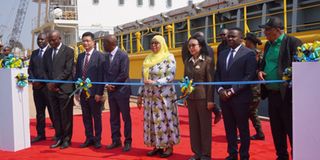
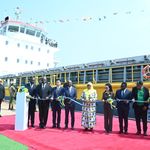
President Samia Suluhu Hassan cuts the ribbon to officially launch four cargo vessels that will operate on Lake Tanganyika during a ceremony in Kigoma Region. PHOTO | STATE HOUSE
Dar es Salaam. For decades, Kigoma carried a description that reflected its physical location but failed to capture its economic potential as it was widely known as the ‘end of the railway.’
This meant that Kigoma was the final destination of Tanzania’s Central Line where trains from Dar es Salaam stopped before reaching the shores of Lake Tanganyika.
President Samia Suluhu Hassan now wants that narrative to change.
Her administration is positioning Kigoma not as a terminal point, but as a strategic logistics and commercial gateway linking Tanzania with some of the most important markets in East and Central Africa, particularly eastern Democratic Republic of Congo (DRC), Burundi and Zambia.
The ambition is being backed by a series of large-scale infrastructure investments, including the construction of the 506-kilometre Tabora–Kigoma Standard Gauge Railway (SGR).
Other projects include the expansion of Kigoma Port, introduction of modern cargo vessels on Lake Tanganyika, rehabilitation of the historic MV Liemba, development of a government shipyard and improvements at Kigoma Airport.
Together, the projects represent a broader economic strategy that connects countries via Tanzania’s Indian Ocean gateway at Dar es Salaam, aiming to transform Kigoma into a regional logistics hub.
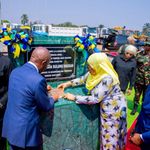
Speaking during the launch of the SGR project and commissioning of four new cargo vessels in Kigoma yesterday, President Hassan said the investments marked a turning point for the region.
“Kigoma will no longer be known as the end of the railway. Instead, it will become the beginning of new opportunities for trade and investment,” she said.
Why Kigoma matters
Kigoma’s importance is rooted in geography. Located on the eastern shores of Lake Tanganyika, the region provides Tanzania with a natural connection to Burundi, eastern DRC and Zambia.
The lake itself forms one of Africa’s largest freshwater transport corridors, stretching for more than 670 kilometres and serving millions of people across four countries.
Yet for decades, Kigoma’s strategic position remained underutilised.
Limited shipping capacity, inadequate port infrastructure and unreliable transport connections meant that the region struggled to fully benefit from its location.
Cargo movement between Tanzania and eastern DRC was often expensive and slow, reducing the competitiveness of businesses operating along the corridor.
The government’s current plan seeks to change this by developing a multimodal transport system where railways, ports, roads and maritime transport operate as one connected network.
Transport Minister, Prof Makame Mbarawa, said the objective was not simply to construct infrastructure, but to create an environment where public and private investments work together to expand economic opportunities.
“Our government believes that sustainable development cannot be achieved by the government alone. It requires strong cooperation between the government and the private sector,” said Prof Mbarawa.
He added that the government’s approach was to support investors rather than compete with them.
“We do not compete with investors; our main responsibility is to empower them. We do not put obstacles in their way; instead, it is our duty to remove those obstacles and ensure they succeed in Tanzania,” he said.
That philosophy is increasingly visible in Kigoma, where private investors have become central to the expansion of lake transport.
The DRC opportunity
At the centre of Kigoma’s economic transformation is the Democratic Republic of Congo.
The DRC is already one of Tanzania’s most important regional trade partners and among the largest users of the Central Corridor, which connects the Port of Dar es Salaam with landlocked markets.
The importance of eastern DRC goes beyond its population. The region is home to significant mineral resources, including copper, cobalt and other strategic minerals that are critical to global industries. For Tanzania, the opportunity is twofold.
First, improving transport links will allow more cargo from eastern DRC to move through Tanzanian ports, increasing revenue for ports, railways, logistics companies and service providers.
Second, it will create opportunities for Tanzanian businesses to access a growing market for manufactured goods, agricultural products, construction materials and services. The government believes that strengthening the Kigoma corridor will make Tanzania more competitive against alternative routes used by traders in the Great Lakes region.
The expansion of Lake Tanganyika transport is therefore not only a regional connectivity project; it is also an economic strategy aimed at increasing Tanzania’s role in regional supply chains.
Connecting Dar with Central Africa
The transformation of Kigoma cannot be separated from developments taking place more than 1,200 kilometres away at the Port of Dar es Salaam.
The port remains Tanzania’s largest maritime gateway and one of the most important entry points for cargo serving domestic and regional markets.
The government’s plan is to create a seamless transport chain where imported goods arriving at Dar es Salaam can move efficiently through the SGR network to Kigoma before crossing Lake Tanganyika into neighbouring countries.
The Tabora–Kigoma SGR project, officially known as Lot 6, covers 506 kilometres and is being implemented at a cost of about Sh7.4 trillion.
Once completed, the railway will connect Kigoma with Tabora, Dodoma, Morogoro and Dar es Salaam, significantly reducing transport time and costs.
Tanzania Railway Corporation (TRC) executive director, Mr Machibya Masanja, told President Hassan that: “the project would fundamentally transform the movement of goods and people between western Tanzania and the coast.”
President Hassan said the investments were designed to take advantage of Tanzania’s unique geographical position.
“God Himself knows why Tanzania was created in the position where we are today. He has blessed us with resources and opportunities that can enable Tanzania to become a major trading hub,” she said. She added that geography alone was not enough; deliberate policies, laws and investments were required to transform the opportunity into economic reality.
Although the SGR has attracted much public attention, experts argue that the railway alone cannot transform Kigoma into a logistics hub.
The success of the corridor depends on every part of the system working together.
This is why the launch of four new cargo vessels on Lake Tanganyika was considered a major milestone.
The vessels, constructed by Gold Voyage Logistics Limited, have a carrying capacity of about 2,000 tonnes each and are expected to improve freight movement between Tanzania and eastern DRC.
Prof Mbarawa said the ships would open a new chapter in lake transport.
“These four new vessels will open a new era of maritime transport on Lake Tanganyika. They will increase cargo capacity, improve transport safety, reduce transportation costs and strengthen trade between Tanzania, the Democratic Republic of Congo and Burundi,” he said.
The private investor has indicated plans to construct two additional vessels by 2027, while TRC and Tanzania Ports Authority (TPA) also plan further investments in marine transport.
The government expects the combined public and private sector investments to increase the number of modern vessels operating on Lake Tanganyika in coming years.
The shipyard question
While celebrating the infrastructure progress, economists have warned that Kigoma’s transformation requires more than railways and ships.
Former Kigoma North MP Zitto Kabwe has argued that the region needs a functional shipyard to support long-term maritime operations.
In his recent commentary, Mr Kabwe welcomed the SGR investment but cautioned that without ship maintenance and construction capacity, Tanzania risks building an incomplete logistics system.
His argument is that every successful transport corridor requires supporting industries.
President Hassan appeared to acknowledge this challenge when she directed the Ministry of Transport to explore partnerships with private investors to accelerate completion of the Kigoma shipyard.
She said government resources alone could slow the process, while collaboration with capable investors could help deliver the project faster.
On the other hand, President Hassan stressed that protecting the investments would be essential: “Without security, there can be no development.”
The President urged citizens to protect infrastructure because damage to roads, railways, ports and other public assets affects not only the government but every taxpayer and the future generation.
Register to begin your journey to our premium contentSubscribe for full access to premium content