Tanzania opposition leader Tundu Lissu demands acquittal, says treason case has no substantive basis


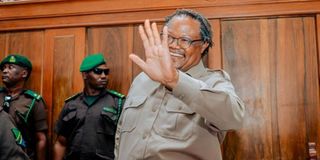
Dar es Salaam. Chadema national chairman Tundu Lissu has asked the High Court to find that he has no case to answer in a treason charge, urging it to acquit him and order the government to pay him compensation.

Mr Lissu submitted on Monday, August 17, 2026, after the prosecution closed its case having called 17 of its 30 listed witnesses.

Mr Lissu faces one count of treason under Section 39(2)(d) of the Penal Code, arising from remarks he allegedly made regarding the 2025 General Election.

The prosecution alleges that on April 3, 2025, in Dar es Salaam, Mr Lissu incited the public to prevent the 2025 General Election by uttering and publishing remarks aimed at pressuring the country’s top government leader.

He allegedly said: “If they say this position amounts to rebellion, it is true... because we say we will stop the election, we will mobilise rebellion, that is how to bring change... so we are going to make trouble... especially, we are really going to disrupt this election... we are going to make serious trouble...”

The case is before a three-judge bench of the High Court’s Dar es Salaam Registry led by Judge Dunstan Ndunguru, alongside Judges James Karayemaha and Ferdinand Kiwonde.

When the case came up on Monday, State Attorney Ajuaye Nzegeli told the court that after reviewing the evidence of the remaining witnesses, the prosecution had concluded that the presented evidence was sufficient.

“We therefore wish to inform this honourable court that the prosecution is closing its case after calling 17 witnesses,” said State Attorney Nzegeli.

Following the closure, the prosecution requested to make submissions on whether the evidence established a case requiring Mr Lissu to enter his defence.

Mr Lissu supported the request, and the court permitted both sides to submit, with Mr Lissu presenting first before the prosecution responds.

Lissu’s submissions

In his submissions, Mr Lissu argued that evidence from the 17 prosecution witnesses failed to establish a prima facie case against him.

He referred to decisions of the East African Court of Appeal in Grey Likungu Mataka and Others v Republic and Hatibu Gandhi and Others.

Mr Lissu said the authorities established three elements for proving treason: that the accused owes allegiance to the United Republic; that the accused had treasonable intent; and that the intent was manifested through writing or an overt act.

He said allegiance was undisputed as he is a Tanzanian citizen. The central issues, he argued, were whether he had treasonable intent and whether it was manifested through writing or an overt act.

Referring to the Grey Likungu case, Mr Lissu said former Chief Justice Francis Nyalali emphasised that a treason conviction requires proof of an overt act, treasonable intent, and allegiance to the United Republic.

Citing the Hatibu Gandhi case, Mr Lissu noted the Court of Appeal held that mere words do not constitute an overt act unless they describe an act of treason, such as directing how to overthrow the government rather than merely stating a desire to do so.

He added that the court clarified that mere words spoken by a single accused person could not amount to an overt act, unlike statements involving multiple persons establishing a conspiracy.

Mr Lissu argued that the section under which he was charged concerned inciting people to call upon the government, Parliament, or the judiciary to take action, which must be proved through writing or an overt act.

He argued that none of the alleged statements mentioned the government, Parliament, or the courts.

“Of all the 17 witnesses, everyone who spoke about those words, I asked them: Is the government mentioned there? It is not,” he said, noting the term covers the Union government, the Revolutionary Government of Zanzibar, and local authorities.

He said no witness confirmed he had mentioned the President, Prime Minister, or regional commissioners.

Mr Lissu further argued that elections are administered by the electoral commission, not the government, meaning the government could not be threatened by an attempt to prevent an election.

He added that statements about stopping an election were not criminalised under the 2025 Presidential, Parliamentary and Councillors’ Elections Act, the Penal Code, or other laws.

“Therefore, the proof of treason as established in the Grey and Gandhi cases is absent and, in fact, there is no evidence of an intention to commit any offence under the laws applicable in Tanzania,” he said.

Mr Lissu stressed he was the sole accused, arguing that under the Gandhi precedent, mere words do not constitute treason for a single accused person.

“So, honourable judges, if the evidence presented has failed to prove a case of committing treason, what am I supposed to defend myself against? On that ground alone, I have no case to answer,” he said.

Jambo TV video evidence

On allegations that his remarks were published on Jambo TV, Mr Lissu said the prosecution should have produced the video recordings and forensic examination reports.

He noted that none of the 17 witnesses presented the footage in court despite prosecution promises to tender nine documents, including video clips and forensic reports.

Consequently, Lissu said, witnesses only testified to seeing videos without actual footage being admitted into evidence.

Mr Lissu noted that of the 17 witnesses, only the 17th was present at the meeting where he allegedly spoke, describing the other 16 as hearsay witnesses.

He added that the witness testified that he and five colleagues recorded and published the video, proving Mr Lissu himself did not publish it.

Regarding event organisation, Mr Lissu said the witness admitted the invitation was issued by Chadema information officer Brenda Lupia and that Mr Lissu was not seen making preparations.

Mr Lissu prayed for an acquittal without being called to enter his defence.

He asked the court to deliver its decision on Monday to spare him returning to prison, with the written ruling to follow later.

Mr Lissu also requested compensation from the government, stating he had spent 496 days in remand over charges he termed legally baseless.