Tanzania’s Benjamin Mkapa Hospital set to become regional cancer hub
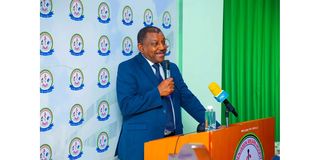
Africa Regional Director of the International Atomic Energy Agency (IAEA), Mr Gashaw Wolde, speaks on Tuesday, February 3, 2026, after touring Benjamin Mkapa Hospital’s new Sh30.2 billion state-of-the-art cancer treatment centre under construction in Dodoma. PHOTO | KATARE MBASHIRU
What you need to know:
Once completed, the Centre of Excellence for Cancer Training and Treatment is expected to transform BMH into one of the region’s most advanced oncology facilities.
By Katare Mbashiru
Dodoma. Tanzania is steadily positioning itself as a leading destination for cancer treatment in East and Southern Africa, following international endorsement of a major oncology project at Benjamin Mkapa Hospital (BMH).
The International Atomic Energy Agency (IAEA) Africa Regional Office has urged BMH, a zonal referral facility in Dodoma, to prepare for patients not only from Tanzania but also from neighbouring countries, a strong signal of growing confidence in the country’s medical infrastructure.
The call followed an inspection visit on Tuesday, February 3, 2026, by IAEA Africa Regional Director, Mr Gashaw Wolde, who toured the hospital’s new Sh30.2 billion state-of-the-art cancer treatment centre under construction.
Although still in its final stages, Mr Wolde said the centre’s design, infrastructure, and preparedness reflect “big plans for the future.”
Once completed, the Centre of Excellence for Cancer Training and Treatment is expected to transform BMH into one of the region’s most advanced oncology facilities.
The project is about 61 percent complete and is scheduled for completion in August 2026, with cancer treatment services set to begin in September this year.
“I see good ideas, good innovation, thank you very much, Tanzania,” said Mr Wolde.
“Do not prepare this facility to treat Tanzanians only. Let it be a hub to receive patients from neighbouring countries. The key is to invest strongly in human resources,” he added.
BMH acting executive director, Dr Henry Humba, said the modern complex will offer advanced radiotherapy and comprehensive cancer care.
“The facility has been designed to meet international standards and will provide state-of-the-art radiotherapy and oncology services,” said Dr Humba.
“We have constructed a modern building worth Sh30.2 billion, and we expect to start treating cancer patients by September. The IAEA Africa has supported us from the project’s inception, including training programmes for doctors and capacity-building for healthcare providers,” added Dr Humba.
However, Dr Humba noted that the hospital urgently requires Sh12 billion to procure and install specialised medical equipment essential for advanced cancer care.
“With this support, we will be able to provide world-class services. Even now, we are ready to receive patients from outside Tanzania, as advised by the IAEA,” he added.
Tanzania’s ambition is already resonating beyond its borders. Two weeks ago, Malawi’s Minister of Health and Environmental Sanitation, Madalitso Baloyi, announced that Malawians can now seek specialised and super-specialised treatment in Tanzania, particularly at BMH, following assessment by Malawian experts who deemed the facility suitable.
Director General of the Tanzania Atomic Energy Commission (TAEC), Prof Najat Mohammed, confirmed that preparations for radiation and cancer treatment services are progressing well and that services will commence this year.
“These developments will significantly reduce the burden on Tanzanians who previously had to travel long distances for cancer treatment,” Prof Mohammed said.
Currently, cancer services in Tanzania are offered at the Ocean Road Cancer Institute (ORCI) in Dar es Salaam, Bugando Medical Centre in Mwanza, and Kilimanjaro Christian Medical Centre (KCMC), with additional services being prepared at Benjamin Mkapa Hospital and Mbeya Referral Hospital.
The BMH project is part of Tanzania’s broader strategy to enhance specialised healthcare, develop regional medical hubs, and attract patients from across East and Southern Africa.
By establishing a modern oncology centre, the country aims to not only improve outcomes for Tanzanians but also strengthen South–South cooperation in healthcare, positioning itself as a regional leader in cancer treatment.
Experts say the centre’s focus on advanced radiotherapy, digital health systems, and trained human resources will make it a model for regional oncology facilities.
Its completion is expected to elevate Tanzania’s healthcare profile, attract medical tourism, and support research and training initiatives for healthcare providers across the continent.
Once operational, the facility will contribute to addressing the shortage of advanced cancer treatment centres in the region, reduce cross-border travel for patients, and improve accessibility to timely and high-quality oncology services.