Tanzania to boost fuel reserves amid raging Middle East conflict
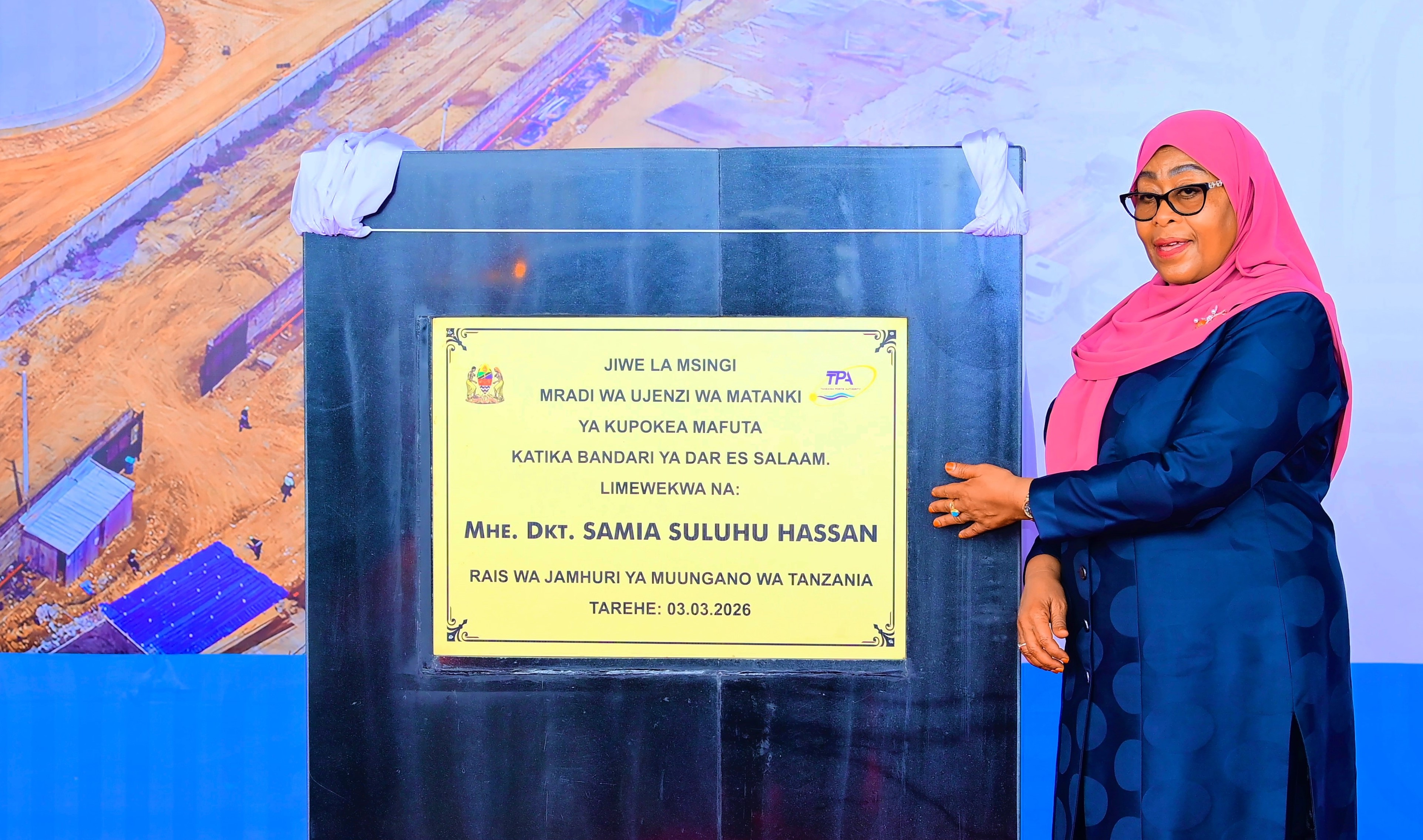
President Samia Suluhu Hassan unveils the plaque after laying the foundation stone for the construction of bulk fuel storage tanks at Dar es Salaam Port on March 3, 2026. PHOTO | STATE HOUSE
Dar es Salaam. President Samia Suluhu Hassan on Tuesday directed the Ministry of Energy and other relevant authorities to strengthen Tanzania’s strategic fuel reserves, aiming to shield the country from potential shortages and price hikes amid the ongoing US-Israeli invasion of Iran.
The President made the announcement during the foundation-stone laying ceremony for the construction of new petroleum reserve tanks in Dar es Salaam, a project valued at Sh678.6 billion designed to expand the National Strategic Petroleum Reserve.
“Given current global energy disruptions, it is vital that Tanzania strengthens its capacity to withstand external shocks, including fluctuations in international oil prices,” President Hassan said. “We must ensure that our energy security is not compromised and that supply remains stable for Tanzanians.”
She also urged the Ministry of Transport and the Tanzania Ports Authority (TPA) to ensure that all related infrastructure projects are executed on time, meet international quality standards and fully comply with environmental safeguards.
Global fuel prices have already been affected by recent global developments, rising by 13 percent in the past week, illustrating the country’s vulnerability to international market volatility.
President Hassan emphasised the importance of proactive planning to mitigate the impact of future disruptions. She called for constructive dialogue among global leaders to restore stability in energy markets while stressing that Tanzania must also act decisively to safeguard its economy.
The Sh678.6 billion project will construct modern storage tanks at the Port of Dar es Salaam, expanding national petroleum storage capacity by 378,000 cubic metres—162,000 cubic metres for diesel, 135,000 cubic metres for petrol and 81,000 cubic metres for Jet A-1. Phase one of the project includes 15 storage tanks, full site preparation, perimeter fencing, installation of 1,087 foundation piles and completion of all 15 pile caps. As of 2 March 2026, overall implementation had reached 41 per cent. Completion is scheduled for February 3, 2027, followed by a 12-month defects liability period.
TPA Director General Plasduce Mbosa described the project as transformative, strengthening Tanzania’s energy security and port competitiveness. “The construction contract, worth Sh678.6 billion including VAT, was awarded to a joint venture between China Railway Major Bridge Engineering Group Co Ltd and WUHUAN Engineering Co. Ltd, while supervision is being undertaken at a cost of Sh23.2 billion,” he said.
He noted that upon completion, the project will double oil handling capacity from six to 12 million metric tons annually and eliminate daily demurrage charges of $25,000, previously passed on to consumers. The initiative has also already delivered socio-economic benefits: of 325 jobs created, 279 have been filled by Tanzanians, while local enterprises are supplying goods and services and young professionals are gaining valuable technical skills.
President Hassan described the project as a cornerstone of Tanzania’s economic transformation and energy security agenda. She reaffirmed that the project aligns with the ruling party’s 2020 election commitment to develop modern transport infrastructure that meets international standards while safeguarding the environment. “Tanzania has made steady progress in upgrading its ports and logistics systems to boost efficiency and competitiveness,” she said. “The expansion of the Port of Dar es Salaam and other maritime gateways has enabled the country to receive larger vessels and handle increasing cargo volumes.”
She stressed that infrastructure development must comply with global standards and environmental protection principles to ensure long-term sustainability. Beyond expanding storage capacity, the President highlighted the need for integrated systems to monitor fuel quantities and quality from offloading to distribution. “Systems must be integrated so that there are no gaps that allow the loss of public funds,” she said.
The President directed contractors and consultants to implement the taxpayer-funded project according to required standards and complete it on schedule. She confirmed that she had laid the foundation stone and urged rapid construction progress, targeting inauguration of the facility in February or March 2027.
President Hassan also reaffirmed the government’s broader vision of positioning Tanzania as a regional trade and energy hub. She noted that increased private sector participation in port management has improved efficiency, expanded capacity and boosted customs revenue from Sh7.3 trillion in 2020 to Sh12.3 trillion in the 2024–2025 fiscal year.
Transport minister Makame Mbarawa added that strategic investments in dry ports such as Kwala, strengthened rail services and partnerships with private sector operators, including DP World and TEATGL, are enhancing cargo movement, reducing congestion and improving overall efficiency. “Our collaboration with private partners demonstrates our commitment to building a modern, reliable and competitive transport system that supports economic growth and serves all Tanzanians,” he said.
Register to begin your journey to our premium contentSubscribe for full access to premium content