Tanzania unveils Sh318 billion defence and national service headquarters
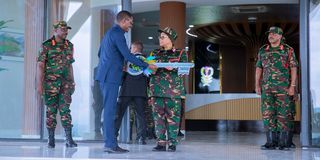
President Samia Suluhu Hassan fires a starting pistol to mark the inauguration of the new permanent headquarters for the Ministry of Defence and the National Service (JKT)in Dodoma on February 24, 2026. PHOTO | COURTESY
Dar es Salaam. The Chief of Defence Forces (CDF), General Jacob Mkunda, has said the construction of the new permanent headquarters for the Ministry of Defence and the National Service (JKT) in Dodoma will cost approximately Sh318 billion, fully funded by the Government of Tanzania.
Speaking on Tuesday, 24 February 2026, during the inauguration of the facility at Kikombo in Dodoma, General Mkunda said the building was officially launched by the Commander-in-Chief, President Samia Suluhu Hassan.
He said that all design and construction works were carried out by the Tanzania People’s Defence Forces (TPDF) in collaboration with the National Service.
According to General Mkunda, the main complex, which houses all ministry and military offices, has been built to high-quality standards and fitted with robust security infrastructure for soldiers and staff.
“This is the first permanent headquarters in the history of both the ministry and the army. Since 1964, the army headquarters — Ngome — and the National Service have operated from Upanga in Dar es Salaam. After the government relocated to Dodoma in 2019, we began with temporary offices at Msalato before starting construction of these permanent headquarters at Kikombo,” he said.
For the first time, he added, the Ministry of Defence, National Service, and the Army Headquarters will operate from one shared building, a move expected to simplify operations, strengthen coordination, and improve efficiency in national defence matters.
General Mkunda thanked the government for financing the project and acknowledged the Parliamentary Standing Committee for its guidance, which enabled timely completion. He also commended retired military chiefs for laying a strong foundation that helped shape construction standards and border security.
He further praised stakeholders involved in implementation, including army-affiliated companies such as Suma JKT and Ngome Company, for ensuring the project was completed on schedule and to the required standards.
A 48-year journey
The Permanent Secretary in the Ministry of Defence and National Service, Dr Faraji Mnyepe, outlined the 48-year journey towards constructing the defence headquarters, noting that the total cost of the three phases stands at Sh318 billion.
He said the first phase cost Sh121 billion, the second Sh107 billion, and the third Sh90 billion.
Dr Mnyepe explained that the idea of housing the Ministry of Defence, National Service, and Army Headquarters under one roof began decades ago but stalled due to economic challenges and war.
Initial plans in the 1970s aimed to improve coordination among the institutions. However, construction halted after the Kagera War with Uganda in 1978, which diverted resources and weakened the economy.
“After the war, the economic situation did not allow the project to continue as intended,” he said.
The project was revived in 2014 under former President Jakaya Kikwete, with plans to build the headquarters at Lugalo in Dar es Salaam. However, economic constraints again delayed progress.
Shift to Dodoma
Dr Mnyepe said a special committee formed in 2009 had recommended Mbezi Lugalo as a suitable site for the headquarters on strategic and security grounds.
A major shift occurred in 2015, after the fifth-phase government under President John Magufuli implemented the decision to relocate the government headquarters to Dodoma. Temporary offices were set up, including at Mtumba Government City, while planning began for the permanent complex.
On 25 November 2019, President Magufuli laid the foundation stone, directing the army to use its own personnel and resources to construct the building and house all key offices under one roof. Design works were managed by a special military committee, and construction followed a force account system, reducing reliance on external contractors.
Project phases
The first phase, completed at a cost of Sh121 billion, involved constructing the main headquarters, furnishing offices, building internal roads, and upgrading electricity and water systems.
The second phase, estimated at Sh107 billion, will include an administrative unit, foreign relations offices, and soldiers’ housing, and will commence once preparations are complete.
The third phase, costing Sh90 billion, will focus on residences for general officers, other officers, and public servants.
Dr Mnyepe said the completion of the permanent headquarters marks a significant step in improving operational efficiency, enhancing coordination, and strengthening national security by bringing all key defence institutions together within a modern, secure complex.