Tanzania, US in major rare minerals research programme
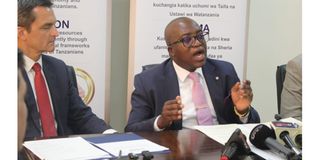
Minister for Minerals, Anthony Mavunde addresses a media conference in Dodoma. He is flanked by Acting US Ambassador to Tanzania, Andrew Lentz.
By Katare Mbashiru
Dodoma . The Tanzanian government, in partnership with the United States, has launched a comprehensive research programme on rare minerals, aiming to boost resource productivity, create jobs, and drive long-term economic growth.
Minister for Minerals, Anthony Mavunde, said the initiative is part of a national strategy to fully map and harness high-value minerals, which are critical for modern technology and global industries.
“These minerals are essential for producing electronics, renewable energy technologies, electric vehicles and other high-tech industries. Efficient extraction will directly benefit our nation and citizens,” Mr Mavunde said on Wednesday, 21 January 2026, in Dodoma.
Preliminary studies have confirmed the presence of rare minerals in Lindi and Mtwara regions.
The government plans to expand research to obtain detailed geological data, which will support sustainable mining, attract investment, and strengthen Tanzania’s position in the global supply chain for strategic minerals.
Tanzanians with mining licences will be prioritised under the programme, ensuring local participation throughout the mineral value chain and increasing revenue for domestic economic development.
“The research expansion is expected to increase production over the coming decades. By 2050, Tanzania could produce significant quantities of these minerals, generating higher government revenue to fund social services such as education, healthcare and infrastructure,” Mavunde said.
He also praised the US government, through its Department of Energy and Minerals, for technical support, including training local experts to build national capacity in the mining sector.
Tanzanians will benefit from a two-day training programme on geological data analysis and interpretation, which will enhance skills, create jobs and strengthen local involvement in mining activities.
US Ambassador to Tanzania, Andy Lentz, said his country will continue collaborating with Tanzania on development projects, emphasising that the rare minerals research partnership will be long-term and mutually beneficial.
"As the US continue to review the bilateral relationship between the two countries, we are looking for American companies and investors to come to Tanzania to create partnership with the government for the benefit of all our people," he said.
Data from the US Geological Survey show that Tanzania, South Africa and Nigeria hold Africa’s largest known rare earth reserves, positioning the continent at the forefront of a global race for these strategic resources.
Rare earth elements—a group of 17 metals including terbium and neodymium—are crucial for everyday technologies. They are used in smartphones, TV screens, high-strength magnets powering electric vehicles and wind turbines, and a range of military hardware, including guided missiles and fighter jets.
Currently, more than 60 percent of the world’s rare earths are mined in China, which also processes over 90 percent of global supply. In October 2025, Beijing announced export restrictions, later suspended following trade talks with the United States, highlighting the strategic importance of alternative sources like Tanzania.
Register to begin your journey to our premium contentSubscribe for full access to premium content