Why Nchimbi’s political journey may not be over


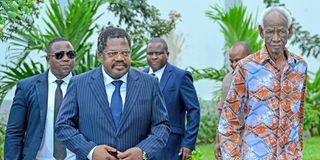
Dar es Salaam. The expulsion of Emmanuel Nchimbi from CCM may have ended his current institutional political role, but analysts say it does not necessarily signal the end of his long-term political career.

Dr Nchimbi, 54, said in his formal letter of resignation that he was retiring from politics and public service. However, CCM’s history shows that expulsion rarely functions as a permanent sentence.

The party has repeatedly demonstrated a structural capacity to forgive, rehabilitate, and reintegrate members who express contrition and meet the formal criteria for reinstatement. Former minister of Foreign Affairs, the late Bernard Membe, is one such example. CCM revoked his membership in 2020 before reinstating him in March 2022 after he sought forgiveness.

A similar precedent was established by Sophia Simba, former chairperson of CCM’s national women’s wing. Purged in March 2017 during a sweeping disciplinary campaign, she initiated a sustained campaign of apology directed at the late President John Magufuli.

When the National Executive Committee (NEC) convened on 21 November 2017, Magufuli personally highlighted her persistent remorse, prompting NEC members to grant her an unanimous pardon.

This institutional forgiveness extended even further in December 2018, when the party pardoned four prominent regional figures ousted during the same 2017 purge: Ramadhani Madabida of Dar es Salaam, Erasto Izengo Kwirasa of Shinyanga, Christopher Mwita Sanya of Mara, and Salum Kondo Madenge of Kinondoni.

CCM’s Constitution provides for such a process. Article 102(8) gives NEC the final authority to reinstate a person who has been suspended or expelled if it is satisfied that the individual has reformed.

Should Dr Nchimbi decide to chart a path back into the ruling elite, the procedural architecture remains intact, leaving his ultimate fate in the hands of the NEC.

A political analyst and University of Dar es Salaam lecturer Dr Onesmo Kyauke says Dr Nchimbi’s political career should not necessarily be regarded as over.

“He is still relatively young, politically speaking, and has been involved in politics for many years. The expulsion does not inherently signal the end of a career within CCM because he can still seek reinstatement,” he said.

Dr Kyauke said Dr Nchimbi could follow the path taken by Mr Membe and other former CCM members who were later reinstated, although any such return would ultimately depend on the party’s prerogatives.

Returning to CCM is not the only possible option for Dr Nchimbi as alternative avenues remain open.

Dr Kyauke said the former Vice President could operate outside traditional party structures, leveraging his influence to champion constitutional reforms, particularly in light of his previous public comments on the extensive concentration of presidential powers.

“Unburdened by party discipline, he could pivot toward high-profile civil advocacy,” he said.

Political analyst from the Open University of Tanzania Dr Revocatus Kabobe said the expulsion has altered the context in which Dr Nchimbi’s retirement should be viewed.

“My political reading is that Dr Emmanuel Nchimbi’s expulsion from CCM significantly changes how we should interpret his decision to retire from politics,” he said. Dr Kabobe said Dr Nchimbi could honour his decision and pursue professional, social, diplomatic or private activities outside active party politics.

However, he said the former Vice President could also reconsider his position in future, particularly after the expulsion ended his long association with CCM on disciplinary grounds.

Dr Kabobe said Dr Nchimbi could initially maintain a low profile before deciding whether to participate in political debates, serve as a mediator or statesman, or return to active politics.

University of Dar es Salaam political analyst Salbinus David said the expulsion could influence Dr Nchimbi’s future decisions.

“Being expelled from the ruling party could leave a negative mark on the former Vice President’s political record and could make it harder for him to simply walk away from politics without reconsidering his next move,” he said.

Political analyst Buberwa Kaiza, however, questioned whether Dr Nchimbi’s announcement should be interpreted as a permanent departure from politics.

“First, I do not believe that Nchimbi’s statement meant leaving politics forever. My view is that he was protecting his retirement benefits as Vice President, which are given on the condition that the beneficiary remains politically inactive,” he said.

Mr Kaiza also interpreted the expulsion as a possible indication of tensions within CCM.

“I see CCM expelling Nchimbi as a sign of a fire, or conflict, that has been burning within CCM. Otherwise, there would not have been such a rush to expel a member,” he said.

He ruled out an immediate move by Dr Nchimbi to an opposition party, saying the former Vice President could instead influence political debates from outside the party.

“No, I don’t see this happening. Rather, I see him largely organising opposition within CCM, even if he is no longer a member of the party, because he remains someone with a significant following and considerable influence among people within the party,” he said.

Lawyers divided over his status

Meanwhile, a sharp legal debate has erupted regarding the exact moment Dr Nchimbi ceased to hold constitutional authority as Vice President after CCM expelled him from the party on Wednesday only a day after the resignation letter emerged and President Hassan readily accepted his resignation.

The controversy pits the timing of his initial resignation letter, which designated an effective date of September 4, against the party’s abrupt decision to expel him on August 26. Head of the Advocacy Department at the Tanzania Human Rights Defenders Coalition (THRDC), Advocate Paul Kisabo, argues that Dr Nchimbi remains in office.

He says Article 47(4)(c) sets out the qualifications for becoming Vice President, including being a member of, and a candidate nominated by, a political party. Article 50, however, sets out circumstances under which the Vice Presidency ends, including resignation.

“The Constitution has not expressly stated that if the Vice President ceases to be a member of a political party, he also ceases to be Vice President,” he says.

Advocate Kisabo also cites Article 149(2), which provides for resignation through written notice and allows the person resigning to specify the date on which it takes effect. He says Dr Nchimbi’s notice clearly stated September 4 as the effective date, meaning the resignation had not taken effect when CCM expelled him.

“Therefore, in my view, he is still the Vice President under the Constitution because it has clearly provided that the office ends upon resignation, and Article 149(2) recognises the date specified in a written resignation,” he says.

Lawyer Peter Majanjara takes the opposite view. He argues that party membership under Article 47(4)(c) is a constitutional requirement for holding the office.

“If he has ceased to be a member of the political party through expulsion, then he no longer meets the constitutional qualifications to be Vice President, so his tenure ends there,” Mr Majanjara says.

He notes the resignation letter would no longer have effect and that Dr Nchimbi ceased to be Vice President on August 26 rather than September 4.  Legal and Human Rights Centre (LHRC) Executive Director Dr Anna Henga supports this interpretation.

She argues that Article 47 requires a Vice President to meet specific qualifications, including being a Tanzanian citizen by birth, being at least 40 years old, being a member of a political party and being nominated by that party.

“Because the party that nominated him has expelled him, he cannot continue to be Vice President,” Dr Henga explains.

The contrasting legal interpretations leave Dr Nchimbi’s constitutional status at the centre of a debate that could extend beyond his resignation.