Why no ‘naming and shaming’: Commission defends approach, urges prosecutions and new Constitution by 2028

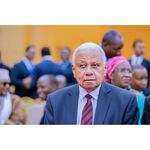
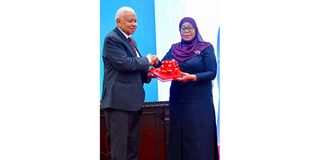
President Samia Suluhu Hassan receives the report of the Presidential Commission of Inquiry into incidents during and after the October 2025 General Election from its chairperson, Retired Chief Justice Mohamed Chande Othman, at State House in Dar es Salaam on April 23, 2026. PHOTO | STATE HOUSE
Dar es Salaam. Tanzania’s Commission of Inquiry into the October 29, 2025 post-election violence has defended its decision not to publicly name alleged perpetrators, instead urging the government to pursue targeted criminal investigations while fast-tracking national reconciliation and constitutional reforms ahead of the 2030 General Election.

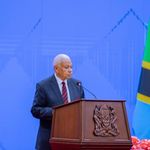
Presenting the final report at State House on April 23, 2026, Commission Chairperson Retired Chief Justice Mohamed Chande Othman said public expectations that the inquiry would “name and shame” those behind the violence were understandable, but legally and procedurally misplaced.

“There has been an expectation that this Commission would publicly identify those who planned and executed the violence, including those responsible for loss of life,” Justice Othman said.

 “However, this is a fact-finding commission. The mandate to investigate criminal liability and prosecute remains with the relevant authorities and has not been transferred to this Commission.”

He warned that publicly accusing individuals without due process would violate basic legal principles.

“You cannot accuse a person without giving them an opportunity to respond. Even where names came up during testimony, fairness demands that such individuals be accorded the right to be heard before any conclusions are drawn,” he said.

Justice Othman added that the complexity of the violence, which affected 202 locations across the country, made it difficult to apply a uniform standard in assigning responsibility.

“Each location had different dynamics. The use of force in one area cannot be measured in the same way as events in another. What happened in Kibamba, for example, cannot be equated with incidents in Tegeta A, Bunju or even Tarime,” he said.

Instead, the Commission has recommended that President Samia Suluhu Hassan direct a shift from general fact-finding to specific criminal investigations to allow the law to take its course.

“We recommend that the next phase should involve specialised investigations into particular incidents, including deaths under unclear circumstances, the alleged masterminds and cases involving missing bodies,” he said.

Reconciliation and national healing

Beyond accountability, the Commission placed strong emphasis on reconciliation, describing it as essential for national recovery.

“Reconciliation and national consensus are critical in healing the wounds left by these events,” Justice Othman said, noting that such efforts should be inclusive and sustained across different levels of society.

He linked the recommendation to ongoing national unity efforts under President Samia’s “4Rs” philosophy—reconciliation, resilience, reforms and rebuilding—saying the process did not begin with the violence but should now be deepened.

“This is a continuation of an existing national agenda. What is needed now is to broaden it and ensure it reaches all levels of society,” he said.

The Commission recommended structured dialogue involving religious leaders to strengthen social cohesion and define clear boundaries between religion and politics to avoid future tensions.

“There is a need for engagement with religious leaders to enhance mutual understanding and prevent conflict arising from overlapping roles,” he said.

Justice Othman added that reconciliation efforts should extend to local government levels using existing administrative systems, supported by a council of respected elders to guide the process and help resolve emerging disputes.

Short-, medium- and long-term measures

The Commission proposed a range of measures aimed at addressing the immediate and long-term consequences of the violence. These include ensuring that all injured victims receive free medical treatment, including access to assistive devices such as prosthetics where necessary.

It also recommended the establishment of a national day of mourning to honour the 518 people who lost their lives during the violence.

“There is a need to formally recognise the lives lost and provide a moment for national reflection,” Justice Othman said.

The report further calls for the development of a coordinated system to provide psychosocial support, including rapid assessments and long-term care for those affected by trauma.

“The psychological impact—stress, grief, fear and loss of trust—has been profound and requires structured intervention,” he said.

New Constitution by 2028

In one of its most far-reaching recommendations, the Commission urged the government to prioritise the enactment of a new Constitution by 2028 to guide upcoming elections.

“Our view is that a new Constitution should be in place by 2028 so that it can be used in the 2029 local government elections and the 2030 General Election,” Justice Othman said.

He noted that a significant portion of the population was excluded from the previous constitutional process.

“About 16 million Tanzanians did not participate in the 2014 constitutional process because they were under the age of 18 at the time. This underscores the need for a renewed and inclusive process,” he said.

The Commission recommended the formation of a new panel of constitutional experts to steer the process.

Justice Othman said the Commission also identified areas requiring institutional reform, including strengthening democratic practices within state institutions, addressing political grievances, and improving accountability in public service.

“There is a need to ensure that democratic principles are upheld consistently in the functioning of state institutions to reduce political tensions,” he said.

He also pointed to concerns over leadership ethics, including adherence to public service codes of conduct and lifestyle accountability.

“Leadership integrity, including observance of ethical standards and public service norms, must be strengthened,” he said.

The Commission further recommended improvements in employment systems, as well as security and law enforcement structures, as part of broader efforts to address underlying drivers of unrest.