Young DJ fights for survival after Tanga gang machete attack
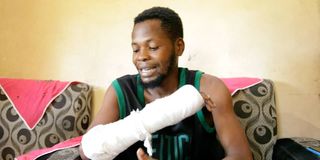
A resident of Makorora in Tanga City, Mr Yasin Omari, recounts how he was machete-attacked by suspected gang members and narrowly escaped death during an interview with The Citizen’s sister newspaper, Mwananchi, on Thursday, March 26, 2026. PHOTO | MBONEA HERMAN
Tanga. What began as an ordinary evening on March 13, 2026, turned into a horrific ordeal of bloodshed, pain, and a desperate fight for survival for Mr Yasin Omari, a resident of Tanga City.
Mr Omari’s life changed in an instant after he was viciously attacked by a group of youths believed to be members of the notorious gang locally known as Vishandu.
The incident, which occurred in the Gatundu area of Makorora Ward, paints a grim picture of growing insecurity in some urban neighbourhoods, where residents increasingly face the threat of violent attacks without apparent reason.
Speaking in a soft but pained voice, Mr Omari introduces himself as a young man striving to earn a living as a DJ and mobile phone technician in the Kiganyani area.
Like many youths, he depends on informal work to sustain himself, unaware that his routine movements would soon place him in mortal danger.
He explains that on the day of the incident, he left home as usual to meet friends, not knowing that the simple outing would mark the beginning of a life-altering and traumatic experience.
Upon arriving in Gatundu, he joined his friends in casual conversation, feeling relaxed and safe as is typical among young people gathering in familiar surroundings.
After a short while, he stepped away to buy food from a nearby stall, where he sat down and began eating, with no sign of the danger that was fast approaching.
“I had just eaten the first, second, and third parts of the portions when I suddenly saw four motorcycles approaching at high speed with their lights switched off,” cautiously recalls Mr Yasin, his voice reflecting the tension of that moment.
Although the sight raised suspicion, he did not immediately think he was the target.
When the motorcycles arrived, some boda boda riders fled, assuming it was a police operation. However, Mr Omari remained seated, believing he had no reason to run.
Moments later, he realised something was wrong. The riders were not police officers but masked young men, a discovery that filled him with fear.
Due to his physical disability and reliance on a prosthetic leg, Mr Omari says he could not run like the others, leaving him dangerously exposed.
“I wanted to run, but I couldn’t. I just stayed, hoping they wouldn’t harm me since I had no conflict with anyone,” he says.
What followed was swift and brutal. The attackers surrounded him without uttering a word and launched a violent assault using machetes.
He began receiving repeated blows, some blunt, others sharply aimed at vulnerable areas such as his neck and head, placing his life in immediate danger.
In a desperate attempt to defend himself, Mr Omari tried to stand firm despite difficulties with his prosthetic leg, which had not been properly secured.
“I tried to lock my artificial leg into position so I could stand properly, but out of fear, I didn’t fix it well,” he explains.
Despite his efforts, the attackers showed no mercy. Their intention, he says, was unmistakable: to kill him.
When he tried to ask why they were attacking him, the response he received only deepened his fear.
“One of them told me, ‘You will find out.’ That’s when I knew they didn’t want explanations; they wanted to finish me,” he recounts.
As the assault intensified, Mr Omari used his hands to shield his head from the machetes, sustaining severe injuries in the process.
One of the blows badly cut into his hand, leaving part of it nearly severed and hanging, increasing both his pain and the risk of fatal blood loss.
“I realised this could be the end of my life, but I decided to fight until the last moment,” he says firmly.
Despite his condition, he gathered the courage to resist, determined not to die without a struggle.
During the attack, he was forced backward toward the road while still being struck, hopping on one leg due to his disability.
Eventually, he tripped over a stone and fell, having already lost a significant amount of blood and strength.
Even then, the attackers were not satisfied. Mistaking his prosthetic limb for a real one, they continued hacking at it before finally fleeing the scene, leaving him severely injured and pleading for help.
Fortunately, a Good Samaritan returning home from work found him and rushed him to Makorora Health Centre for preliminary treatment.
Due to the severity of his injuries, he was later referred to Tanga Regional Referral Hospital (Bombo) for further care.
At Bombo Hospital, doctors provided treatment but determined that he required specialised orthopaedic and nerve care.
He was subsequently referred to the Muhimbili Orthopaedic Institute (MOI), a step that has proven financially overwhelming for his family.
Speaking with deep distress, his mother, Ms Rehema Charles, says they received news of the attack in the early hours of the morning, leaving the family shocked and terrified.
She explains that while they have done everything possible to support their son, the cost of advanced treatment is beyond their means.
“We have been advised to go to Muhimbili, but we simply cannot afford it. We are appealing to well-wishers to help our son get the treatment he needs,” she says emotionally, reflecting the reality faced by many families confronted with sudden medical emergencies.
Residents in the area have also voiced concern over the rising incidents of violent crime linked to youth gangs like Vishandu.
A resident, Mr Idd Bakari, says such attacks are becoming increasingly common and require urgent intervention from law enforcement authorities.
Meanwhile, Mtakuja Street Chairperson in Makorora Ward, Husein Ally, emphasises the importance of cooperation between residents and local leaders in identifying and reporting criminal elements.
He emphasised that without such collaboration, security agencies would struggle to tackle the growing threat to public safety effectively.
He further points out that Mr Omari’s case is particularly tragic, as the young man had already been coping with a disability following a previous accident, only to face another life-threatening ordeal that now demands urgent medical and social support.
Mr Omari’s story offers a stark insight into the realities of insecurity in some urban communities, especially for young people striving to live honest lives but finding themselves victims of senseless violence.
It also raises broader questions about public safety systems, access to healthcare for low-income families, and the critical role of community solidarity in responding to crises.