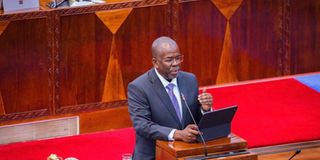
The Minister for Finance, Khamis Mussa Omar, read the Government Budget for the year 2026 2027 on June 11 to Parliament; in which he presented a Budget of Sh62.33 trillion, a 10.3 percent increase from last year’s, sourced to 74.2 percent from domestic revenues to emphasise the need for self-reliance.
The Budget targets a GDP growth rate of 6.3 percent, and is themed:
“Building a resilient economy through digital transformation, strategic investment, and sustainable fiscal policies for inclusive economic growth”, the 2026/2027 Budget being the first to be implemented under Tanzania’s National Development Vision, 2050.
Newspapers have a tradition of adorning each Budget with fancy names like: “Recovery Budget”, “Industrialisation Budget”, “Relief Budget”; and this year’s one was called “Unique Budget” by a Government Broadsheet; and “Self-Reliance Budget” by one Swahili Daily.
However, as an old timer, you cannot fail to see the difference between Budget Day of many years bygone, and today.
In those yonder days, people would cling to their radios, listening and looking fascinated at what they heard from the Minister of Finance.
A tradition had grown that in each Budget Speech there would be measures to put up prices. That was usually a foregone conclusion, the question being price rises by how much.
An increase in prices was usually expected on what, in some countries, are called “sin taxes”.
Higher taxes on: beer, spirits, and wines; cigarettes and tobacco; and gambling and casinos.
With “sin taxes” governments aimed not only to raise revenue, but also to discourage the consumption of such goods. Unique was the Minister of Finance who did not put up prices for these goods.
Nevertheless, there was general agreement in those days that increase in taxes would not reduce the demand for beer.
In a way, therefore, the government was assured of revenue from such sources, whose demand was inelastic
These days, the reaction from the public over the Budget is a bit more sophisticated, possibly as a result of increasing financial literacy.
This year for example, as soon as the minister finished reading his Budget Speech, the Parliament’s Budget Committee immediately raised alarm over the growing Public Debt.
Procedurally, the Committee must have seen the Budget proposals and must have had opportunities to guide how the Budget would be before the proposals were finalised.
Nevertheless, it is important to realise that public borrowing is regulated by law, is realised through the Ministry of Finance, and is undertaken within the limits of the Budget approved by Parliament. There is a Debt Management Division in the Ministry of Finance.
Further guidance is obtained from the Government Loans, Guarantees, and Grants Act, Cap 134 and its Regulations.
In accordance to section 25.1(a) of, Cap 134, the Government, through the Ministry of Finance, is required to prepare a Medium-Term Debt Management Strategy (MTDS) and an Annual Borrowing Plan (ABP) in line with the overall fiscal framework.
The ABP is a structural plan that guides the debt management, in operationalising the provisions described in the borrowing strategy selected in the MTDS.
The Government overarching debt management objective, articulated in Regulation 4 of the Cap 134, aims at “meeting Government financing needs while minimising borrowing costs”.
That primary goal is complemented by secondary objectives that is: Fostering the development of domestic financial markets; Ensuring the sustainability of the debt burden; Mitigating debt-related risks; and, Balancing the sharing of the benefits and costs of public debt between the current and future generations. Public Debt, therefore is well-regulated.
The fact that Public Debt also aims at fostering the development of domestic financial markets is usually not discussed. Yet, without public borrowing, many of the important investment opportunities which are touted by the current crop of financial literacy advisors, such as Government Bonds, would not exist.
Governments borrow principally by selling Government bonds and Treasury bills to domestic and foreign investors (lenders), who may be individuals, banks and other financial institutions, pension funds, or other investors.
Individuals and Corporate bodies buy government bonds directly or through mutual funds/ETF. Financial Institutions such as banks, pension funds, and insurance companies are also major buyers, seeking safe, fixed-income assets.
In brief, public borrowing fosters domestic financial markets primarily by establishing a risk-free benchmark yield curve.
This provides a reliable pricing reference that allows private corporations and financial institutions to issue their own debt, price complex financial products, and accurately manage liquidity.
Thus, while trends like migrating to commercial loans from concessional loans is worrisome, there is need to bear in mind the importance of public borrowing in fostering domestic financial markets.
A key point to emphasise, is that investing opportunities offered by public borrowing should be accessible to the ordinary citizen countrywide.
Lusugga Kironde is Professor of Land and Urban Economics and lead consultant at TKA Company Ltd.