Refineries, ports and the future of E African integration – 3
By Anna Tibaijuka
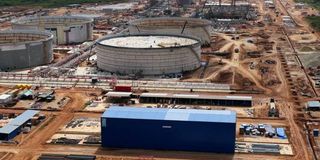
In the previous article, I argued that East Africa should compare ports not only as they exist today, but according to what they could realistically become by 2050. That leads to a practical question: what size of ships must a future refinery be able to handle?
This matters because refinery economics do not end at the refinery gate. Crude oil must arrive at competitive cost, and refined products must leave just as efficiently. For a large merchant refinery, shipping costs can materially affect the final cost of every barrel.
Larger vessels generally lower transport costs per unit because the cost of a voyage is spread over much more cargo. But they require deeper water, wider navigation channels, adequate turning space, suitable berths and efficient loading and storage facilities.
Port depth is therefore not merely an engineering statistic. It is part of industrial competitiveness.
Tanga’s unusual advantage
Tanga already has something unusual: EACOP brings Ugandan crude directly to the Tanzanian coast. A refinery there could therefore receive part of its feedstock by pipeline rather than by sea.
But if a future refinery became larger than the volume of Ugandan crude available to it, additional crude might have to be imported. Likewise, if Tanga became a major exporter of refined products or petrochemicals, efficient access to large ocean-going tankers would become increasingly important.
This is where Mwambani deserves renewed attention.
Mwambani, south of the existing Tanga port, has previously been considered for deeper port development. That proposal did not proceed, and Tanzania instead invested in improving the existing Tanga port.
The question today is not whether the old Mwambani proposal should simply be revived. It is whether the arrival of EACOP and the possibility of a much larger Tanga energy-industrial complex justify a fresh technical and economic appraisal.
The correct comparison is therefore not between today’s Tanga and today’s Lamu or Mombasa. It is between the credible full-development potential of each location.
What maritime capacity could the Tanga-Mwambani corridor economically support? Could it handle the large crude and product tankers required by a globally competitive refinery? What would dredging and maintenance cost? Would an offshore crude terminal be more economical than bringing the largest tankers directly into harbour? How much industrial land would remain available? And how would the total logistics cost compare with other East African alternatives?
Those are the questions that matter.
Dredging is not the objective
There is an important caution. Dredging is not a magic solution.
Navigation channels can silt up and require expensive maintenance. Seabed geology and coastal currents may impose limits. Marine ecosystems, fisheries and neighbouring communities must also be protected.
So the case for Mwambani cannot rest on the simple proposition that deeper water is automatically better.
The economic benefit of additional maritime capacity must exceed its financial, social and environmental cost.Nor is the objective to boast about which East African port can receive the biggest ship. The objective is lower sustainable logistics costs.
That requires thinking about East Africa’s ports as a specialised network rather than a contest with one winner. Mombasa will remain a major regional gateway. Lamu already offers important deep-water capacity. Dar es Salaam has its central-corridor role. Tanga may develop a specialised petroleum and industrial function. Mwambani could enhance that role if new studies show that the economics are sound.
Regional integration should make such specialisation easier, not harder.
Port capacity can change the refinery itself
The deeper strategic point is that maritime capacity can change the commercial character of a refinery.
If a Tanga refinery depends mainly upon Ugandan crude delivered through EACOP, it has one type of supply model.
If the same refinery can also import crude competitively from international markets and export large volumes of petroleum products, it has considerably greater flexibility.
Potentially, Tanga could combine a secure regional feedstock base with access to the global crude and product markets.
That possibility is economically much more important than the simple question of whether Tanga is deeper or shallower than another port today.
And it leads directly to the next issue in this series.
A refinery built mainly around an assured crude supply and defined market operates differently from one designed to buy crude competitively and sell across many markets.
Does East Africa need a captive refinery, a merchant refinery—or some combination of both?