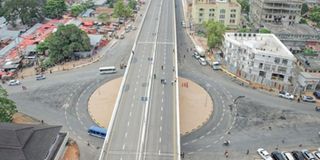
Recently, on Tuesday January 6, 2026, the Zanzibar President inaugurated the first flyover ever, in Zanzibar, and with this, it is hoped that the long-standing congestion and delays at the ever-busy Mwanakwerekwe junction, have found a solution.
A number of flyovers are already operation in the city of Dar es Salaam and several are in the pipeline; all aimed at addressing traffic congestion especially at major junctions.
Besides, some see flyovers as a sign of development, something to be proud of. A colleague and professor of Town Planning used to complain why a large city like Dar es Salaam, with over six million inhabitants, would not have a single flyover.
I am sure that he is happy, now that the City has several of these. The same sense of happiness is reported from Zanzibar.
Nairobi is now boasting of various flyovers, operational and under construction: Ngong Road-Naivasha Road flyover; the T-Mall flyover; Athi River flyover; Dagoreti corner flyover; and others.
On March 5 2025, in the Ugandan capital of Kampala, President Yoweri Kaguta Museveni officially commissioned Phase 1 of the Kampala Flyover Construction and Road Upgrading Project.
So, several African countries and city authorities are pinning their hope to solve traffic congestion, on constructing flyovers.
Many see these, moreover, as signs of development, as signs of delivering; of solving peoples’ problems in ways that are visible. Others see them as potential tourist attractions.
A flyover is defined as a bridge or elevated road built to allow vehicles to pass over other roads or intersections without stopping. In American English, a flyover is called an overpass.
There are various types of flyovers. These vary by design, purpose, and material, including straight, curved, T-junction, diamond, cloverleaf (loop), multi-level, and U-turn flyovers, used for grade separation over roads or railways.
Common forms are single-level (overpass/underpass) for basic crossings, multi-level/cloverleaf for complex interchanges; and in the form of materials used (steel or concrete).
Flyovers are constructed with the aim of reducing traffic congestion by separating conflicting traffic flows competing to use the road space; by increasing road capacity, and by shortening travel times at busy junctions.
There is, however some general agreement that flyovers are only a temporary solution to overall traffic congestion; many times, shifting congestion to other areas or downstream bottlenecks as increased road space encourages more private vehicle use overall, as well as convergence to where the flyover is.
While improving local flow, flyovers can fail to enhance overall network efficiency and sometimes worsen conditions by creating new queues at exit ramps and increasing dependency on private cars, highlighting the need for integrated transport solutions beyond just adding more road space.
Indeed, this could be the case in African cities where the road network is highly deficient, which makes drivers to converge where the good roads and flyovers are. We are beginning to experience queues running up the flyovers, in the city of Dar es Salaam, especially at peak hours.
Traffic often builds up on the smaller feeder roads leading to the main flyover junctions, which can cause tailbacks onto the main structure itself or bottleneck the entry or exit points. To some extent, this is because road traffic is growing faster than road capacity, meaning new infrastructure struggles to keep pace with the number of vehicles on the roads.
The Prime Minister is quoted as having noted recently, that car registration in the country was growing at a supersonic speed. All these cars end up on the road.
It has been noted that despite flyover projects, the overall road network still faces challenges.
There are few roads, and even these are many times of poor quality and are poorly networked and maintained. Thus, traffic problems are expected to continue in the absence of comprehensive traffic management solutions.
Flyovers come with a bag of disadvantages, including high construction costs, visual blight, significant noise and air pollution during construction and operation, limited accessibility for pedestrians/cyclists, and potentially creating neglected, unsightly spaces underneath them, which the homeless have found useful to use as shelter.
Stakeholder who favour private car ownership are all for more flyovers and highway expansion. However, there are those who argue that however much is spent on engineering solutions, traffic congestion will continue, as long as private cars are continually added on the roads. The increased capacity is always temporary.
Nevertheless, it should be noted that in many African cities, there is an overall deficiency of good quality and networked roads. Many times, drivers have no alternatives to converging on the good roads that there are.
Instead of more flyovers, the approach could be more ring roads, more feeder roads, constructed with more function and less political expediency in mind.
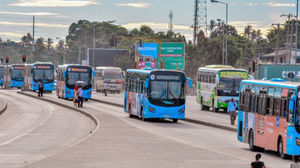
In the long-run, better public transport to encourage car owners to leave them at home, may be the solution.
Register to begin your journey to our premium contentSubscribe for full access to premium content