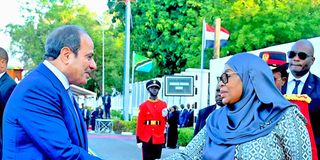
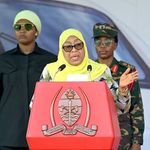
President Samia Suluhu Hassan bids farewell to Egyptian President Abdel Fattah El-Sisi at State House in Dar es Salaam on Saturday following the conclusion of his one-day state to Tanzania. PHOTO | STATE HOUSE
The recent visit to Tanzania (18 July) by Egyptian President, Abdel Fattah El-Sisi, presents us with an opportunity to ponder about the experiences which the two countries can share.
Egypt has an African history going back millennia and millennia. Many of us know about the pharaohs, the pyramids and the sphynx. We may recall learning about Egyptian irrigation based on the ‘shadoof’ technology. The shadoof is a hand-operated lever mechanism invented in ancient Egypt around 2000 BC. It features a long wooden pole balanced on a pivot, with a bucket suspended from the long end and a heavy counterweight on the short end, enabling farmers to easily lift water from the Nile River into elevated fields and canals. Thus, Egypt has long experience in crop irrigation.
The catchment basin of the river Nile, Egypt’s lifeline, includes Tanzania in the form of Lake Victoria (Lweeru) and the river Kagera.
Egypt has huge experience in building dams, what with the Aswan Dam, across the River Nile, and being one of the world’s largest embankment dams. Built between 1960 and 1970, the Dam was established mainly to control the Nile’s unpredictable seasonal floods, secure a steady water supply for year-round agricultural irrigation, and generate vital hydroelectric power for Egypt's industrialisation.
The dam flooded a large area (creating Lake Nasser), causing the relocation of over 100,000 people. Ninety thousand Egyptian fellahin (peasants) and Sudanese Nubian nomads had to be relocated. Fifty thousand Egyptians were transported to the Kawm Umbū valley, 50 km (30 miles) north of Aswān, to form a new agricultural zone called Nubaria, and most of the Sudanese were resettled around Khashm al-Qirbah, Sudan.
Many archaeological sites were submerged while others, including the 3000-years old temple complex of Abu Simbel were relocated, in a costly rescue mission dubbed “the international ‘Noah’s Ark’ of archaeological treasures”.
Currently, the Aswan is blamed for coastline erosion, soil salinity, and health problems. Nevertheless, it yields enormous benefits to the economy of Egypt. For the first time in history, the annual Nile flood is under human control. The dam impounds the floodwaters, releasing them when needed to maximise their utility on irrigated land, to water hundreds of thousands of new hectares, to improve navigation both above and below Aswān, and to generate enormous amounts of hydroelectric power (the dam’s 12 turbines can generate 10 billion kilowatt-hours annually). The dam’s reservoir also supports a fishing industry.
Clearly, Tanzania can benefit immensely from Egypt’s experience in building and managing dams. The company, Arab Contractors (Osman Ahmed Osman & Co.), in a joint venture with the Egyptian company Elsewedy Electric, were the primary engineering and construction contractors for the Julius Nyerere Hydropower Station. Arab Contractors were the main contractors in building the Aswan Dam.
Like Tanzania, Egypt is building a new capital city officially named The New Capital (formerly known as the New Administrative Capital or NAC). It is located in the desert about 45 kilometers east of Cairo, and serves as the country's new seat of government.
The idea of moving Tanzania’s capital occupied the minds of both the German and British colonial officials, with Morogoro, Kidete, Tabora and Dodoma coming under consideration. After Independence, Mr Joseph Nyerere, Mwalimu Nyerere’s brother tabled a private member’s motion in Parliament in 1966, proposing to move the country’s capital to Dodoma. A decision was finally taken at the level of the ruling party in 1973, to move the capital to Dodoma, over a period of 20 years.
By 1993, however, the construction of the capital city was virtually grounded; but was revived with new vigour in 2019, and today, the whole government is operating from the Government City of Mtumba in Dodoma, designed and constructed by local experts.
The project of building a New Administrative Capital (NAC) for Egypt started in 2015. It is a massive smart city spanning 700 square kilometers. It aims to relieve Cairo’s crippling congestion, housing shortages and pollution, by serving as the official seat of government, hosting state ministries, the parliament, and the presidential palace. The new metropolis is designed to eventually accommodate up to 8 million residents across 20 residential districts, spanning an area the size of Singapore.
Among the key developments in the NAC are: the Iconic Tower, which is currently the tallest building in Africa, anchoring the new Central Business District; the Octagon, a massive, hyper-secure headquarters for Egypt’s Ministry of Defense; the Green River, a sprawling central park stretching the length of the city, planned to be six times larger than New York’s Central Park; and mega places of worship, that is, one of the largest mosques in the world and the largest cathedral in the Middle East.
Both Egypt and Tanzania are shifting their capital cities. In that stable you find Malawi, Nigeria and Cote d’Ivoire. Tanzania and Egypt, certainly could learn a lot from each other.