Decent work: A structural requirement for Tanzania’s Development Vision 2050
Representatives from different companies during a tripartite workshop aimed at strengthening labour relations between TUICO and employers. The workshop was held recently in Dar es Salaam and was also attended by officials from the Prime Minister’s Office – Labour, Employment and Industrial Relations.
Each year, Labour Day offers an opportunity to recognise workers’ contributions, reflect on the conditions under which work is performed, and assess the direction of Tanzania’s labour market.
This year’s theme, “Decent Work is the Pillar for Sustainable Development in the Implementation of the Tanzania Development Vision 2050,” calls for a deeper consideration of the role of work in shaping the country’s economic future.
The signing ceremony of the Collective Bargaining Agreement between the Tanzania Union of Industrial and Commercial Workers (TUICO) and the Public Service Social Security Fund (PSSSF), which took place on 19 December 2025.
Decent work is often treated as a social objective, something to be pursued alongside development. In reality, it is a structural requirement for achieving it. As defined by the International Labour Organization (ILO), decent work rests on access to productive employment, rights at work, social protection, and social dialogue.
Where these elements are weak, productivity suffers, inequality deepens, and growth becomes uneven. Where they are strong, economies become more stable, inclusive, and resilient.
In Tanzania, these principles are embedded in the Employment and Labour Relations Act, which provides the legal foundation for freedom of association, collective bargaining, and minimum workplace standards. The strength of this framework lies not only in its provisions but in the extent to which these rights are exercised, protected, and enforced across workplaces.
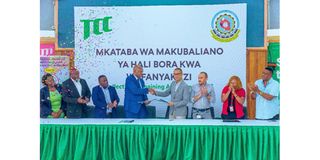
TUICO’s Industrial Sector Head, Innocent Alute (left), and the Chief Executive Officer of Tanzania Cigarette Company Limited (TCC Plc), Roy Manalili (right) swap documents after signing a Collective Bargaining Agreement in August 2025.
As Tanzania advances towards the ambitions outlined in the Tanzania Development Vision 2050, the centrality of labour becomes increasingly evident. Industrial growth, expanding investment, and deeper integration into regional and global markets are reshaping the world of work.
At the same time, employment relationships are becoming more fragmented. Outsourcing, subcontracting, and informal arrangements are altering traditional forms of work. While these trends may enhance flexibility and efficiency, they also risk weakening job security and reducing workers’ bargaining power.
TUICO Assistant Secretary Hassan Mtyota mobilises workers at Tanzania Tooku Garments Company Limited in Dar es Salaam.
Within this evolving context, internationally recognised labour standards remain critical. Fundamental principles, such as those enshrined in ILO Conventions No. 87 and No. 98, provide the institutional foundation for workers to organise and engage in collective bargaining.
These are practical mechanisms through which workers influence the terms and conditions of their employment and contribute to more balanced and stable labour relations.
The Tanzania Union of Industrial and Commercial Workers (TUICO) operates within and through this legal and institutional framework. Its work is not separate from national development; it is part of the mechanisms that make development inclusive and sustainable. Through organising, representation, and negotiation, the union helps shape the conditions under which work takes place across key sectors of the economy.
TUICO’s recent efforts have focused on expanding representation and deepening engagement at the workplace level. These efforts are reflected in rising membership, which grew to more than 140,000 nationwide by December 2025, up from 132,794 in January. Sustained membership growth and workplace outreach continue to extend representation across diverse sectors, including less-structured forms of employment.
Collective bargaining remains central to this process. The 59 collective bargaining agreements (CBAs) concluded over the past six months have improved wages and working conditions while strengthening predictability and stability in industrial relations.
At the same time, structured engagement through workers’ councils and dispute-resolution mechanisms has enabled 331 workplace grievances and disputes to be addressed constructively, with many resolved through dialogue before escalation.
Capacity building has been a consistent focus. TUICO has placed significant emphasis on training programmes and seminars to equip workers and their representatives with the knowledge required to engage effectively in negotiations and exercise their rights. Over the past six months, 1,200 training sessions have been conducted, strengthening the quality of representation and supporting more effective participation in economic processes.
These efforts take place within a labour market that continues to evolve. The expansion of non-standard employment, the persistence of informality, and the growing influence of global production systems require adaptive responses.
Representation must extend beyond traditional workplaces, while institutional systems are strengthened to support evidence-based decision-making, including through digital tools to improve efficiency and data accuracy.
Looking ahead, TUICO’s priorities are clear: broaden organising efforts into emerging and underserved sectors, strengthen evidence-based collective bargaining, and deepen engagement in social dialogue processes.
Members of the TUICO Negotiation Committee and the management of CRDB Bank pose for a group photo during a consultative meeting held on 19 January 2026 at the Parrot Hotel in Arusha.
Equally important is the continued strengthening of institutional systems, including data and information management, to ensure that interventions respond to real labour market conditions.
Achieving these outcomes requires coordinated action. The government must ensure consistent enforcement of the legal framework. Employers must align business practices with fair and sustainable employment conditions.
Workers must remain organised and actively engaged in exercising their rights.
Decent work is not separate from Tanzania’s development ambitions. It is one of the conditions that will determine whether those ambitions are inclusive, stable, and sustainable.