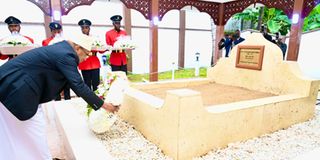
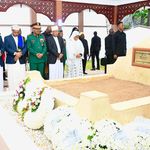
Zanzibar President Hussein Ali Mwinyi lays a wreath at the grave of the first president and Revolutionary Council chairman, Sheikh Abeid Amani Karume, after prayers at the CCM Kisiwandui sub-office to mark Karume Day in Unguja on Tuesday, April 7, 2025. PHOTO | STATE HOUSE
Unguja. Zanzibar President Hussein Ali Mwinyi has said there is every reason to continue remembering and honouring the late Abeid Amani Karume for his courage in successfully leading the Revolution that removed the darkness overshadowing the island.
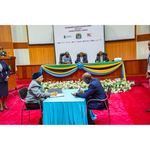
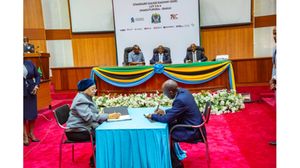
Dr Mwinyi made the remarks on Wednesday, April 8, 2026, in a speech delivered on his behalf by the Second Vice President, Hemed Suleiman Abdulla, during the eighth memorial conference for the late Karume at the Mwalimu Nyerere Memorial Academy (MNMA), Karume Campus, Zanzibar.
In honouring him through action, Dr Mwinyi said the Revolutionary Government of Zanzibar (RGZ) will continue strengthening quality social services for citizens, promoting investment, and expanding employment opportunities, in line with his determination to end oppression.
“When he carried out the Revolution, he said it had brought freedom and removed Africans from the humiliation of colonial rule,” said Mr Abdulla on behalf of Dr Mwinyi.
He said these words reflect Karume’s genuine commitment to citizens’ liberation, restoring dignity, prosperity, and fostering unity.
He said the conference, which brings together different groups to reflect on his ideas and vision, should ensure they are sustained and promoted so they continue shaping society and boosting productivity, while participants become effective ambassadors in advancing Mzee Karume’s ideas and philosophy through practical actions in communities and workplaces.
Speaking on the theme, “The Vision of Sheikh Abeid Amani Karume in Promoting Nationalism and a Sustainable Economy,” he said it should be carefully reflected upon and practically applied to accelerate Zanzibar’s economic development while maintaining peace and social cohesion.
He said Mzee Karume never wished anyone to be oppressed because of social status or religion.
“We believe we have learned a culture of serving one another, loving one another, and living equally, and leaders must continue properly supervising their responsibility to deliver development in cooperation with citizens,” he said.
“It is important to remember that Karume was a community-oriented leader who consistently emphasised national unity, and that is why today we are proud of Tanzania, which resulted from the founders uniting our countries on April 26, 1964,” added Mr Abdulla.
He said it is a duty to sustain the historic Revolution and Union for present and future generations.
MNMA board chairperson, Stephen Wasira, said the main objective of the Revolution was to promote economic development and establish the rule of law.
“The Revolution introduced changes that guaranteed equal rights, allocated land equally, ensured economic justice and fairness before the law. Therefore, when we remember him, we recall achievements that fostered unity in Zanzibar, and today there is no discrimination,” he said.
He said about 60 percent of graduates from the institution are women, yet previously women were denied opportunities; therefore, when we say the Revolution moves forward forever, that is what it means, if abandoned, it becomes a backward Revolution,” insisted Mr Wasira.
Mr Wasira, who is also the CCM Vice Chairperson for Mainland Tanzania, said the institution decided to hold the conference annually to educate young people on the significant work carried out by the founders of the two nations.
“If we do not explain, young people may assume conditions have always been as they are now, yet there were individuals who struggled to secure those rights. They must understand that during the colonial era in Zanzibar, there were no rights, and services were delivered with widespread discrimination,” he said.
According to Mr Wasira, in Zanzibar, justice was difficult to obtain and granted based on race, tribe, or origin: “If your background did not please the ruler, you could not obtain justice; if it pleased him, you would receive it.”
For his part, MNMA Rector, Prof Haruna Mapesa, said the institution provides training in social sciences, leadership, ethics, and good governance, as well as research and consultancy services to public and private institutions, honouring the founders of the Revolution and Independence.
He said the institution continues to serve as a centre for knowledge dissemination, problem-solving, and national unity: “An institution that has continued to serve as a hub of knowledge, preparing leaders in various fields.”
He added that the institution has established a tradition of holding conferences for leaders and founders of the two nations to revisit their ideas and philosophy and examine how they can contribute to development and economic growth.
“On April 5, 2018, the first conference was held, and today’s event is the eighth, guided by the theme: the Vision of Sheikh Abeid Amani Karume in Promoting Nationalism and a Sustainable Economy,” he said.
During the conference, two papers were presented: the contribution of patriotism in strengthening national unity and the role of science and technology education in the growth of the blue economy.