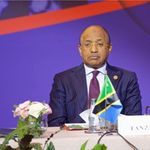
Zanzibar President, Dr Hussein Ali Mwinyi (right), receives the 2025 General Election report from the Zanzibar Electoral Commission (ZEC) Chairman, Judge George Joseph Kazi (left), at State House, Zanzibar on September 8, 2026. PHOTO | JESSE MIKOFU
Unguja. Zanzibar’s President, Dr Hussein Ali Mwinyi, has received the report on the 2025 Zanzibar General Election during the handover, which took place at State House, Zanzibar.
The Zanzibar Electoral Commission (ZEC) Chairman, Judge George Joseph Kazi, handed over the report on Tuesday, September 8, 2026.
Receiving the report, President Mwinyi commended ZEC for supervising a peaceful and calm election, urging the commission to work with the government to address challenges identified so they do not recur in future elections.
“That election was conducted in an atmosphere of peace and calm, which gave citizens the opportunity to exercise their democratic right, a situation that has brought great pride and success to Zanzibar,” said Dr Mwinyi.
He praised ZEC for several key achievements, including an increase in registered voters and the Revolutionary Government of Zanzibar funding the General Election by 100 percent for the first time, allocating Sh12 billion for the exercise.
He also expressed satisfaction with improvements to ZEC’s working environment, including the construction of a new modern headquarters and the strengthening of electoral infrastructure.
Dr Mwinyi thanked ZEC executives for their work and urged them to maintain high standards of integrity, promising continued government support to improve conditions ahead of upcoming elections.
ZEC Chairman Judge Kazi said the report was prepared in accordance with legal requirements to provide a comprehensive overview of the 2025 electoral process.
He noted that under Section 27(1) of the Election Commission Office Establishment Act No. 1 of 2017, the commission is required to submit an election report to the President within 12 months.
“This report contains eight chapters covering the introduction, election preparations, administration, voting, post-election events, revenue and expenditure, evaluation, achievements, challenges, and recommendations,” said Judge Kazi.
Highlighting major successes, he noted that the election was fully self-funded by the Revolutionary Government of Zanzibar, held in a peaceful atmosphere, and produced results that were announced on time.
He added that the number of registered voters on the Permanent Voters' Register rose from 566,352 in 2020 to 717,557 in 2025, representing a 26.7 percent increase.
Other milestones included the continued use of Tactile Ballot Folders enabling visually impaired voters to cast ballots independently, and the provision of official transport to all presidential candidates during campaigns for the first time.
However, the commission outlined several operational challenges, including legal ambiguity regarding proportional representation for special women's seats in local government authorities when allocations are not evenly divisible.
Other difficulties included failures in the mobile payment system that delayed allowances for some election clerks, political parties failing to cascade ZEC voter education to their agents, a lack of first aid services at polling stations, non-compliance by some candidates and agents, and network communication disruptions.
In the election held on October 29, 2025, Dr Mwinyi won re-election with 448,892 votes (74 percent), defeating his main challenger, Othman Masoud of ACT-Wazalendo, who secured 139,399 votes in the election contested by 17 political parties.