Zanzibar farmers decry power, poor roads and weak markets
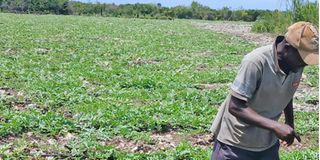
A watermelon farmer, Mr Misalaba Lindi, points to something in his field in Bwejuu village, Unguja South, during the Agriculture Minister’s visit. PHOTO | JESSE MIKOFU
Unguja. Farmers in Unguja South have asked the government to address unreliable electricity, poor roads, counterfeit farm inputs and weak markets that they say are undermining agricultural production.
The farmers, mainly producing vegetables and fruits, raised the concerns yesterday during a visit by Zanzibar Minister for Agriculture, Irrigation, Natural Resources and Livestock, Mr Suleiman Masoud Makame, to Bwejuu, Paje and Mtule villages.
A farmer and secretary of the local farmers’ association, Mr Hamdani Makame Kidoza, said low electricity voltage was making it difficult to operate irrigation pumps.
“The long distance, with as many as 56 poles from the transformer, causes the electricity voltage to drop, making it difficult to provide enough water to crops such as tomatoes,” he said.
He also complained about poor-quality inputs and pesticides suspected to be counterfeit, saying some failed to control pests and instead worsened the problem.
Farmers further cited inadequate agricultural extension services, saying the absence of experts in farming areas denied them access to professional advice.
Markets were another major concern, with farmers facing competition from produce supplied from mainland Tanzania and Kenya.
Mr Kidoza said tomato prices could fall to Sh25,000 per crate when supplies from outside Zanzibar increase.
“These are the issues holding us back as farmers. We are struggling, but we are facing major obstacles such as these,” he said.
Mr Kassim Ramadhan, a Bwejuu farmer, and Ms Khadija Kassim, secretary of the Kibojo farmers’ group, said poor roads were causing post-harvest losses.
They said farmers had to transport produce over poor roads to reach the main highway, exposing it to damage before reaching markets.
“By the time we take tomatoes from here to the market, they are already damaged because of the heavy shaking caused by the lack of roads,” Ms Khadija said.
The Director General of the Zanzibar Agricultural and Livestock Research Institute (ZALIRI), Dr Abdalla Ibrahim Ali Kidodi, cautioned farmers against indiscriminate pesticide use.
He said healthy crops could withstand some pests and diseases without excessive reliance on chemicals.
Dr Kidodi said ZALIRI, in collaboration with the Tanzania Agricultural Research Institute (TARI), was finalising trials of two improved tomato varieties, TARI 1 and TARI 2.
The varieties are expected to reduce farmers’ dependence on expensive hybrid seeds.
“Currently, our experts are in the laboratory developing plant nutrients suited to Zanzibar’s environment to increase productivity,” he said.
Mr Makame acknowledged a gap between the ministry and rural farmers, promising more frequent visits to address their concerns.
He said the government would conduct a comprehensive assessment of agricultural production to help reduce Zanzibar’s dependence on imported fruits and vegetables.
During the visit, the minister advised farmers to increase nitrogen application to crops such as butternut squash to improve yields.
On electricity, Mr Makame said the ministry would engage the authorities responsible for power supply, but advised farmers to consider solar energy because of current pressure on Zanzibar’s electricity supply.
“We will meet our colleagues (in the electricity sector), but we all know that there is currently pressure on the power supply. So, while that process continues, we advise farmers to use solar,” he said.
He also promised to link the farmers with the Tanzania Agricultural Development Bank (TADB) to access financing.
Mr Makame said the ministry would unveil a comprehensive food security plan, including measures to address farmers’ concerns over markets and capital, after completing the assessment.
“These government measures are aimed at ensuring that agriculture becomes a genuine means of improving the livelihoods of the people of Zanzibar,” he said.