How Gulf conflict has opened fresh economic opportunities for Tanzania

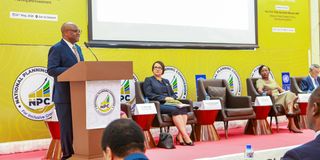
Minister of State in the President’s Office [Planning and Investment], Prof Kitila Mkumbo. PHOTO | COURTESY

Dar es Salaam. The escalating tensions around the Strait of Hormuz have disrupted global energy flows and trade routes, but private sector stakeholders and policymakers say the shock is also accelerating structural shifts that could redirect investment towards emerging markets such as Tanzania.

The disruption, affecting a key maritime corridor handling nearly a fifth of global crude oil shipments, has triggered rising oil, fertiliser and freight costs.
However, stakeholders argue it is also reshaping capital allocation patterns towards alternative energy sources, regional industrialisation and digital infrastructure.

The minister of State in the President’s Office [Planning and Investment], Prof Kitila Mkumbo, said geopolitical uncertainty in traditional energy-producing regions was already influencing global investment decisions.

 “The uncertainty is encouraging global investors to diversify their energy portfolios and explore alternative investment destinations. Africa, with its significant untapped oil and gas potential, stands to benefit from this shift,” he said on May 22, 2026.

He was speaking here in the city during a consultative meeting convened by the National Planning Commission to assess the potential economic impact of the Gulf crisis on Tanzania.

Prof Mkumbo said offshore exploration activities across Africa were gaining pace, supported by what industry data points to as a growing number of high-impact discoveries in key sedimentary basins.

“Promising geological prospects and expanding offshore exploration activities are already attracting renewed investor interest,” he said.

He said a second opportunity lay in addressing Africa’s long-standing refining deficit, as volatility in global energy markets forces governments to reconsider domestic and regional refining strategies.

A third channel, he added, is deeper trade integration under the African Continental Free Trade Area (AfCFTA), which he described as increasingly urgent in reducing exposure to external shocks.

“Stronger regional value chains and greater intra-African trade can help reduce external vulnerabilities and improve economic resilience,” he said.

The insurance sector is also expected to benefit from the shifting risk landscape, with rising demand for trade cover, risk protection and investment security.

Tanzania Insurance Regulatory Authority (Tira) Commissioner, Dr Baghayo Saqware said geopolitical tensions had reinforced the importance of insurance in sustaining economic activity during periods of disruption.

“For example, when ships are stranded or trade routes are disrupted, insurance becomes essential.

What we are learning is that sectors of the economy are highly interconnected, meaning insurance companies now need to expand their capital base so they can benefit from these opportunities while also supporting the growth of both the national and global economy,” he said.

He added that modern economies could not function without effective insurance systems, as investors require confidence that risks are adequately managed.

“No one can invest confidently without insurance coverage. Insurance gives confidence to investors and businesses, which is why companies in the sector should continue emphasising the importance of insurance in supporting economic growth and stability,” he said.

Vice-chairman of the Association of Tanzania Insurers, Mr Jared Awando, said the sector was poised for continued expansion as businesses seek protection against geopolitical, climate and supply chain risks.

“The insurance sector will continue to grow because it exists to manage disasters and uncertainties. More people and businesses are now understanding the importance of insurance,” he said.

However, the Bank of Tanzania (BoT) cautioned that the immediate macroeconomic impact of the crisis remains uneven, with pressure already visible in fuel-intensive sectors.

In its April 2026 Monthly Economic Report, the BoT said industries with high fuel dependence and limited pricing flexibility, such as logistics and support services, were facing sustained margin pressures.

It also warned that agricultural lending could tighten, potentially affecting input supply chains and amplifying food inflation pressures.

At the same time, the central bank noted that some sectors are likely to benefit from shifting consumption and investment patterns.

“The ICT sector stands to gain as households and firms substitute toward digital commerce, payments and communication when physical transaction costs rise,” the BoT said. Finance and insurance sectors are also expected to expand due to rising demand for hedging instruments.

But industry analysts caution that these gains are not automatic.

Managing partner at Warioba Ventures, Mr Martin Warioba, said digital sector expansion depends heavily on policy direction and broader economic conditions.

 “When liquidity tightens and the velocity of money slows, overall economic activity contracts, including digital consumption in some segments,” he said.

He said sustained growth in ICT would require deliberate policy support, particularly in import substitution, digital infrastructure development and local production capacity.

If properly implemented, he added, digital systems could become central to economic restructuring by improving supply chain coordination and formalising informal trade.

“If import substitution policies are accelerated, digital systems become critical enablers—from supply chain coordination to e-commerce platforms,” he said.

Beyond economic structures, the crisis is also reshaping the information environment influencing markets and behaviour.

Sahara Ventures chief executive officer Mr Jumanne Mtambalike said economies were increasingly exposed to what he termed “information volatility”.

“The crisis underscores how deeply global and domestic economies are now exposed to the information layer of technology,” he said.

He noted that social media platforms were now capable of rapidly transmitting market signals—and misinformation—with immediate economic consequences.

“Statements by political leaders or influential actors on platforms like X can trigger reactions across financial markets and consumer behaviour,” he said.

He warned that artificial intelligence was intensifying both efficiency gains and systemic risks, particularly through the spread of synthetic content and misinformation.

“As global AI infrastructure becomes concentrated, access to tools, data ecosystems and procurement channels becomes increasingly centralised,” he said, adding that this could create strategic vulnerabilities for developing economies.

Without stronger policy frameworks, he warned, local technology firms risk being marginalised in enterprise-level digital markets.