Sefue explains how tax reforms will encourage business growth
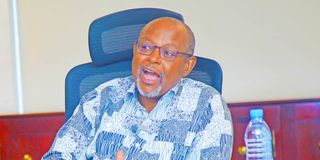
Retired Chief Secretary, Ambr Ombeni Sefue, speaks during an interview with journalists from Mwananchi Communications Ltd in Dar es Salaam recently. PHOTO | MICHAEL MATEMANGA
Dar es Salaam. Former Chief Secretary, Amb Ombeni Sefue has welcomed the government's decision to grant newly registered businesses a one-year tax grace period, saying it implements one of the key recommendations made by the Presidential Commission on the Review of Tax System Reforms, which he chaired.
In March 2026, the commission submitted 284 recommendations aimed at addressing structural weaknesses in the country's tax system, including legislative gaps, administrative inefficiencies, taxpayer services and the use of information and communication technology.
The commission found that Tanzania's tax system was characterised by frequent policy changes, overlapping mandates among revenue collection agencies and a narrow tax base.
As a result, a relatively small number of formal sector taxpayers shoulder a disproportionate share of the tax burden, while much of the informal sector remains outside the tax net.
Speaking to journalists from Mwananchi Communications Limited (MCL), Amb Sefue said the one-year tax grace period would ease the burden on start-ups and encourage more entrepreneurs to formalise their businesses.
He said the previous system discouraged business registration because entrepreneurs became liable for tax before establishing viable operations.
Under the previous arrangement, he said, registering a business with the Business Registrations and Licensing Agency (Brela) automatically alerted the Tanzania Revenue Authority (TRA) through integrated digital systems.
In some cases, TRA officials approached newly registered businesses with tax assessments before they had generated any income.
"This 'shock' was scaring people away from formalising. The government has now listened to our recommendation to provide a one-year grace period. It shows an understanding that businesses need time to grow before they can be taxed," said Ambassador Sefue.
Expand the economy
He said the reform forms part of a broader strategy to expand the formal economy by encouraging more businesses to register.
Amb Sefue noted that many Tanzanians own valuable assets, including land and buildings, but these remain "dead capital" because they lack legal recognition.
He likened formalisation to obtaining a passport.
"Everyone in the village may know who you are, but if you want to travel internationally, authorities will not simply take your word for it. You need a passport," he said.
"Formalisation is the passport for your property. If you own a house but do not have a title deed, you cannot use it as collateral to obtain a bank loan to start or expand a business."
He added that even personal relationships with bank managers cannot replace legally recognised assets required to secure financing.
Without greater formalisation, he warned, Tanzania would struggle to produce the next generation of large indigenous businesses comparable to the Bakhresa Group.
Financial literacy
Ambassador Sefue said formalisation alone would not guarantee business success without improved financial literacy.
He cited the mining sector in Geita, where some young people had accumulated significant wealth but lacked the knowledge to manage and invest it effectively.
"I have met young people in Geita who became billionaires through mining, but instead of treating that money as capital for investment, some spend it on luxury vehicles or other consumption," he said.
He said achieving Tanzania's ambition of becoming a $1 trillion economy by 2050 would require citizens to understand investment, risk management and wealth creation.
Private sector and Vision 2050
Amb Sefue said Vision 2050 places the private sector at the centre of economic development, with around 70 percent of growth expected to be driven by businesses.
He said Tanzania must move away from an approach in which the government attempts to manage every aspect of the economy and instead strengthen partnerships with domestic and foreign investors.
Addressing concerns about international investment agreements, he said Tanzania's cautious approach had enabled it to learn from the experiences of other resource-rich countries.
He said his studies at Cambridge University on how emerging oil and gas producers manage natural resources had helped build expertise in negotiating agreements that safeguard national interests.
Lessons from TBL privatisation
Reflecting on Tanzania's economic reforms, Ambassador Sefue recalled the privatisation of Tanzania Breweries Limited (TBL) during the administration of former President Ali Hassan Mwinyi.
He said the 1995 decision faced strong opposition from trade unions and critics, who accused the government of selling national assets to foreign investors.
The criticism intensified during May Day celebrations in Mbeya, where union leaders publicly criticised the decision.
"I was at State House listening to the radio when speakers in Mbeya criticised the President, calling him a villain who was destroying the country," he recalled.
According to Amb Sefue, President Mwinyi later asked him whether the criticism reflected public opinion. Despite the opposition, he said the privatisation was necessary because TBL had expanded beyond its core business.
He said investors found the company operating health services, transport fleets, workshops and sports teams instead of focusing on brewing.
According to Amb Sefue, the investors told him they specialised in producing beer, not running hospitals, transport services or real estate.
He said TBL's subsequent turnaround demonstrated the importance of concentrating on core business activities.
By outsourcing non-core services and investing in production, the company improved efficiency, enhanced product quality and completed projects such as its Mwanza brewery.
Amb Sefue said the lessons from TBL's transformation and the new tax reform underscore the importance of creating an environment in which businesses can grow before they are expected to contribute fully through taxation.
He said the one-year tax grace period and greater emphasis on formalisation represent important steps towards building sustainable enterprises capable of supporting Tanzania's long-term economic vision.
Register to begin your journey to our premium contentSubscribe for full access to premium content