Sefue recounts the pressures of serving four heads of state
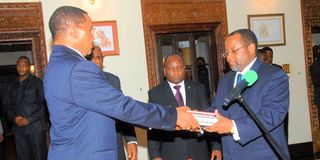
President Jakaya Kikwete hands over working tools to the newly sworn-in Chief Secretary, Ambassador Ombeni Sefue following his swearing-in ceremony at the State House in Dar es Salaam on December 31, 2011. PHOTO | FILE
Dar es Salaam. For 17 years, Mr Ombeni Sefue worked at the centre of the presidency, first as a presidential aide and later as Chief Secretary.
While many associate state house with prestige and influence, he says the reality was defined by immense responsibility, relentless pressure and little room for errors.
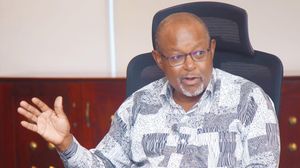
In an interview with Mwananchi Communications Limited (MCL) journalists, the veteran diplomat reflected on a career that spanned four administrations, those of Presidents Ali Hassan Mwinyi, Benjamin Mkapa, Jakaya Kikwete and John Magufuli.
He described speech writing and serving as Chief Secretary as among the most demanding assignments in public service, requiring discipline, constant preparation and a willingness to put national interests above personal comfort.
Mr Sefue said his journey into the presidency began unexpectedly when he was recalled from Tanzania's embassy in Stockholm to serve as an aide to President Mwinyi.
"Every day you went to work carrying that responsibility. If you disappointed anyone else, you could be transferred, but if the President lost confidence in you, where would you go? That would be the end of your career," he said.
One of his earliest challenges was writing speeches for President Mwinyi, whose command of Kiswahili was widely admired. Having spent years in the foreign service, where most of the communications were carried out in English, Mr Sefue initially struggled.
"My earlier drafts were coming back covered in red ink," he recalled. President Mwinyi's advice transformed his approach.
"You are thinking in English and translating into Kiswahili. If I am speaking Kiswahili, think in Kiswahili and write in Kiswahili. If I am speaking English, think in English and write in English."
Mr Sefue said the lesson extended beyond language to understanding how leaders communicate with citizens.
One of the defining moments of his time at state house came during the economic reforms of the early 1990s, when the government privatised the Tanzania Breweries Limited (TBL).
The decision attracted fierce criticism from trade unions and opposition politicians, who accused the government of selling national assets to foreign investors.
The backlash culminated during the 1995 May Day celebrations in Mbeya, where union leaders refused to invite President Mwinyi to address the event.
Mr Sefue said he was listening to the live radio broadcast from his office when President Mwinyi walked in.
"'Ambassador, have you heard what they are saying in Mbeya? Am I really like that?' he asked."
The exchange, he said, revealed the personal burden carried by leaders. "They often face criticism while implementing policies they believe will benefit the country in the long term." As it turned out, TBL performance improved after concentrating on its core business, reinforcing President Mwinyi's belief that the reforms, though politically costly, were necessary.
Serving President Mkapa presented a different challenge.
Mr Sefue described the late President as intellectually rigorous, expecting advisers to be thoroughly informed before presenting any briefing or draft speech.
"If you were preparing a draft for him, you had to know more than he did. Otherwise, what value were you adding?" he said.
That expectation demanded constant reading and research.
While colleagues sometimes spent free time shopping during overseas visits, Mr Sefue said he searched bookshops for publications that could help both him and the President stay informed.
He also developed the habit of independently verifying information submitted by ministries.
"If a ministry provided inaccurate statistics and the President repeated them, he would not ask the ministry where they came from. He would ask me," he said.
Among the most demanding periods of his career came when President Mkapa underwent medical treatment in Zurich.
Although in severe pain, the President insisted on delivering his monthly address to the nation.
"'If I don't speak, people will think I am close to death,' he said."
With most members of the presidential delegation having returned home to reduce costs, Mr Sefue was left handling administrative duties while also preparing the President's speech.
He spent his days supporting the President's medical schedule before working late into the night writing the address.
"It taught me that public service often requires putting national duties ahead of personal comfort," he said.
When President Kikwete appointed him Chief Secretary, the responsibility shifted from speech writing to coordinating the government.His predecessor, Philemon Luhanjo, offered a simple warning: "This chair is hot."
Mr Sefue said one of the biggest tests came during political tensions following the discovery of natural gas in Mtwara. "There was widespread misinformation, and many people believed their resources were being taken elsewhere while they were left behind," he said.
The government had to address public concerns while developing local content policies to ensure Tanzanians benefited from the country's natural resources.
To better understand the sector, Mr Sefue attended a two-week programme at the University of Cambridge for emerging oil and gas producers.
The knowledge, he said, proved valuable as Tanzania developed policies for major energy projects, including the proposed $44 billion liquefied natural gas (LNG) project.
Magufuli
I also briefly served under President John Magufuli as the Chief Secretary for a period of approximately four or five months.
My tenure with him was the culmination of a transition period. I had reached retirement age during President Kikwete’s final years, but he requested me to I remain in office to ensure smooth transition with the incoming administration.
My primary duty, when President Magufuli came into office, was to act as an enabler, ensuring that he effectively fulfille the mandates for which he was elected by the citizens. When I eventually handed over the mantle to my successor, John Kijazi, I briefed him on the inherent difficulties of the role.
I noted, however, that Kijazi possessed a distinct advantage because he had previously served as Magufuli’s Permanent Secretary at the ministry of Works, meaning they already shared a deep professional familiarity and a strong mutual understanding.
Throughout my brief but intense service with President Magufuli, my focus remained steadfast on delivering results to the high standard expected of the office.
After retiring as Chief Secretary, President Hassan appointed him to the Criminal Justice Commission and another commission established to investigate incidents related to the 2025 General Election.
He described the assignments as among the most emotionally demanding of his career because they involved listening to people who had lost relatives or believed they had suffered injustice.
"It is not something you want to wake up to every day, listening to stories of people who have died or been hurt," he said.
The Criminal Justice Commission also exposed him to conditions within Tanzania's prisons.
During one visit, he met a young inmate who admitted committing offences but pleaded for compassion. "'I am a criminal, but I am also the President's child. Tell her that,' he said."
The encounter strengthened the commission's recommendation that prisons place greater emphasis on rehabilitation through counselling, psychological support and vocational training in collaboration with the Vocational Education and Training Authority (VETA).
Mr Sefue believes such programmes would improve former inmates' chances of rebuilding their lives after release.
Reflecting on his career, he credited his parents with instilling the discipline and values that guided his public service.
He also urged young Tanzanians, particularly Generation Z, to avoid seeking instant success and instead build careers patiently.
Leadership, he said, is earned through competence and integrity rather than titles.
He encouraged young people to broaden their skills to compete internationally by mastering additional languages such as French, Spanish and Chinese, while also preserving high standards of Kiswahili.
"Speaking someone's language opens doors that a translator cannot," he said.
Looking back, Mr Sefue said public service was never about status or recognition.
Register to begin your journey to our premium contentSubscribe for full access to premium content