Sh700bn niobium deal puts Tanzania in US supply chain
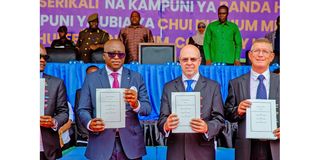
The minister for Minerals Anthony Mavunde (left), Panda Hill Shareholders’ Representative Pierre Joubert (centre) and Panda Hill Tanzania Limited General Manager Dennis Cook, pose with signed Panda Hill Niobium project agreements after the signing ceremony in Mbeya. PHOTO | COURTESY
Mbeya. Tanzania has signed a $300 million (about Sh700 billion) agreement with Panda Hill Tanzania Limited, placing Mbeya at the centre of a new trade and industrialisation strategy aimed at positioning the country as a supplier of processed strategic metals to global markets, including the United States.
Officials say the project marks a shift from exporting raw minerals to producing value-added materials used in advanced manufacturing, a move viewed as important to Tanzania’s long-term economic transformation and export growth.
The agreements cover the development of the Panda Hill niobium project, one of the few known deposits of the metal globally. Niobium is used to strengthen steel and produce high-performance alloys required in major infrastructure, energy, automotive and aerospace industries.
Minister for Minerals Anthony Mavunde said the project reflects a policy direction that Tanzania must gain more economic value from its natural resources through domestic processing, state participation and stronger links to industrial development.
He said the government wants mining projects to support industrialisation, job creation and foreign-exchange earnings rather than remain limited to extraction.
“We want our minerals to contribute directly to national development through value addition, ownership participation and local economic activity,” Mr Mavunde said, linking the project to the country’s long-term development agenda under President Samia Suluhu Hassan.
Mr Mavunde said the global niobium market is dominated by a small number of producers, making Panda Hill strategically important.
According to the government, Brazil supplies about 80 percent of global niobium, another producer in Brazil contributes about 11 percent, while Canada produces around 6 percent. With Panda Hill, Tanzania is expected to become the fourth significant producer, supplying about 4 percent of world demand with planned output of roughly 100,000 tonnes per year.
Officials said the trade dimension of the project is equally significant because it includes on-site processing and smelting to produce ferroniobium, a higher-value industrial material used by steelmakers and manufacturers. This value-addition model is expected to allow Tanzania to export processed materials to premium markets, including the United States, instead of shipping raw ore.
Panda Hill Tanzania Limited General Manager Dennis Cook said the new agreements allow the project to move forward after several years of delay following changes to mining laws in 2017.
He said the company will now apply for a Special Mining Licence and update technical and financial plans before construction begins.
The investment includes development of the mine, a beneficiation plant and a ferroniobium furnace and smelter complex. The smelter is considered a key part of the project because only a few such facilities exist worldwide.
Company data show there are currently three comparable ferroniobium plants globally — two in Brazil and one in Canada — meaning the Mbeya facility would be the first in Africa.
Officials say the expected local economic impact is one of the main reasons the project is considered significant.
The company projects that about 70 percent of goods and services during production will be sourced locally, with total local procurement over the life of the mine estimated at $1.77 billion. Annual local spending is expected to exceed $60 million, creating opportunities for Tanzanian firms in transport, construction, maintenance, security, catering and other services.
The project is expected to support more than 1,600 jobs during construction and about 600 permanent positions once operations begin, with thousands more indirect jobs linked to supply chains.
The mine will be located on land currently used by the Songwe Prison farm. Mr Mavunde said the agreement includes plans to build a new modern prison facility to replace infrastructure within the project area.
Treasury Registrar Nehemiah Mchechu said the government will hold a 16 percent stake on behalf of citizens through the Treasury Registrar’s office under the country’s natural-resources participation framework, which allows state ownership without upfront capital contribution.
The agreements were signed by Deputy Attorney General Samwel Maneno on behalf of the government, formalising both the investment framework and Tanzania’s shareholding structure.
Officials say the Panda Hill project is intended to demonstrate a new model for mining in Tanzania, where resource projects are expected to support industrialisation, expand exports and strengthen the country’s position in global supply chains.
Register to begin your journey to our premium contentSubscribe for full access to premium content