Tanzania’s PPP allocation too small to make meaningful impact, say experts
The Tanzania Private Sector Foundation (TPSF) Director of Research, Policy and Advocacy, Ms Mwanahamisi Hussein, speaks at a high-level PPP stakeholders’ conference in Dar es Salaam on March 9, 2026. With her is the Public-Private Partnership Centre (PPPC) Executive Director, Mr David Kafulila. PHOTO | COURTESY
Dar es Salaam. Economists and policy experts have raised concerns over Tanzania’s current budget for preparing Public–Private Partnership (PPP) projects, warning that allocations are insufficient to mobilise the massive investments envisaged under the national development agenda.
The focus is on the “project preparation” phase, a critical technical stage that determines whether infrastructure proposals are bankable and can attract private capital.
Without robust preparation, experts say, many ambitious plans remain concepts that fail to secure international or local financing.
The issue was highlighted early this week during a high-level PPP stakeholders’ conference in Dar es Salaam.
The event brought together senior government officials, economists, academics, development partners, and private-sector representatives to assess the country’s readiness to scale up PPP financing as a driver of industrialisation.
Delegates cautioned that while the government increasingly relies on the private sector to bridge the infrastructure gap, the current funding for the groundwork phase could bottleneck the pipeline of viable projects.
These processes transform raw development ideas into structured, de-risked investment opportunities that the private sector can evaluate with confidence.
A PPP specialist and conference coordinator, Dr Bravious Kahyoza, said Tanzania currently allocates about Sh2 billion for this stage, which he described as “minuscule” compared with the multi-trillion-shilling portfolio the government expects to implement through partnerships.
“Project preparation is the bedrock of any successful PPP. If we do not invest sufficient resources at this foundational stage, many projects will never reach a level of maturity where an investor feels comfortable committing capital. We are underfunding the engine of our investment drive,” Dr Kahyoza told participants.
International best practice suggests governments allocate roughly two percent of the total expected investment value to project preparation, ensuring technical and financial parameters are sound before tenders are floated.
Gap between policy and funding
Applying this two percent benchmark to Tanzania’s Third Five-Year Development Plan (FYDP III) exposes a stark funding deficit.
The plan carried an estimated investment value of Sh21 trillion, which, according to global standards, would have required about Sh420 billion for adequate preparation. Instead, actual allocations remain a tiny fraction of that sum.
Analysts argue this gap raises serious concerns about the country’s ability to build a reliable project pipeline.
Without “seed money” for studies, projects often struggle to reach financial closure or fail to meet the rigorous due diligence standards of development finance institutions.
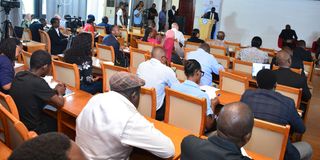
A cross-section of stakeholders attends a high-level PPP stakeholders’ conference in Dar es Salaam on March 9, 2026. PHOTO | COURTESY
The FYDP IV challenge
The stakes are higher as Tanzania transitions to the Fourth Five-Year Development Plan (FYDP IV), spanning 2026 to 2031.
Planning estimates indicate the total cost of implementing FYDP IV will be about Sh477 trillion.
Crucially, around 70 per cent of this amount, roughly Sh334 trillion, is expected from the private sector, with PPP projects targeted to mobilise over Sh170 trillion during the five years.
Under the two percent guideline, Tanzania would need to invest roughly Sh3.4 trillion in project preparation to achieve these targets.
“This is the scale of the challenge we face. If the state wants the private sector to bring trillions to the table, it must first invest billions to make those projects bankable,” said Dr Kahyoza.
Why preparation matters
Investment negotiator Joseph Simbakalia said detailed groundwork strengthens the state’s position during negotiations with multinational firms.
“A well-prepared project means the government fully understands the risks, expected returns, and long-term fiscal implications,” he explained.
“It allows us to negotiate from a position of informed strength, protecting the national interest while offering a fair deal to investors,” he added.
Former Controller and Auditor General, Ludovick Utouh, warned that PPPs are not a “free lunch” or a shortcut from fiscal responsibility, stressing that while mobilizing capital, they also create long-term contingent liabilities.
“PPP is a sophisticated tool, not an escape route,” Mr Utouh said, calling for enhanced transparency, rigorous reporting, and robust audit systems to ensure public resources are managed with accountability.
Investor confidence
The Tanzania Private Sector Foundation (TPSF) Director of Research, Policy and Advocacy, Ms Mwanahamisi Hussein, said investors act only when credible technical data is available.
“Well-prepared projects reduce the ‘risk premium’ for investors. Incomplete feasibility studies or weak technical groundwork force investors to either walk away or demand higher returns to cover uncertainty,” she said.
Government stance
Planning and Investment Minister, Prof Kitila Mkumbo, acknowledged that the state is increasingly relying on PPPs to bridge the gap between infrastructure needs and a limited development budget.
“Our population is growing, and urbanisation is rapid, placing immense pressure on transport, energy, and water systems,” said Prof Mkumbo, noting that since the National PPP Policy of 2009, the legal framework has been refined to create a better investment environment.
Data shows 101 PPP projects are currently at various stages across Mainland Tanzania.
Experts said that for these projects to become growth engines under FYDP IV, the government must significantly increase its investment during the preparation phase.