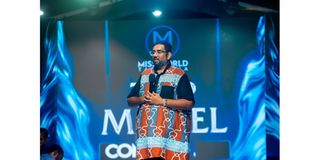
For more than two decades, Mustafa Hassanali has been a defining force in Tanzania’s fashion industry, a name associated with prestige, innovation and influence on some of the country’s biggest platforms.
Today, he stands at the centre of another high-stakes transformation, this time taking on one of the country’s most scrutinised and contested spaces: the beauty pageant industry.
As the national director of Miss World Tanzania, Hassanali is not simply stepping into a new role; he is attempting to rewrite the rules of an industry long shaped by tradition, controversy and shifting public expectations.
Speaking with The Beat in a wide-ranging interview, Hassanali makes it clear that his journey into the beauty pageant world was never part of a grand plan.
Instead, it evolved organically from his early experiences in fashion, dating back to the late 1990s when one of his designs was worn by a Miss Tanzania contestant who went on to win the title.
“That was my wow moment,” he recalls. “A teenager seeing someone win wearing your dress, it changes everything. From there, the journey just took off.”
That moment marked the beginning of a long relationship with the pageant industry, though largely from the sidelines.
For years, Hassanali dressed contestants, introduced innovations such as coordinated opening outfits, and contributed to what he describes as the ‘golden era’ of Miss Tanzania, when the event drew nationwide attention and television audiences.
But by 2010, he had stepped away entirely. “I didn’t attend a pageant for over a decade. Life moved on, and so did I,” he says.
His return in 2025, therefore, was unexpected, even to him. It began when representatives from the Miss World Organisation visited Tanzania as part of exploratory efforts linked to hosting future global events.
Hassanali, through his involvement in tourism and events, was brought in to guide them through potential venues across Dar es Salaam and Zanzibar.
That encounter would prove pivotal. “I met Julia Morley, the chairman of Miss World, and we had conversations, not about me becoming a director, but about the platform itself. At the time, I was just grateful for what pageants had done for my career,” he explains.
Yet, what stood out to him most was a shift in philosophy within the Miss World system, particularly the removal of swimsuit competitions and a stronger emphasis on “beauty with a purpose".
“That changed everything for me. I’ve never believed in reducing a woman to physical measurements. Stretch marks and skin tone are human realities. What matters is impact, intelligence, and authenticity,” he says.
Encouraged to submit a letter of intent, Hassanali took a leap of faith. “I didn’t even fully understand what I was getting into,” he admits. “But I thought, What do I have to lose?”
Within months, he had secured the franchise. What followed, however, was far from straightforward.
Organising Miss World Tanzania in just three months proved to be one of the most demanding undertakings of his career.
“This is not fashion week. This is something else entirely. The level of complexity, the emotional investment, the responsibility, it’s on another level,” he says.
Unlike fashion shows, which he describes as logistically intense but predictable, beauty pageants involve deeply personal stakes. Contestants arrive not just with ambition but also with expectations from families, communities, and, in many cases, themselves.
“These are young women with dreams. Some are fighting to prove something, to their parents, to society, or even to themselves,” he says.
It is this understanding that has shaped his approach. From the outset, Hassanali set out to build a system that addresses long-standing criticisms of the industry, particularly the lack of support for winners after the crown.
“ In the past, winners were celebrated one day and forgotten the next. We didn’t want that,” he says.
Instead, the new Miss World Tanzania model includes structured support: a monthly stipend, accommodation, healthcare, grooming services, and professional development opportunities.
The aim, he explains, is to create not just a titleholder, but a fully equipped ambassador.
“You can’t expect someone to represent a country on a global stage if they are struggling with basic needs,” he adds.
Equally important has been the emphasis on preparation, both mentally and professionally.
Contestants undergo intensive training, from public speaking to personal branding, as well as sessions on health, nutrition, and emotional well-being.
While acknowledging that discussions around mental health are relatively new in Tanzania, Hassanali insists they cannot be ignored.
“Pressure has always existed. What has changed is that people now talk about it differently. But whether you call it mental health or not, the reality is these girls face immense pressure,” he says.
To address this, partnerships have been formed with professionals who continue to provide support even after the competition ends.
However, the journey has not been without controversy.
One of the most persistent debates has been the existence of multiple “Miss Tanzania” titles, leading to public confusion over legitimacy and representation.
Hassanali is direct in his response. “There are many pageants, yes. But Miss World Tanzania is the only one with the mandate to send a representative to Miss World. That’s the distinction,” he says.
He attributes the confusion to historical structures and a lack of public awareness but insists that clarity will come with time.
“People are used to what they’ve known for years. Change takes time,” he says.
The controversy has, at times, had tangible consequences. Some sponsors withdrew due to perceived uncertainty, highlighting the challenges of rebuilding trust in a highly visible industry.
Yet, Hassanali sees a silver lining. “The attention, positive or negative, has brought visibility. And visibility creates opportunity,” he notes.
Beyond logistics and controversy, his broader vision is rooted in something deeper: empowerment.
For Hassanali, beauty pageants are not merely about crowns and titles; they are platforms for confidence-building.
“Confidence is everything. Whether you’re on a runway or answering a question on stage, the ability to stand in front of people and own your space is life-changing,” he says.
He draws parallels between modelling and pageantry, noting that while both demand poise, pageants require an additional layer of intellectual engagement.
“In modelling, you don’t speak. In pageants, you must think on your feet, under pressure, in front of an audience. That’s a different kind of challenge,” he explains.
It is this combination of confidence and communication that he believes prepares contestants for broader roles in society.
“These girls are future leaders. They will be professionals, mothers, and influencers in their communities. What they learn here goes beyond the stage,” he says.
Looking ahead, Hassanali’s ambitions extend beyond national competitions. With Tanzania set to host Miss World in 2027, he sees a unique opportunity to position the country as a global cultural and tourism hub.
“This is not just about a pageant. It’s about economic diplomacy, cultural exchange, and showcasing Tanzania to the world,” he says.
He emphasises that success will require collective effort, from government institutions to private sector players and even the media.
“The narrative matters. How we tell these stories shapes how the world sees us and how we see ourselves,” he says.
Despite the challenges, Hassanali remains optimistic. “Every misfortune has the word ‘fortune’ in it,” he says with a smile. “You just have to look for it.”
As preparations continue for Tanzania’s representative to compete internationally, his focus remains firmly on building a sustainable, credible system, one that not only crowns winners but also creates opportunities.