Dar es Salaam. On a small island off the coast of Mkuranga, what began as a young woman’s errand quietly evolved into a national mission.
In 2023, shortly after completing her undergraduate studies, Ms Farhiya Elmy travelled to Kwale Island to buy seaweed.
Her mother had been advised to use it for reproductive health. But as she stood watching women farmers, waist-deep in the ocean under the scorching sun, the purpose of her visit shifted.
The women worked against the tides, their hands exposed to cuts and infections. They carried heavy loads from sea to shore.
Yet their earnings barely reflected the true value of the resource they cultivated. “What struck me most was the contradiction. These communities were surrounded by ocean wealth, yet living in poverty, while the ecosystems they depend on were slowly degrading,” she recalls.
That moment shaped the path of a rising woman determined to merge science, enterprise, and community empowerment.
Today, Ms Elmy is a marine scientist, social entrepreneur, and blue economy advocate working at the intersection of ocean conservation, women’s livelihoods, and sustainable innovation.
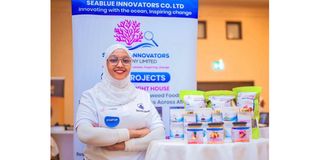
She is the founder and chief executive officer of SeaBlue Innovators Company Limited, a social enterprise that processes seaweed into affordable food products, wellness items, and biodegradable alternatives.
The philosophy of her institution is to place seaweed farmers, particularly women and youth, at the centre of value creation.
After her visit to Kwale, she began working closely with coastal communities across Zanzibar and mainland Tanzania.
The story was the same in village after village. According to her, women carry the heaviest burden in the seaweed value chain yet earn the least.
Young people are disengaged. Middlemen dominate the market. Climate change continues to worsen production conditions.
Marine science helped her understand why reefs were stressed, why seaweed quality was declining, and why ecosystems were becoming less resilient. But she soon realised that science alone would not change lives.
“Knowledge without action is not enough,” she says.
Entrepreneurship became her bridge, translating research into practical solutions that generate income, dignity, and employment.
Transforming coastal value chains
Ms Elmy has coordinated and led large-scale community programmes, including the Regional Fisheries Programme under Trademark Africa, working with more than 50 coastal communities across Zanzibar and mainland Tanzania.
Through SeaBlue Innovators, she promotes local processing, local skills, and local ownership of value.
Farmers are supported not only to grow seaweed but also to improve post-harvest handling, pursue value addition, and strengthen financial literacy. Building the enterprise has not been without challenges.
Convincing consumers and buyers to trust seaweed-based wellness and biodegradable products requires education, quality assurance, and regulatory compliance. These demands are often costly for early-stage businesses.
Meanwhile, farmers face inconsistent yields, limited drying infrastructure, and low farm-gate prices. Yet the opportunities are vast. Tanzania’s coastline holds significant seaweed potential.
Demand for affordable health products and eco-friendly packaging continues to rise. “The greatest opportunity lies in value addition within communities,” she explains. “Farmers should not remain raw material suppliers. They can become co-creators in a high-value market.”
At the heart of Ms Elmy’s approach is intentional inclusion.
“Inclusion must be designed. If we do not intentionally create space for young women, they will be left out by default,” she says.
Her programmes prioritise skills training in farming quality, post-harvest management, leadership, and entrepreneurship.
Youth are engaged as aggregators, processors, and eco-product ambassadors. Structured market linkages aim to reward quality rather than perpetuate exploitation. Equally important is voice.
Women and youth feature as leaders in community dialogues and public storytelling. Continuous feedback from farmers informs interventions, whether addressing safety concerns, drying solutions, or fair pricing discussions.
Currently pursuing a Master of Science in Biodiversity Conservation, Ms Elmy’s research interests span coral reef ecosystems, marine genetics, and nature-based solutions. Her scientific work sharpens her practical interventions.
Rather than focusing solely on income, she integrates ecological monitoring, water quality awareness, and ecosystem health indicators into livelihood programmes.
Her ground-breaking study on the population genetics of Mkunga, or eel fish, marked the first scientific assessment of its kind in Tanzania. Eels are a high-value species with a unique life cycle, reproducing only once.
This makes them particularly vulnerable to overfishing. Population genetics research helps determine whether different areas host distinct eel stocks and how vulnerable they may be to over harvesting or habitat disruption.
“Conservation and management must be based on biological reality, not assumptions,” she says.
Nature-based solutions for resilience
With climate change intensifying coastal pressures, Ms Elmy advocates nature-based solutions that strengthen both ecosystems and livelihoods.
Mangrove restoration supports fish nurseries and protects shorelines from erosion. Coral reef restoration, when combined with community monitoring, helps reduce local stressors.
Sustainable seaweed and mariculture models diversify income while maintaining low environmental footprints.
For her, conservation must not be framed as sacrifice. When communities benefit economically from protecting nature, stewardship becomes a shared responsibility.
Beyond the shoreline
Ms Elmy is also a professional diver and has collaborated with Simba Sports Club to highlight diving within Tanzania’s sporting landscape, linking ocean advocacy to broader public engagement.
Her contributions have earned recognition.
She was named an Ocean Champion by the Western Indian Ocean Marine Science Association and awarded the title “Malkia wa Nguvu” in 2025 by Clouds TV.
Through interviews across multiple media platforms, she continues to raise awareness about ocean health and women’s leadership in science. Yet she views such honours not as status symbols, but as responsibility.
“Visibility should open doors for communities and for other young women watching,” she says.
A vision for the future
Looking ahead, Ms Elmy envisions a Tanzanian blue economy that is inclusive, science-led, and community-owned.
In her vision, ocean resources generate tangible wealth for coastal people while ecosystems are restored and protected.
She hopes to see local processing industries flourish, fair markets for producers established, youth employment pipelines expanded, and conservation outcomes strengthened.
Her role, she says, is to continue building and proving a model that works, combining marine science, enterprise, and community leadership. What began as a daughter’s trip to buy seaweed has grown into a movement grounded in dignity, resilience, and opportunity.
For this Rising Woman, healthy oceans and empowered coastal communities are not distant aspirations.