Dar es Salaamhas a centuries-old history; though the tales of the colonial past have largely faded, the cultural impact remains.
The Kiswahili language borrowed some words from German, English and Arabic, just as the first Tanzanian government inherited the German colonial buildings.
More than a century after the Germans left Tanzania, their architectural footprint remains visibly intact and an integral part of today's government operations.
No better place to see this than the old Dar es Salaam, the city centre, from Ocean Road hospital, built in the 1890s, that would later pioneer cancer treatment to the old boma, the oldest surviving building in Dar that was modified by the Germans in the 1880s, as they made it their administrative headquarters.
These buildings have become part of the fascinating city tour. As the relationship between Tanzania and Germany has evolved into that of development partners, their embassy is one of three diplomatic missions housed at Umoja House, located just a stone’s throw from Azania Front Lutheran Church, built by German missionaries in 1898.
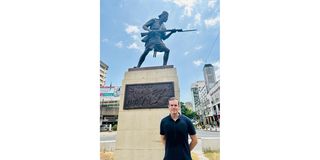
Maximillian Müller, the Deputy Head of Mission at the German Embassy in Tanzania, recently embarked on a personal city tour accompanied by a Tanzanian historian, Bernard ‘Ben’ Ntahondi.
He sat down exclusively with The Citizen to talk about it and a range of other issues related to tourism, the culture programs they support and places he has visited across Tanzania.
Question: So, for how long have you been in Tanzania?
Answer: I have been here for 8 months and I should really work on my Kiswahili.
Although the German language doesn’t have as much influence on Kiswahili as English or Arabic, some German words were locally adapted and are still used today — for example, shule, which means ‘school’ in English and comes from the German Schule and sekunde, which means ‘second’ in English and comes from the German sekunde.
Dar is sunny during the day. What prompted you to go out there for a city tour?
I asked myself if it was a good idea to go under the scorching sun, but it was my idea to go out I wanted to see more of the historic town, sometimes we are too busy at the office and I wanted to make time to go out there, the rainy season is approaching and I thought now is a good time before it starts raining everyday.
You were accompanied by Bernard, a local historian, serving as a tour guide, who recommended him to you?
He is a historian and an expert; the embassy has worked with him for a long time on topics of colonial legacy and the past. He has also worked with German institutions and he has become a friend. He was kind enough to show me around and provide me with his expert knowledge on history.
We all know the Tanzania mainland was under German rule; are there remnants of its history and where can one see that?
Here in old town, there are many reminders of the colonial past, like Azania Front Cathedral, the old Boma that was the headquarters of German colonial administration, Ocean Road hospital and also the overall city planning.
That is the reminder of the cruelty of German colonial rule and racial zoning, reserving the best parts of the city for Germans and Europeans, Asians were designated another part of the city and the outskirts were for Tanzanians, just a reminder of what Germans did in the past.
Some cities in Africa, built during colonial times, were inspired by European cities, like Nairobi, which was built with British architecture. Was Dar es Salaam built like any German city?
Not particularly, but buildings like Azania Front Cathedral, you can see some German architectural style from that period. It's a little bit weird to see that when you arrive in Dar es Salaam, it's a reminder of colonial rule.
The building is still functional today. Do they allow visitors to walk in if you want to see the history?
Yes, it is still alive today and it's good to see the Tanzanian community that uses it as a church today. We were able to go to the top of the bell tower to see the view of the city.
I personally have a very close connection to the church because my wife and I chose to have both our daughters baptised there last year.
The bell tower at the historic church was originally used to call worshippers to services; it was later a fundamental landmark for sailors docking at the dar es Salaam harbour.
The bell at the tower still has German writing on it. More than 100 years later, the bell tower is still used to call for prayers and is a tourist attraction as tourists tour the old city.
The main building has remained intact as renovations have sustained the structure throughout the years. The Statehouse in Dar es Salaam, located on Obama Drive, was originally built by Germany in 1885, serving as an administrative office.
The building, which was destroyed during the First World War, still features German architectural designs with British colonial modifications and modern buildings that were added once it became the statehouse of the president of Tanzania.
Similarly, another German building that has stood the test of time is the Ocean Road. Originally opened in 1987 as Imperial Governorate Hospital, it was renamed Ocean Road Cancer Institute (ORCI).
Does it amaze you that the building is still standing today?
It's still standing because of Tanzania's commitment to take care of it, to invest in it and use the building, a testament to Tanzania's resilience and an interesting fact is that the German architect August Wißkow, who designed it, was inspired by Zanzibari architecture. The hospital has a library named after Robert Koch, a famous German scientist and researcher.
There is a war cemetery in Dar es Salaam where German and British soldiers were buried. Did you get to go there?
Not on that tour, but I have been there, of course. Visiting a war cemetery is always sobering, a reminder of the wars. With the UK now being a very close partner, it is also a reminder of what was different in the past.
We were enemies more than 100 years ago and fought on Tanzania's soil, with Tanzanian people paying the price.
We celebrate every year, the war remembrance day in November together with our colleagues from the British embassy and we are based in the same building. We have a very strong corporation. from enemies to very close friends.
Visiting a war cemetery, does it help in reminding this generation of the price of conflicts?
I hope so, it should be that way, but I think it's also our job to make the people know, it's not just for us to visit, but also to take school pupils for trips there, to show them what the past was like. Conflicts and wars are not something of the past, unfortunately its very alive today.
You are in this nice building, Umoja House, Dar es Salaam, which is mushrooming with skyscrapers. Are you afraid that history is fading away?
I'm not afraid, I have trust in Tanzanian people and authority, to preserve and take care of the old structures, they are also colonial buildings, so it's up to Tanzanian people to decide what to do with them. If they want to keep it or demolish it. But I think Dar es Salaam is a growing city its a hub in East Africa, so the city is changing, of course.
Can Dar es Salaam still grow and develop, but still find room to preserve its history, like to see deliberate efforts made in Stone Town in Zanzibar?
I think that’s possible, if you look at the old Boma, the oldest building in Dar es Salaam and you see the Johari Rotana hotel behind it, you see that it is possible to have both next to each other.
It never occurred to ask myself why Dar es Salaam dwellers drink hot tea in the morning in this hot city and I saw a picture of you drinking it. Is it a Dar es Salaam culture you are adapting to?
We drink tea in Germany, but we are more coffee drinkers and you also grow amazing coffee in Tanzania. But I learnt once that it's good in a hot country to have a hot drink.
The remnants of German history are in many other places in Tanzania, like Bagamoyo and Lushoto. Do you plan to visit these other places as well?
I will try to, I have been to Bagamoyo, the German embassy, we have a corporation with TASUBA Bagamoyo College of Arts and Culture. We have an arts competition with students, who paint the use of old colonial buildings and what they looked like. I will visit Lushoto soon. I think it's a very interesting place.
Germany has more than 100,000 visitors coming to Tanzania every year, with most visiting the northern circuit, the popular Serengeti, Ngorongoro and Zanzibar.
He recommends future visitors to go off the beaten track and discover the less-visited areas like southern Tanzania. For 8 months Maximillian Müller has been in Tanzania, He has been to many places people would dream of visiting in their lifetime, visiting Zanzibar two times, went to Nyerere National Park, Mwanza, Kigoma and even met Dr. Jane Goodall before she passed on and later went to Gombe National Park to pay his respect.
Register to begin your journey to our premium contentSubscribe for full access to premium content