Africa’s $100 billion agriculture funding gap in focus as Nairobi summit seeks investment deals
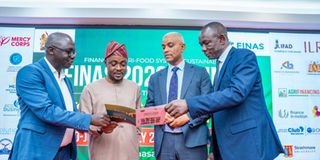
From Left: Agriculture Economy and Financial Advisor, GIZ Kenya Mr Kennedy Oketch, AGRA’s Senior Policy Officer Mr David Adama,Secretary of Administration in the State Department of Agriculture Mr Rashid Khator, Director of Policy at the State Department of Agriculture, Ministry of Agriculture Mr Peter Owoko during the FINAS2026 media launch in Nairobi. PHOTO | COURTESY
Josephine Christopher is a senior business journalist for The Citizen and Mwananchi newspapers
Mwananchi Communications Limitted
Dar es Salaam. Africa’s persistent agricultural financing gap will come under the spotlight in Nairobi later this month as more than 1,000 policymakers, financiers and investors gather to explore ways of unlocking capital for the continent’s food systems.
The Financing Agri-Food Systems Sustainably (FINAS) 2026 Summit, scheduled for June 30 to July 2, comes at a time when African countries are grappling with an annual agricultural financing shortfall estimated at more than $100 billion despite the sector remaining a key driver of economic growth and employment.
Agriculture contributes up to 30 percent of GDP in several African economies and employs the majority of the continent’s workforce. Yet commercial banks in many countries allocate less than 5 percent of their lending portfolios to the sector, highlighting the scale of the investment challenge.
The summit will bring together representatives from Tanzania, Nigeria, South Africa, Egypt and other African countries, alongside development partners including the World Bank, the Food and Agriculture Organization of the United Nations (FAO), the Japan International Cooperation Agency (JICA) and Germany’s development agency, GIZ.
Speaking during the official launch of the summit, Kenya’s Principal Secretary for Agriculture, Dr Paul Ronoh, said the meeting comes at a critical time for Africa’s agricultural transformation agenda.
“The summit provides an opportunity to assess whether investments in the sector are delivering the intended results and to identify new opportunities for accelerating growth,” he said in a speech delivered on his behalf by Rashid Khator, Secretary of Administration in Kenya’s State Department for Agriculture.
“Financing must be results-oriented and generate measurable outcomes that strengthen sustainable agri-food systems across the continent.”
Project Manager for Sustainable Agricultural Systems and Policies (AgSys) at GIZ Kenya, Dr Sophia Baumert, said the forum has evolved from a national platform into a continental initiative driving dialogue on agricultural financing and food systems transformation.
“FINAS began as a national platform in 2024 and has grown into a pan-African forum that promotes accountability and stronger partnerships among stakeholders,” she said.
“As GIZ, we are supporting the process by facilitating dialogue and fostering collaboration towards more resilient and sustainable agri-food systems.”
Ahead of the summit, organisers will convene a series of high-level dialogues focusing on the establishment of an Agricultural Development Fund, implementation of the Kampala Declaration, expansion of green finance and the formation of a private sector-led agri-food systems finance working group.
The three-day programme will feature ministerial and chief executive roundtables, keynote addresses, side events and investment-focused sessions built around four themes: policy alignment, innovative and inclusive finance, climate-resilient growth, and trade and investment cooperation.
Participants will also visit some of Kenya’s leading innovation and investment hubs, including Konza Technopolis, Tatu City and facilities along the Northern Corridor transport network.
AGRA Vice President for Programme Delivery and chair of the FINAS Secretariat, Prof Hamadi Boga, said the summit is intended to move discussions beyond policy commitments and towards practical implementation.
“FINAS 2026 is about moving beyond commitments to coordinated action,” he said.
“By bringing together policymakers, financiers and practitioners, the summit seeks to unlock capital at scale and transform policy ambitions into bankable investments that benefit farmers and agri-businesses.”
Climate-smart financing is expected to feature prominently in discussions as governments and investors seek ways to align agricultural investment with climate adaptation and mitigation goals.
FSD Kenya’s Agriculture Finance Lead, Mr Jared Ochieng’, said stronger collaboration is needed to develop innovative financing solutions for the sector.
“Africa’s food systems continue to face multiple challenges, including limited financing, market constraints, conflicts and climate change,” he said.
“As stakeholders, we must work together to develop sustainable financing models that can support the transformation of agri-food systems across the continent.”
The summit comes amid growing momentum for agricultural transformation in Africa, with governments increasing budget allocations to the sector and development finance institutions expanding support for sustainable agriculture and food security initiatives.
Organisers say the forum is expected to generate new partnerships and investment opportunities aimed at building more resilient, inclusive and investment-ready food systems across the continent.