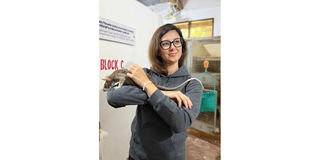
Timea Hillender was captivated by the TV series “This Wild Life,” set in the East African wilderness, featuring the Douglas-Hamilton couple. She saw that, despite challenges, someone can pursue science, research, and adventure simultaneously and even have a family.
“This Wild Life” sparked something in her, and she began to wonder why she was not living much closer to nature, why she was not actively seeking adventure, especially if she could do something good for the animals she loves so much.
Timea, President of Africa Stories for the African Wildlife Association, based in Hungary, is dedicated to supporting wildlife conservation and humanitarian efforts in East Africa. With support from the Hungary Helps Agency.
They financed the studies of young Kenyan girls at the Kenya Wildlife Service Law Enforcement Academy located in Tsavo National Park so that after training, the girls could have a chance at a better life while working in wildlife protection.
They turned their focus to Tanzania with plans to replicate the same initiative.
“Our interest turned toward Tanzania about three years ago, and we started searching for project sites and project ideas with my team. In 2025, we also tried to connect with local organisations in Zanzibar regarding several projects. We also visited the Apopo,” she said.
Located at Sokoine University of Agriculture in Morogoro, it is known for training African giant rats that have been deployed around the world, from detecting landmines and explosives in Cambodia to detecting tuberculosis. The centre has produced famous rats like Magawa.
“Apopo had such a profound impact on me that for my second master’s degree, which I completed in June 2025 (Óbuda University, Budapest – Humanitarian Response Manager Faculty), I wrote my thesis on the following topic,” she explained.
They are currently writing a grant application to support Apopo, within which they would like to cover the costs of their internal training programmes and contribute to getting more Morogoro women into the Apopo team so that they can provide a better life for their families and become role models in their communities.
“Although supporting the giant rat training programme operating in Tanzania is not the same as wildlife conservation, it is still connected to it,” she said. “Perhaps after the Russia-Ukraine conflict ends, we may hear more about the Morogoro mine detecting rats; these animals may participate in surveying the territories.
However, this is not straightforward, as the climate significantly complicates the year-round deployment of the animals, among other things,” she added.
Besides their work in Morogoro, Timea and her team have worked in wildlife conservation in East Africa, with the ranger training support program, among others.
They helped female members of the local community obtain ranger qualifications, thereby providing the national park with a trained workforce who can protect various species with their expertise. Lately, conservationists have been speaking about curbing the number of tourists at national parks.
Timea thinks the over-tourism phenomenon has partly been caused by the media because it over-advertises a particular national park, and suddenly, that one park attracts everyone.
Pointing her finger at the annual great migration of more than 1.5 million wildebeests, along with zebras and gazelles: “It’s almost unenjoyable because of the safari vehicles bumper to bumper. From jeeps packed with tourists, you can’t take photos or just admire the landscape and animals without hearing the engines of 30 other cars or the tourists’ hooting,” she elaborated.
As a conservationist, this aspect of tourism is unsettling for her. “I think the crowd takes away part of the enjoyment value, and on the other hand, it must have an impact on the animals and nature as well.
Although the animals are used to the cars and their noise, it surely makes a difference whether the cars move in almost convoys or appear nicely dispersed,” she pointed out. She urges examining this from various perspectives and undoubtedly finds pro and con arguments and answers to every question.
She has been visiting the national parks of the East African Community since 2020. Initially, she was not consciously observing and had no research intentions; she only discovered the most obvious differences and similarities between the parks, like any traveler.
She made notes for herself about how much different it is to return to a national park in a completely different season of the year, how much the wildlife changes, how parks empty during drought, and how animals migrate towards greener areas. From 2024, she started to observe the parks more consciously, keeping in mind their operational functions and tasks, mainly because her MA programme had begun.
Focusing on what the existence of parks means not only for the wildlife but also for the surrounding locals. Noting the role of National Parks not only to gather animals and show them to tourists but also to take care of nature conservation, biodiversity preservation, and acts against poaching and environmental damage.
National Parks have an increasingly important role in cooperating with local communities, supporting sustainable livelihoods (e.g., ecotourism, crafts, community projects), and reducing conflicts between people and wildlife. An area in which Timea and her organization have been involved.
Timea’s research in East Africa and the Sahel region is profound. From water resource conservation in Tanzania National Parks, the ‘watershed’ zones in Kilimanjaro and Udzungwa. How forests regulate the water cycle, reduce erosion, and ensure year-round river flow.
And how important water systems are connected to the parks (e.g., Rufiji - Nyerere National Park, Lake Manyara, certain protected shorelines of Lake Tanganyika). “Preserving natural habitats helps maintain water quality and water supply for surrounding communities,” she noted.
Aside from her research and conservation work, Timea makes time for herself and friends when she visits Tanzania. To her amazement, she discovered a substantial Tanzanian-Hungarian community in Dar es Salaam, with which she has connected.
The Tanzanian-Hungarian community in Dar gets together regularly; among them are Tanzanians who studied in Hungarian universities. They speak Hungarian fluently; not only do they remember the language, but they also know how to cook Hungarian food.
They talk about Hungarian cities where they went on trips. It’s quite amazing what an impact Hungary and the Hungarian people had on them. She said, Last year in Morogoro, when they were going home coming from APOPO, they sat down for coffee at the train station, and suddenly a local gentleman greeted them in Hungarian.
They were amazed and overjoyed. They later met him in Dar and had a longer conversation and got to know each other. She already plans to come back to Tanzania and get to use her visit for work and adventure.
Register to begin your journey to our premium contentSubscribe for full access to premium content