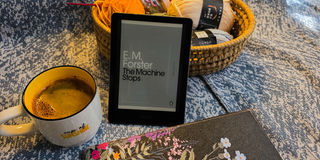
The Machine Stops was written in 1909. It feels so familiar that reading it awakens some of my fears about how advanced our own ‘machine’, which will not be named, has become.
“The Machine,” they exclaimed, “feeds us and clothes us and houses us; through it we speak to one another, through it we see one another, in it we have our being.” Sounds familiar? Perhaps yes, from the Bible? Yes, but this is not about that book.
The Machine Stops was written in 1909. It feels so familiar that reading it awakens some of my fears about how advanced our own ‘machine’, which will not be named, has become.
In this world, people live underground. The Machine runs their entire lives. They can summon whatever they need when they need it. They live in small rooms like prisoners. To better understand this room, imagine a room with no window. But it is full of buttons for summoning services such as food, a bed, screens to talk to friends, etc.
What kind of life is this? I question it at the back of my mind; I think about how glued to our phones we are. We treat life as if nothing else exists beyond the screens.
I keep agreeing with people when they say, “Thank God I grew up in a generation where we played outside”, because back then, we had nothing else to play with but the world around us.
Vashti is a mother to Kuno, who lives on the other side of their underground world. They rarely speak because Vashti is one of the thinkers, and she has no time to spare to speak to her son. She spends her time thinking, giving lectures and attending lectures, all of these “done” from the comfort of her small room.
Kuno wants to see his mother. Talk to her in person, not through the Machine, because the Machine is not everything. “Pay me a visit, so that we can meet face to face, and talk about the hopes that are in my mind.”
Isn’t this a cry that many of us have now? The need to be physically present with our loved ones vs through the machines. We are slowly replacing physical social life with “social life” through machines. It is not as easy to express your emotions through a screen as it is when physically present.
Kuno was that one person who wondered if there was more to life than the confinement of the Machine and the uniformity of this world, from the rooms, experiences and even people’s thinking.
Cue in AI and other technological advancements. As the author writes, “the civilisation that had mistaken the functions of the system, and had used it for bringing people to things, instead of for bringing things to people. Those funny old days, when men went for change of air instead of changing the air in their rooms!”
I agree with this, and by no means am I against the “machines,” for I am using one to write this, but my point is: how do we balance the use of technology before it starts replacing all our thinking and the way we live and experience life?
In this underground, secondhand thoughts are praised more than original thoughts or ideas. For example, Vashti only has one book that teaches her and other people about the Machine. Yes, you can access other literature if you want. Does this sound familiar? There have been reports about some AI companies destroying physical books after scanning them for AI training.
Kuno finds ways to think for himself and sees the surface of the earth. He sees the hills, and he realises that it will take other people longer to realise that there is life beyond the underground. Beyond the machines, as he tells his mother, “Cannot you see, cannot all you lecturers see, that it is we who are dying, and that down here the only thing that really lives is the Machine? We created the Machine to do our will, but we cannot make it do our will now.”
This is a book written in 1909; this is 2026. It left me with more questions than answers. Will humanity be saved? Kuno is threatened with Homelessness (death) for finding his way out on his own.
The Machine has now become a religion, “in it we have our being.” Once the people of the Underground start worshipping the Machine as their God, there is no going back.
After finishing this book, my mind kept going back to this quote from the book: “But Humanity, in its desire for comfort, had overreached itself. It had exploited the riches of nature too far.”
As a species, we have come a long way to get where we are. We have made strides in science and technology. But how do we ensure that these achievements will not be the end of us?
Jane Shussa is a digital communication specialist with a love for books, coffee, nature, and travel. She can be reached at [email protected].