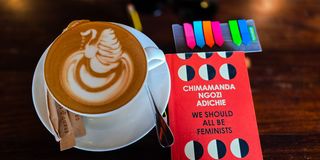
I am currently reading Can Feminism Be African? by Minna Salami, in which she asks provocative questions about what it would mean for Africa to be a feminist continent.
Her questions sent me back to Adichie's TED Talk, later published as the short book We Should All Be Feminists, which lays out the case for feminism in the simplest possible terms.
I paused Salami to revisit it because I wanted to sit with the book that first made the idea feel simple again.
Adichie draws on her experiences as a feminist in Nigeria, though the encounters she describes are not unique to it.
She recalls her late friend Okoloma asking, after one of their many arguments, whether she knew she was a feminist.
It was not a compliment. In his mouth, as in many people's, "feminist" carried a freight of accusations.
To be a feminist where I live is, for many people, to be an angry woman who hates men, or, as Adichie puts it, someone who hates bras, hates african culture, thinks women should always be in charge, doesn't wear makeup, doesn't shave, has no sense of humour, and doesn't use deodorant.
I laughed out loud reading it. It is funny, and it is also, sadly, mostly true.
Because of this, many women find it hard to admit they are feminists.
I have watched people reach for "humanist" instead, to dodge the association.
I did it myself five years ago; I did not want to be the angry, man-hating woman. I was wrong.
Adichie went the other way, piling qualifiers onto her feminism to outrun the caricature.
At one point, she writes, she was a "Happy african feminist who does not hate men and who likes to wear lip gloss and high heels for herself and not for men."
The joke is that she has to say all of it at all.
In primary school, Adichie's teacher promised to make the class monitor whoever scored highest on a test. The monitor was a real power; the monitor wrote down the noisemakers, and any child would want it.
Adichie got the highest score. She was passed over anyway, because the monitor had to be a boy, and to the teacher, this was so obvious it needed no explanation. At my own schools, the "St. Kayumbas" of the world, that prize was a big deal too, and I suspect it still is.
I return to this because it remains true.
A woman more qualified than the men around her is still passed over for being a woman, and the unfairness of it is the whole reason the feminist movement still matters, in the West, yes, but in Africa, too.
There are other urgent things to fight for here.
This is one of them: that people be measured by their qualifications and not their gender.
Adichie's other examples translate easily to my context.
An unmarried woman wears a wedding ring to a conference to be granted the respect reserved for married women.
Adichie tips a parking attendant, and he thanks her male companion instead, because in his mind, money in a woman's hand must have come from a man.
I have my own version.
Several restaurants in Dar es Salaam assume a woman alone has come only to find a man to pay for her, so they ignore you when you walk in, certain you will not be buying anything.
Once, when a group of us arrived in Masaki, the greeting was "kama hamnunui chakula hamuwezi kupiga picha," if you're not buying food, you can't take photos. Same assumption: that women cannot feed themselves.
This did not happen to someone I heard about. It happened to my friends and me.
What the book asks of you is simple: what do you actually believe a feminist is? Strip away the caricature of the angry, man-hating woman at war with her own culture.
A feminist is a person who believes in the social, political, and economic equality of the sexes, the insistence that women be treated as human beings who deserve respect for being human, and the acknowledgement that for centuries, they were not.
Things are better now. They are not yet equal. To call this conviction by some softer name, to reach for "humanist" as I once did, does it a disservice.
The word may have been coined in Europe, but where it was coined has nothing to do with whether it is true.
We are biologically different, men and women; we are not unequal. Adichie's book is short and simple, and that is exactly why I keep returning to it.
It hands you the argument in a form you can carry into a restaurant in Masaki or a primary-school classroom and recognise at once.