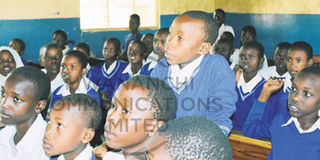
Leonard Andrew answers a question from his teacher in a classroom at Nyarugusu Primary School, Geita Region. Several children are working in gold mines in the region. PHOTO I BENARD LUGONGO
What you need to know:
Normally they would be eating lunch at their homes and return within an hour to resume classes.
It is 1pm, a bell rings at Nyarugusu Primary School, Geita Region, and pupils rush to the school ground for assembly after lunchtime.
Normally they would be eating lunch at their homes and return within an hour to resume classes.
Today the bell calls them back. They line up neatly for a parade. A school band starts to beat its drums and the remaining pupils begin heading to the classrooms.
Among the members of the school band is Leonard Andrew, efficiently looking and committed to playing the drum. The school he loves as well.
Leonard, 12 who is a Standard Six pupil, also performs well in examinations, he is among the top five pupils in his class.
Normally he scores good marks in examinations, often putting him at third or fourth position in his class of 180 pupils.
But not during the past year. He was someone else, did not like school and skipped classes. When he was in Standard Five he abandoned his education entirely and began to work at the goldmines – the worst form of child labour in the region.
Sharing his story, he says his mother’s efforts to convince him to go back to school were futile: At the time, he thought earning money was the better choice.
“I didn’t abandon school because of poverty. My mother is financially capable to pay for my school fees and other needs,” he says.
“I left school because I didn’t like it. The learning environment could not attract me and I felt that I learned nothing. Thus, I thought I would not lose anything in quitting school.”
Working at the goldmine which is operated by informal small scale miners, during three months Leonard earned between Sh2,000 and 5,000 a day.
However, he says, the amount was little compared to the hardship he endured and the difficult work of crushing gold ore all day long.
“It was a cruel environment. One of my memorable moments there is when a rude youth attacked me with a stone, causing my head to bleed. The next day I went there unhappy,” he recalls.
Luckily, one day while on his way back from the mine, he ran into a former classmate, Cornel Magarwi, who was heading home from school.
Applying knowledge he gained from his Geography teacher concerning the effects of mercury used to wash gold ores, Cornel convinced Leonard to return to school.
“I told Leonard that mercury will affect his health. I am glad he listened to me. With support from Plan International, Tanzania, he decided to come back to school,” he says.
Under its three-year child project that is due to end next month, Plan International identifies and reintegrates children back to school.
The project is implemented by Plan International in collaboration with the Community Relief Development Trust (CORDET), New Light Children Centre Organisation (NELICO) and Village Saving and Loan Association.
It is funded by the European Union (EU) and French Development Agency (AFC) which granted Euro 800,000 and Euro 180,000 respectively, aimed at clamping down on child labour.
Mr Maximilian Kitigwa is a Plan International project coordinator in Geita Region. According to him the project forms and manages children’s clubs at schools and provides learning facilities which help in attracting pupils to study.
For those clubs the project uses parasocial and community workers that educate children concerning the importance of education as well as alerting them to the effects of engaging in child labour.
“This helps in changing the minds of children who have abandoned school and work at goldmines,” says Mr Kitigwa.
Headteacher of Nyarugusu Primary School, Mr Peter Kitagina, says that thanks to the project’s implementation at his school, many pupils benefited from the training provided and learning equipment.
“Compared to the last three years, pupils’ absenteeism at school has been significantly reduced,” he notes.
According to him, attendance has now steadily remained at 90 per cent against 70 per cent that was recorded before the project.
More than 12,000 children in Geita and Nyang’hwale districts have been rescued from working at gold mines since the project started in 2012.
Police, government social welfare officers and NGO workers were all involved in the rescue of the children.
A 2013 Human Rights Watch report titled “Toxic Toil: Child Labour and Mercury Exposure in Tanzania’s Small-Scale Gold Mines” revealed shocking details abou children working in gold mines in Tanzania, Africa’s fourth-largest gold producer.
According to the report, children worked in deep, unstable pits for shifts up to 24 hours and transported as well as crushed heavy bags of gold ore. This put them at risk of injury from pit collapses, as well as threaten their health through exposure to mercury, breathing dust and carrying heavy loads.
However, Geita District Commissioner Mr Manzie Mangochie, says through the Public Private Partnership (PPP) they managed to work with Plan International in the area and managed to address the problem of child labour.
Whereas the project focused on creating awareness among small scale miners over negative effects of deploying children in goldmines, Geita District administration contributed efforts by enforcing the law.
“In many cases I went with police officers who ordered small scale miners to refrain from employing children. Those who disobeyed had to face the law,” says Mr Mangochie.
Following implementation of the project, he confirms that child labour in the area has almost been abolished.