When students swap studies for the allure of gold mining
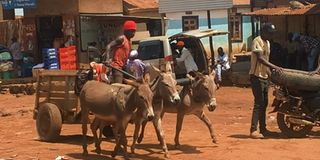
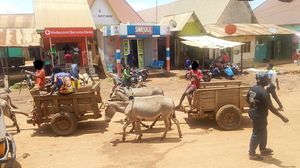
A young man transports rocks from small scale mines to crushing sites in Geita Region. Dozens of children in Lwamgasa Village, Geita Region, have quit school this year, preferring to involve themselves in activities associated with small-scale gold mining in the area. The government is set to launch operations in unregistered mining areas, where children are often found engaged in hazardous activities. PHOTO | ROSEMARY MIRONDO
Geita. In Lwamgasa Village, Geita Region, about 60 children set to start Form One have vanished from classrooms, raising alarm among teachers and local leaders.
Despite strict attendance enforcement, the pull of nearby mining activities is proving stronger than the school bell, threatening the futures of these young students and the community’s efforts to keep children in education.
Meanwhile, the government has stepped up efforts to keep children out of mining sites, announcing a fresh crackdown targeting informal mining operations where child labour is most prevalent, even as authorities intensify a parallel push to ensure every child is in school.
Inspection authorities are set to launch operations in unregistered mining areas, where children are often found engaged in hazardous activities.
The move comes as the government reinforces its stance that no child should be employed in mines under any circumstances.
Minerals Deputy Minister Steven Kiruswa said all mining activities must be registered and monitored through government systems, including individual pits.
Registered operators are subject to routine inspections to ensure compliance with labour and safety regulations.
“Children are not allowed to work in mines. Where violations occur, strict action is taken,” he said, adding that most cases of child labour are linked to informal, unregistered mining operations.
Authorities, he said, will revoke licences of registered operators found breaching regulations, while illegal operators will be removed and prosecuted.
Lwamgasa Village chairperson Amos Mwita confirmed that while most children enrolled this year have reported to school, around 60 pupils remain missing, and authorities are still trying to locate them.
“All children expected to attend form one this year have reported to school, except for about 60 whose whereabouts are unknown. We are tracking them to find out where they are,” he said.
Mr Mwita urged residents to assist in tracing children who are supposed to be in school but are seen roaming the village.
“If you meet children on the streets, report them to the Village Leader so action can be taken regarding where the children come from and where they are supposed to be,” he added.
“Village leaders have introduced strict measures to enforce attendance.
Parents whose children fail to attend school may face disciplinary action, including a penalty of one bag of cement. We require payment of one bag of cement as a penalty, to instil fear of punishment.
The cement is then used for village development projects,” Mr Mwita explained.
He further noted that local leaders intervene when guardians, such as elderly grandparents, are unable to ensure children attend school.
“If an elderly guardian is caring for grandchildren and the parents are far away, and the elder cannot educate the children, we step in.
Sometimes a child simply refuses to go to school; when we identify this, we take action,” he said.
This comes after a group of children were sported in Lwamgasa area working in areas where gold rocks are crushed and washed including a 14-year-old boy, who was found with his friends playing pool who works breaking and washing stones to survive, has dropped out of school due to hunger.
“I left school because we had no food. I would go to class hungry, struggle to concentrate, and return home to nothing cooked.
When the hunger became unbearable, I had no choice but to quit. There’s no support for school fees or meals now; I quit school when I was in Standard Six and now I would have been in Standard Seven,” he explained.
At Mwaloni, another 15-year-old boys said he grinds stones to earn a living. “I grind the stones and put it in a basin (karai). When I fill one sack, I’m paid Sh2,000, which I use to get food.”
He said he dropped out while in Standard Four and he would have been in Standard Seven now.
“I couldn’t read or write well, so I decided to leave. When I asked my mother to send me back, I promised I wouldn’t be lazy anymore, but she said she couldn’t repeat the same mistake.”
Teachers say absenteeism remains a serious problem, particularly in areas affected by mining activities and the situation reflects the complex pressures facing families in mining communities, where children are often drawn into economic activities that disrupt their education.
A teacher in Lwamgasa, who requested anonymity because he is not the official spokesperson, said children under 18 are prohibited from working in mines, but some are still involved in mining activities in the area.
“Lwamgasa village has numerous schools, but absenteeism is a serious problem,” he said. “A child may be enrolled in the first grade, attend for a few months, and then disappear.”
According to the teacher, when schools attempt to locate missing pupils, they often discover that families have moved the children to other mining areas.
“Sometimes we find they have been moved to neighbouring villages such as Tembo where mining activities are ongoing.”
School records show that if a child is absent for 90 days, they are no longer counted among active students and are instead listed as missing.
The team added that migration linked to small-scale mining is a key factor behind the problem. In some cases, parents enrol children in school while simultaneously involving them in gold panning.
“Children may attend school for a short time, but when the gold runs out, they move with their families to another mining area.”
Some children come from distant areas such as Singida to search for gold with their families.
The teacher also cited a recent incident where he found two pupils roaming the streets without their uniforms. Citing one from Standard Six and another Standard Seven.
I encountered two students walking outside school. They said they were going home to ask for money for school items but their story did not hold water and therefore I took them to the police station near the council centre and the parents were contacted parents for clarification,” the teacher said.
He explained that school disappearance affects pupils at different levels. In one seventh-grade class, eight out of 165 registered students did not sit for examinations because they had disappeared.
“In 2025 alone, a total of 61 children from first to seventh grade ran away from school due to mining-related migration and labour,” the teacher said.
National data shows that the problem of school absenteeism and dropout linked to truancy is widespread.
This is because of poor supervision and weak enforcement of section 5(1) of the employment and labour relations act, cap. 366 (cap. 366, revised edition, 2023), which have contributed to the increase of child labour in Geita mines, causing children aged between 10 and 15 years to drop out of school and be denied their right to education and a better future.
Tanzania has a strong legal framework for the protection of children’s rights, including Section 5(1) of the Employment and Labour Relations Act, Cap. 366 (Revised Edition, 2023) and the Law of the Child Act (Cap. 13, Revised Edition, 2023), both of which prohibit children under the age of 18 from engaging in hazardous work such as mining.
In addition, Section 6.2 of the Mineral Policy of 2009 directs the Government to establish and enforce strict regulations against child labour in order to safeguard children’s welfare where authorities are expected to prevent children from accessing mining production areas.
According to the 2022 Population and Housing Census Adolescents and Youth Report by the National Bureau of Statistics (NBS), 25.7 percent of school dropouts aged 10 to 13 nationally are attributed to truancy or refusal to attend school.
Data from the Basic Education Statistics 2023 (BEST) report by the Ministry of Education, Science and Technology and PO-RALG shows that in 2022, Geita Region recorded 21,596 primary school dropouts and 9,008 secondary school dropouts, the highest in mainland Tanzania.
At CCM hamlet, Gombani Street, branch (shina) number 8, community leaders are raising the alarm over children dropping out of school to engage in labour-intensive work.
Mr Sylvester Omolo said any child who skips school risks their father being prosecuted. “We’ve sensitised parents to ensure children attend school, but many are pressured by their own parents due to harsh living conditions,” he said.
He explained that mining areas are particularly dangerous. Children aged 12 to 15 carry sacks of ground rocks from one site to another for Sh5,000. In gold processing, washing without mercury earns Sh5,000,
“Washing with mercury is officially prohibited though children from extremely vulnerable backgrounds may still do it. Mines are fenced to prevent children from passing through,” he said.
He noted that some children are orphaned or lack parental support, forcing them to work to survive. Despite claims that students attend school hungry, Mr Omolo said parents contribute food, and schools provide midday porridge to ensure children do not skip classes.
“Local schools have agreed to supply meals: secondary schools receive 25 kg of beans and 20 kg of maize, while primary schools get 5 kg each.”
In Lwamgasa, village leaders say they will continue tracking missing pupils and enforcing attendance rules to ensure children return to school.
Ward Education Coordinator for Lwamgasa Peter Wambura declined to comment on grounds that he could not say anything without getting permission from his supervisor.
“I work for my government and I cannot comment on such matters without authorization my supervisor,” he said.
Read the government’s detailed reaction tomorrow
Register to begin your journey to our premium contentSubscribe for full access to premium content