DR Congo imposes 21-day quarantine on travellers from Ebola-hit areas after France records first imported case
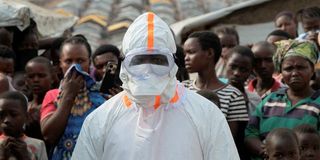
A health worker in personal protective equipment (PPE) stands near displaced people waiting for the burial of suspected Ebola victims at the Kigonze displaced persons camp, one month after an outbreak was declared, in Bunia, eastern Democratic Republic of Congo, June 18, 2026. PHOTO | REUTERS
Kinshasa. The Democratic Republic of Congo (DRC) has introduced stricter travel controls, requiring anyone returning from Ebola-affected areas to undergo a 21-day quarantine before being allowed to travel abroad, following the confirmation of France’s first imported case linked to the ongoing outbreak.
The new measure was announced as health authorities seek to contain the spread of the virus, which has triggered growing concern across Central Africa and beyond.
The outbreak, centred in the eastern province of Ituri, has become one of the fastest-growing Ebola epidemics in recent years.
France confirmed on Wednesday that a doctor who had returned from a humanitarian mission in the DRC tested positive for Ebola, marking the first case detected in Europe since the outbreak began.
The patient was immediately isolated and transferred to a specialist medical facility, while health authorities launched contact tracing to identify anyone who may have been exposed.
Under the new Congolese regulations, travellers arriving from affected regions must complete a mandatory 21-day monitoring period—the maximum incubation period for Ebola—before they can leave the country.
The move is intended to reduce the risk of international transmission and reassure countries receiving travellers from the region.
According to the World Health Organisation (WHO), the current outbreak is being driven by the Bundibugyo strain of the Ebola virus, for which there is no approved vaccine.
The disease spreads through direct contact with the bodily fluids of infected individuals and can cause severe haemorrhagic fever.
Health officials say the outbreak has already spread beyond the DRC into neighbouring Uganda through cross-border movement, prompting heightened surveillance and contact tracing efforts. WHO figures show Uganda has reported imported cases and secondary infections linked to the Congolese outbreak.
Despite concerns over international spread, French and global health authorities have stressed that the risk to the general public remains low because Ebola is not transmitted through the air and requires close contact with an infected person’s bodily fluids.
The WHO has declared the outbreak a Public Health Emergency of International Concern and continues to support response efforts in affected areas, where insecurity, population displacement and weak healthcare infrastructure have complicated containment measures.
As authorities race to curb transmission, the DRC’s latest travel restrictions reflect growing efforts to prevent the outbreak from spreading further beyond the region.