Is Pakistan turning its side of Kashmir into another Balochistan?
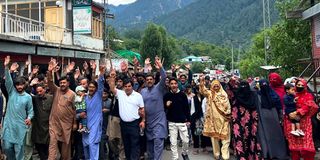
People chant slogans as they walk during a protest and shutter-down strike called by the banned Joint Awami Action Committee (JAAC). PHOTO | COURTESY
By Salman Rafi Sheikh
Pakistan-administered Kashmir was never really free, and Islamabad's actions have proven it.
In early June, Pakistan banned what is likely the largest civic movement in the region as as a terrorist organization, shut down internet services and deployed thousands of paramilitary personnel.
The death toll from the ensuing clashes rose above 20, even as nominations opened for the July 27 legislative election. The narrative Pakistan has long promoted about the part of Kashmir under its control is now beginning to unravel in public.
The immediate trigger came on June 1, when the Supreme Court of Azad Jammu and Kashmir (AJK) rejected a public demand to abolish the 12 legislative seats reserved for refugees from Indian-administered Kashmir in the AJK legislative assembly.
The ruling was a major setback to the legal campaign the Joint Awami Action Committee (JAAC), a broad civil-society protest coalition, had pursued for nearly three years. Four days later, the Pakistan-administered Kashmir government banned JAAC under the territory's anti-terrorism law, accusing it of "creating anarchy" and "promoting hatred." The JAAC pressed ahead with a planned rally on June 9 anyway. The result was the worst unrest the territory has seen in years, exposing contradictions in Pakistan's Kashmir policy.
Islamabad has long contrasted Azad Kashmir's supposed autonomy with India's tighter control across the Line of Control. Yet that contrast has always rested more on rhetoric than reality.
Whatever government rules in Islamabad exercises decisive influence over politics in Muzaffarabad, the AJK capital, and the 12 refugee seats have been central to that arrangement.
Occupied by representatives who do not reside in Azad Kashmir, these seats have often supplied the votes needed to make or unmake governments.
Therefore, the JAAC's demand to abolish them challenged one of the key institutional mechanisms of Islamabad's political leverage over the territory.
That helps explain why the response was not negotiation, but a court battle followed by a terrorism designation. Reserved seats for refugees, however, is not the movement's only concern. The JAAC first emerged in 2023 over rising electricity charges and flour prices.
But once the movement began questioning the political architecture underpinning Pakistan's control of AJK, it crossed a line the state was unwilling to tolerate.
The decision to invoke anti-terrorism legislation against a movement built around civic protest also reflects a broader pattern in Pakistan's politics.
Nationalist movements in the restive southwestern region of Balochistan and rights campaigners in Khyber Pakhtunkhwa in the northwest have faced very similar treatment.
More recently, Baloch rights activist Mahrang Baloch was sentenced to life imprisonment after campaigning against enforced disappearances. This sentence will only reinforce the ongoing separatist insurgency in Balochistan.
Could Kashmir become the next Balochistan? For three years, the JAAC has largely avoided organized violence -- restraint has been one of its greatest strengths.
Yet recent events suggest the space for peaceful politics is shrinking. On June 14, one JAAC leader was charged with sedition after reportedly urging Kashmiri soldiers serving in Pakistan's military to abandon their posts. Whether this reflected official strategy or an individual's frustration matters less than what it reveals: a movement pushed outside normal politics is beginning to adopt language that would have been unthinkable only a year ago.
History suggests that insurgencies rarely emerge overnight. They develop when peaceful avenues for political participation are systematically closed, when civic organizations are criminalized, and when ordinary grievances are redefined as security threats.
Branding disputes over electricity prices and electoral representation as terrorism may suppress dissent temporarily, but it also risks convincing people -- just like the Baloch -- that constitutional politics are irrelevant.
If that perception hardens, AJK could face the kind of homegrown militancy that Pakistan has spent decades insisting belongs only across the Line of Control.
That outcome is still avoidable. One reform would require candidates contesting the 12 refugee seats to hold domicile in AJK, bringing these constituencies into line with residency standards that already apply elsewhere in Pakistan.
There is a legitimate case for reserving representation for Kashmiri refugees. There is no good case for that representation going to people who have never lived among the voters they claim to speak for.
Another reform would establish a constitutionally protected forum for regular negotiation between the federal government and Azad Kashmir, modeled on Pakistan's Council of Common Interests.
A permanent institution with scheduled meetings and binding dispute-resolution procedures would replace today's familiar cycle of protest, federal concessions, temporary calm, renewed confrontation and repression.
Neither proposal requires a fundamental restructuring of the state. Both seek to widen political participation. But they require a government with democratic legitimacy.
That makes the July 27 election especially consequential. Holding a vote while internet services remain suspended and the territory's largest civic movement remains banned will only deepen questions about the credibility of the outcome.
For years, Pakistan has argued that repression fuels instability in Indian-administered Kashmir. It now risks validating that argument on its own side of the Line of Control.
If Islamabad continues to substitute coercion for politics, AJK may cease to be merely a site of recurring protest and become the birthplace of a homegrown insurgency created not by foreign infiltration but by the steady closure of peaceful political space.
Salman Rafi Sheikh is an assistant professor of politics at the Mushtaq Ahmad Gurmani School of Humanities and Social Sciences at Lahore University of Management Sciences.