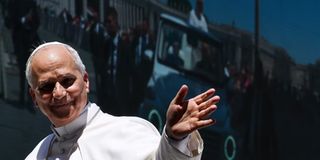
Vatican City. Pope Leo this week repudiated a major doctrine used by the Catholic Church since at least the fifth century to assess when countries may be justified in waging war, in a move experts say could have far-reaching implications for global powers.
The rejection of the doctrine came in the pope’s first major document, issued on Monday, which also called for global regulation of artificial intelligence systems and offered the clearest apology yet for the Catholic Church’s historic role in supporting the transatlantic slave trade.
“The ‘just war’ theory, which has all too often been used to justify all kinds of war, is now outdated,” Leo wrote in the encyclical titled Magnifica Humanitas (Magnificent Humanity).
“Humanity possesses far more effective and capable tools for promoting human life and resolving conflicts, such as dialogue, diplomacy and forgiveness,” he added.
Chicago Cardinal Blase Cupich, a close ally of the pope who attended the Vatican presentation of the document on Monday, told Reuters that Leo is concerned about how world leaders have used the theory to justify war.
“We have to make clear that the just war theory was always meant to be a restraint, not a permission slip, which sadly some are misusing to justify decisions to go to war rather than seek paths to peace,” Cupich said.
Theory cited by US officials
Leo, who has adopted a more forceful tone in recent months and drawn criticism from US President Donald Trump after condemning the Iran war, warned in the document about the growing number of conflicts worldwide and said profits from the arms industry were fuelling violence.
The just war theory, which broadly argues that war should only be waged in self-defence or to resist aggression, has been cited by Trump administration officials, including Vice President JD Vance, a Catholic, in defending the Iran war.
In April, after the pope’s official X account posted that God “is never on the side of those who wield the sword”, Vance referred to the just war theory during an event in Georgia and urged the pope “to be careful when he talks about matters of theology”.
Anna Rowlands, a British academic who took part in Monday’s Vatican presentation of the document, told Reuters that Leo was expressing concern about “a new age of changing conflict, now increasingly technology-driven”.
“It is a strong statement about the need for the just war theory to be placed within a renewed and wider framework for building peace and resolving conflict,” she said.
Longstanding doctrine
The just war theory was first articulated by St Augustine of Hippo, a leading figure of the early Church whom Leo has said inspired his decision to become a priest. The pope belongs to the Augustinian religious order founded on Augustine’s teachings.
Augustine, who died in 430, proposed criteria for determining whether a war could be considered just. He argued that wars should only be fought to restore peace and never out of cruelty.
His principles remain central to curricula at military academies around the world, including West Point, the US Naval Academy and the US Air Force Academy.
Critics of the Iran war have also invoked the theory to argue that the conflict, triggered by surprise US-Israeli air strikes against Iran on February 28, was unjust.
Washington Cardinal Robert McElroy, for example, said in April that the war was “morally illegitimate”, citing Augustine’s principles.
Marie Dennis, a former leader of the international Catholic peace movement Pax Christi, said Leo’s document “exposes the fiction of a ‘just war’ and confronts a culture of power that is normalising war”.
“Pope Leo joins millions around the world, including in the US, who see hope in the proven effectiveness of non-violent strategies for protecting democracy, transforming conflict and ensuring legitimate defence,” she said.