Starmer rejects calls to quit as vetting failure sparks political storm
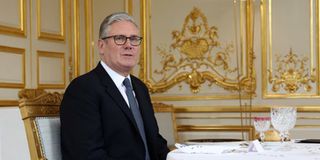
British Prime Minister Keir Starmer poses before a working lunch of bilateral talks with French President Emmanuel Macron ahead of the multinational virtual summit at the Elysee Presidential Palace, in Paris, France, on April 17, 2026. PHOTO | REUTERS
London. UK Prime Minister Sir Keir Starmer has said he was “angry” after discovering he was not informed that his former ambassador to the United States had failed security vetting before being appointed, as he faces renewed political pressure over his judgment but insists he will not resign.
Starmer, who secured Labour’s largest parliamentary majority in modern UK history at the 2024 general election, is under fresh scrutiny just weeks before key local elections in England, as well as regional votes in Scotland and Wales, where his party is expected to face significant losses.
The controversy follows the dismissal of Labour veteran Lord Peter Mandelson as US ambassador over his links to the late convicted sex offender Jeffrey Epstein. While Starmer had initially weathered political criticism by limiting Britain’s involvement in US President Donald Trump’s and Israel’s military actions in Iran, the latest revelations have reopened questions about his leadership.
On Thursday, it emerged that Mandelson had not passed security vetting prior to his appointment—information Downing Street says the Prime Minister was not made aware of. Opposition politicians have seized on the issue, questioning how a Prime Minister could be unaware of such a fundamental detail and calling for his resignation.
‘Unforgivable’ not to be told, says Starmer
Speaking to reporters on Friday while in France for talks on the Iran crisis, Starmer said it was “unforgivable” that he had not been informed of the vetting failure, particularly as he had assured Parliament that proper procedures had been followed.
“It is unforgivable that I was not told when I was telling Parliament that due process had been followed,” he said.
Pressed on whether he would resign, Starmer said he would set out the relevant facts to Parliament on Monday. A Downing Street spokesperson later insisted the Prime Minister had no intention of stepping down.
Officials moved quickly on Thursday evening to contain the fallout, including the dismissal of Sir Olly Robbins, the Foreign Office’s most senior civil servant, in what Downing Street sources described as an effort to restore accountability.
However, the explanation that Starmer was unaware of key information about an appointment he previously described as a “stroke of genius” has fuelled further doubts within political circles about his grip on government operations.
Political pressure builds ahead of local elections
Labour MPs have reacted with growing unease, though there is little immediate appetite for a leadership challenge. One Labour backbencher, speaking anonymously, described the Mandelson affair as “a gift that keeps on giving” for the opposition and warned it would keep Starmer under sustained pressure heading into the May 7 local elections.
Another Labour MP suggested that Deputy Prime Minister David Lammy, who served as Foreign Secretary at the time of Mandelson’s appointment, should consider resigning, arguing: “The choice is incompetence over deceit.”
Downing Street has rejected claims of a broader cover-up, insisting that neither ministers nor officials in the Prime Minister’s Office were aware of the vetting failure.
Senior Labour peer Lord George Foulkes urged restraint, warning against overreaction. “We need to keep things in perspective when there are so many issues he has been dealing with well,” he said.
Under Labour Party rules, a leadership challenge could be triggered if 20 per cent of Labour MPs—equivalent to 81 lawmakers—support a rival candidate.
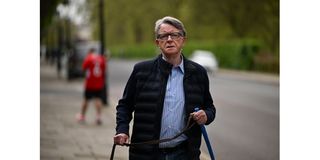
Former British ambassador to the U.S. Peter Mandelson returns to his residence in London, Britain, April 17, 2026. PHOTO | REUTERS
Did Starmer mislead Parliament?
At the centre of the political dispute is whether the Prime Minister unintentionally or otherwise misled Parliament when he previously stated that Mandelson had completed all required security checks and that no concerns had been raised.
A Foreign Office letter from January last year, released by Parliament last month, appeared to confirm Mandelson’s clearance, stating: “Your security clearance has been confirmed by the Vetting Unit and is valid until 29 January 2030.”
However, it has since emerged that Mandelson was later removed from his post in September after details of his association with Epstein became public through documents released in the United States.
He is also now subject to a police investigation on suspicion of leaking official documents to Epstein, allegations he has not publicly addressed. His lawyer did not respond to requests for comment regarding the vetting process.
Starmer has previously apologised for appointing Mandelson, accusing him of creating what he described as a “litany of deceit” regarding his relationship with Epstein.
Opposition attacks intensify
Opposition leaders have sharply criticised the Prime Minister’s handling of the affair.
Conservative Party leader Kemi Badenoch described Starmer’s defence as “preposterous”, while Reform UK leader Nigel Farage accused him of “blatant dishonesty”.
Badenoch also wrote on social media platform X that working under Starmer had become “one of the most dangerous occupations in the UK”, referring to the recent departure of a senior aide. “There are few known survivors,” she added.
The political row has further intensified scrutiny of Starmer’s leadership style and his government’s internal communication structures, with critics arguing the scandal points to deeper failures at the heart of Downing Street.
Leadership questions persist
Despite growing criticism, analysts say Starmer is unlikely to face an immediate challenge unless Labour’s electoral performance worsens significantly in the upcoming local polls.
For now, Downing Street is attempting to contain the political damage while insisting the Prime Minister retains full support within government.
Starmer is expected to make a formal statement to Parliament on Monday, in what is likely to be a crucial moment in determining whether the controversy fades or develops into a deeper political crisis.